Financial Stocks, Which Had Slowed Down for a While, Prepare to Rise Again in the Second Half
Financial Industry Selected as a Sector to Watch in the Second Half by Securities Firms
Second Half Value-Up Second Rally Expected... Financial Stocks Anticipated to Benefit
Financial stocks, considered the primary beneficiaries of the corporate value-up program, are gearing up for another rally in the second half of the year. While financial stocks showed a significant surge in the first quarter riding on the value-up momentum, they showed a pause in the second quarter. However, expectations for a rebound in the latter half of the year are growing again.
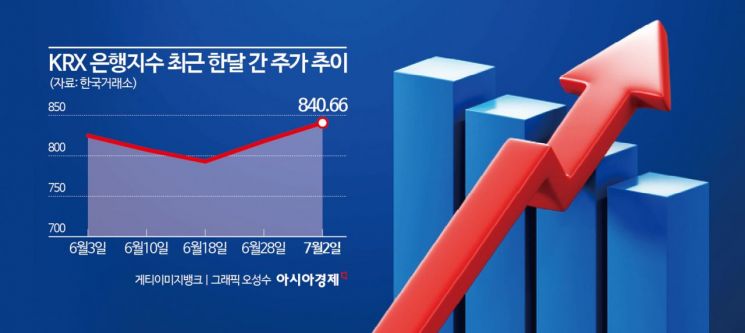
According to the Korea Exchange on the 3rd, despite the overall market weakness the previous day, financial stocks showed a strong performance. The KRX Bank Index rose by 2.85%, while the KRX Insurance Index and Securities Index increased by 1.73% and 0.49%, respectively. Meanwhile, the KOSPI fell by 0.84% that day.
Looking at individual stocks, bank stocks stood out with strong gains. KB Financial rose 4.52%, Shinhan Financial Group increased by 3.45%, and Hana Financial Group went up 4.49%. KB Financial hit an intraday high of 85,000 KRW, marking a new 52-week high.
In the securities industry, there are opinions that financial stocks should be the focus in the second half of the year. This is because the U.S. presidential election and the value-up program are expected to act as upward momentum for financial stocks in the latter half. Ha In-hwan, a researcher at KB Securities, said, "Considering the likelihood of President Trump's election, experience with deregulation, the possibility of interest rate hikes, the value-up program, and the 20-year cycle in which financial stocks have played a leading role in the domestic stock market, it is necessary to focus on financial stocks in the second half of the year." He added, "As the U.S. presidential election approaches, the chances of former President Donald Trump being elected are increasing. If Trump is elected, he is likely to pursue deregulation rather than stricter policies for the financial industry, which could serve as a catalyst to boost the global financial cycle itself."
Right after the financial crisis, U.S. President Barack Obama implemented the 'Volcker Rule,' a regulatory measure to limit risky investments by banks and financial institutions and to curb their expansion. President Trump began efforts to ease the Volcker Rule starting in 2018, with the final relaxation taking effect in 2019. U.S. financial stocks, which had experienced long-term sluggishness after the financial crisis, showed an upward trend following the easing of Volcker Rule regulations in 2019. Researcher Ha said, "Although this is a direct benefit to U.S. companies, the big cycle of deregulation in the financial industry is expected to have a positive indirect impact on the Korean financial industry as well."
The possibility of interest rate hikes is also seen as favorable for financial stocks. Ha explained, "Although there is a high possibility of a rate cut at the September U.S. Federal Open Market Committee (FOMC) meeting, the important point is that expectations for further cuts are not high. If expectations for additional cuts are low, the decline in the 10-year U.S. Treasury yield could be limited, and moreover, Trump's election itself can be a factor for interest rate increases."
Above all, the value-up program, which has driven the strength of financial stocks this year, is expected to continue to act as a growth driver in the second half. The securities industry is predicting a second value-up rally in the latter half. Park So-yeon, a researcher at Shin Young Securities, said, "The driving force behind the second value-up rally in the second half will likely be the 2025 tax law amendment announced by the Ministry of Economy and Finance around late July to early August." She added, "Although the ruling and opposition parties may not reach a smooth agreement, the opposition party also agrees with the overarching theme that 'stock market revitalization is necessary,' so there is no need to be overly pessimistic." She further noted, "The value-up momentum is likely to be reinforced again around July to August when the Ministry of Economy and Finance announces the tax law amendment, and again around November to December when the next year's budget and tax law amendments are expected to pass."
Choi Jung-wook, a researcher at Hana Securities, said, "In Japan, following the Tokyo Stock Exchange's measures to improve the low price-to-book ratio (PBR) in March last year, the stock price continuously responded to ongoing value-up events such as the action program to realize corporate governance reform in April and the revision of the Nippon Individual Savings Account (NISA) system in January this year." He added, "This is an example where value-up acts as a mid- to long-term stock price growth factor that continuously responds to events rather than a one-time catalyst. In Korea, interest in bank stocks as value-up-related stocks should continue to expand."
© The Asia Business Daily(www.asiae.co.kr). All rights reserved.

















