Consumer Price Index Enters 2% Range
Fresh Fruit Prices Continue to Rise
Last month, the consumer price inflation rate recorded 2.4%, maintaining a 2% range for the third consecutive month. This is the lowest inflation rate in 11 months. The living cost index also entered the 2% range.
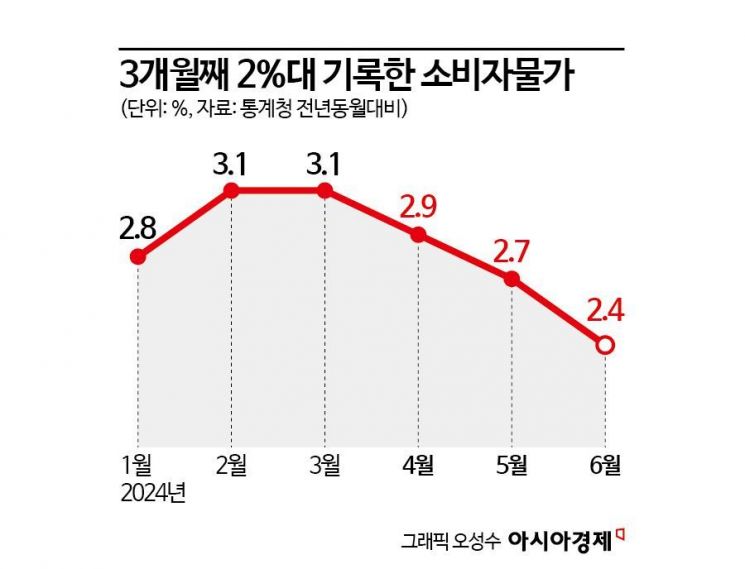
According to the 'June Consumer Price Trends' released by Statistics Korea on the 2nd, the consumer price index last month rose by 2.4% compared to the same month last year. This marks the third consecutive month in the 2% range following April (2.9%) and May (2.7%), and is the lowest inflation rate in 11 months since July last year (2.4%). The consumer price inflation rate, which slowed down to 2.8% in January, surged above 3% again in February (3.1%) and March (3.1%) due to skyrocketing fruit and vegetable prices, before falling back to the 2% range from April onward.
Gong Mi-sook, Director of Economic Trend Statistics at Statistics Korea, said, “Although petroleum prices increased, the rise in prices of agricultural products, electricity, gas, water, and processed foods narrowed, resulting in the lowest inflation rate in 11 months.” Regarding agricultural product prices, she analyzed, “Compared to the previous month, favorable weather conditions improved crop yields, and prices of seasonal fruits generally decreased compared to the previous month.” The inflation rate for agricultural, livestock, and fishery products in June was 6.5%, slightly down from 8.7% in the previous month.
The fresh food index rose 11.7% compared to the same month last year. Fresh fruits showed the strongest increase, rising 31.3%. In contrast, fresh vegetables and fresh fishery products fell by 0.8% and 1.4%, respectively. Notably, pears, which have increased in consumption as a substitute for apples, surged 139.6%, marking the largest increase since statistics began. Prices of apples (63.1%) and tomatoes (18.0%) also continued to strengthen. Gim (seaweed) rose 28.6%, the highest increase since December 1987 (34.6%).
Petroleum products also rose 4.3%, expanding the upward trend from the previous month (3.1%). This is the highest increase in 18 months since a 6.3% rise in December 2022. Statistics Korea explained that this was due to a base effect from low international oil prices last year.
Processed foods increased by 1.2% compared to the same month last year, recording the smallest rise in 40 months. A Ministry of Economy and Finance official explained, “The government communicated with the food industry to minimize price increases as much as possible,” adding, “Government fiscal policies likely influenced the timing of price hikes, causing delays.” Discount events held by the distribution industry last month also had an impact.
The living cost index, compiled from 144 items frequently purchased and with a large expenditure share that consumers are sensitive to price changes, rose 2.8% compared to a year ago. This is the lowest inflation rate in 11 months since July last year (2.0%). After peaking at 4.5% in October last year, the living cost index’s rate of increase slowed until January this year (3.4%), then continued to rise consecutively in February (3.7%) and March (3.8%). A Ministry of Economy and Finance official explained, “Since the living cost index consists of items with high consumer sensitivity and mainly includes agricultural products, the slowdown in prices of major items is a signal.”
Core inflation indices, which show the underlying trend of prices, also settled in the 2% range. The index excluding agricultural products and petroleum products rose 2.0% compared to the same month last year. The index excluding food and energy rose 2.2% compared to the same month last year.
The government expects inflation in the second half of the year to stabilize in the low to mid 2% range. Kim Byung-hwan, First Vice Minister of the Ministry of Economy and Finance, said at the price-related vice ministers’ meeting that day, “Prices of agricultural products such as vegetables have generally fallen, and the living cost inflation rate has also entered the 2% range. Unless there is a special additional shock, inflation is expected to stabilize in the low to mid 2% range as the government forecasted.”
Vice Minister Kim added, “However, to maintain vigilance, we have secured 28,000 tons of napa cabbage and radish to prepare for summer demand, and newly stockpiled garlic, onions, and dried red peppers to prepare for supply instability.” He also said, “Since the partial restoration of the fuel tax on the 1st, we will continue inspections through the government-wide petroleum market monitoring team to prevent unfair price hikes.”
© The Asia Business Daily(www.asiae.co.kr). All rights reserved.
![Clutching a Stolen Dior Bag, Saying "I Hate Being Poor but Real"... The Grotesque Con of a "Human Knockoff" [Slate]](https://cwcontent.asiae.co.kr/asiaresize/183/2026021902243444107_1771435474.jpg)











