'2nd K-Shipbuilding Technology Alliance' Held
2 Trillion Won Public-Private Investment in 10 Flagship Projects
Three Shipbuilders Jointly Develop Welding Collaborative Robots, etc.
South Korea plans to secure the world's best eco-friendly ship technology with zero carbon emissions by 2040 and commercialize fully autonomous ships. To achieve this, the government and private companies have agreed to invest more than 2 trillion won together.
The Ministry of Trade, Industry and Energy held the '2nd K-Ship Technology Alliance' at the eco-friendly ship equipment company Panasia, attended by First Vice Minister Kang Kyung-sung, and announced the 'K-Ship Super Gap Vision 2040' containing these plans.
Over the past six months, the ministry collaborated with about 100 experts from industry, academia, and research institutes, including CTOs of the three major shipbuilders, to establish a public-private joint roadmap for shipbuilding industry technology development through 2040. The ministry selected 100 core technologies (351 detailed technologies) that the shipbuilding industry must secure in three major areas: eco-friendly, digital, and smart, with the goal of becoming the world's top shipbuilding technology powerhouse by 2040. The ministry explained, "The current level of the 100 core technologies is estimated to have a technology gap of about 1.7 years compared to leading countries such as the EU and the United States," and "based on this, detailed acquisition plans for each technology in the three areas were derived."
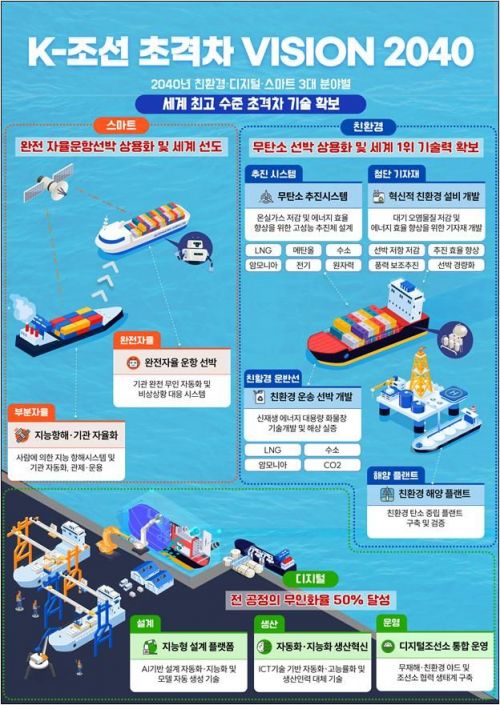
First, in the eco-friendly sector, the goal is to complete a zero-carbon emission ship technology portfolio by 2040 by developing eco-friendly fuel propulsion technologies such as hydrogen and ammonia, as well as future fuel production plant technologies. Additionally, efforts will focus on securing core technologies such as liquefied hydrogen carrier cargo tanks and large electric propulsion ships, which will be the next revenue sources after liquefied natural gas (LNG), and on commercialization including maritime demonstration.
Furthermore, aiming for a 50% unmanned process rate by 2040, automation technologies for all processes including design, production, and yard operation will be secured. Welding and painting automation technologies and collaborative robot technologies that can replace high-risk and difficult tasks will be developed first. In the mid to long term, technology for automated ship block factories capable of 24-hour operation will be secured, and the establishment of a test bed factory will also be pursued.
Moreover, with the goal of commercializing fully autonomous ships by 2040, technologies necessary for unmanned navigation such as sensors, equipment, and integrated operation systems will be secured. Technologies that allow human-robot collaboration to assist crew tasks and safety technologies to prepare for emergency situations will also be developed.
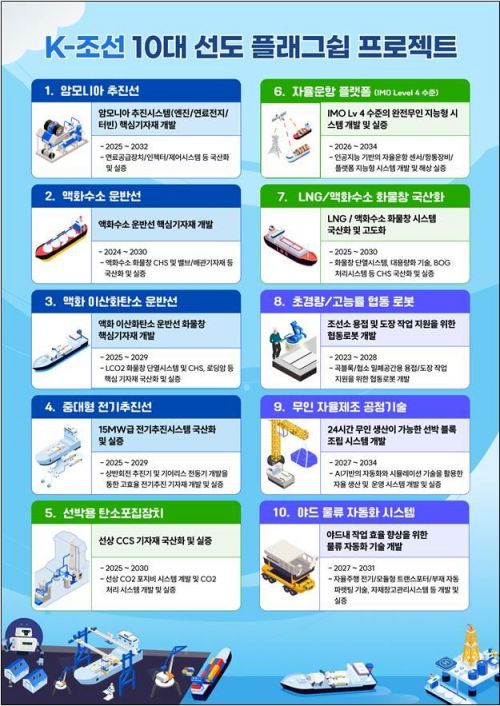
The government also presented 10 flagship projects. The 10 projects, including ammonia-powered ships, liquefied hydrogen carriers, ship carbon capture systems, autonomous ship platforms, and unmanned autonomous manufacturing processes, will be supported through innovation and challenge-type technology development, demonstration, and standardization to be nurtured as new growth engines for the shipbuilding industry following LNG ships. The Ministry of Trade, Industry and Energy stated, "To complete the 10 flagship projects, the public and private sectors will invest at least 2 trillion won over the next 10 years as one team."
Meanwhile, the government and the three major shipbuilders signed a memorandum of understanding (MOU) for joint response to develop four field-responsive technologies to improve production process efficiency as a priority. The three shipbuilders will jointly promote ▲welding collaborative robots ▲worker welding and painting training systems using virtual reality (VR) ▲artificial intelligence (AI) chatbots to support foreign workers on-site ▲and the development of a production collaboration platform between shipbuilders and partner companies, with the government providing active support.
© The Asia Business Daily(www.asiae.co.kr). All rights reserved.


















