Projects Promoting Changes in Economic and Social Structure in the Fourth Industrial Era and Reforming the Busan-Style Urban Planning System
Reflecting Busan's Characteristics, Need to Develop Urban Planning System... Establishing a New Busan-Style Urban Planning Framework
Two projects, the 'Geumsa Innovation Platform within Geumsa Industrial Complex' and the 'Yeongdo-gu Industrial Area Revitalization Pilot Project,' have been selected for the 'Leading Projects for Spatial Innovation Zones' organized by the Ministry of Land, Infrastructure and Transport.
The city of Busan is promoting the reorganization of its urban spatial planning system to adapt to economic and social structural changes, such as the rise of compact cities that efficiently utilize limited urban space through high-density, mixed-use development, and reduce travel time in the era of knowledge-based industries and the Fourth Industrial Revolution.
Accordingly, last May, the city applied for the 'Geumsa Innovation Platform within Geumsa Industrial Complex' and the 'Yeongdo-gu Industrial Area Revitalization Pilot Project' as leading projects for spatial innovation zones under the Ministry of Land, Infrastructure and Transport, aiming to serve as a catalyst for the reorganization of the urban planning system.
With the revision of the National Land Planning Act, the new 'Spatial Innovation Zone' system will be implemented starting August 7. This system includes: ① 'Urban Innovation Zones,' which allow for flexible planning of land use and density; ② 'Mixed-Use Zones,' which ease land use restrictions and increase density; and ③ 'Urban Planning Facility Complex Zones,' which combine urban and non-urban planning facilities in a three-dimensional manner and increase density.
The selected leading projects for spatial innovation zones will be implemented as Urban Innovation Zones.
One of the selected projects, the 'Geumsa Innovation Platform,' will be developed on land owned by Parkland within the Geumsa Industrial Complex in Geumjeong-gu. It will include: ① Geumsa The Market, a complex cultural space; ② Park Platform, a startup retail platform; and ③ Landmark Innovation Platform, a knowledge industry complex platform.
The project will be built across three buildings, ranging from four basement levels to 23 above-ground floors, with a site area of 28,555 square meters and a total floor area of 94,999 square meters in the Geumsa-dong area of Geumjeong-gu.
The project cost is estimated at approximately 219.4 billion KRW, with expected effects including 500.8 billion KRW in production inducement, 157.9 billion KRW in value-added inducement, and the creation of 31,594 jobs. The project developer is Parkland.
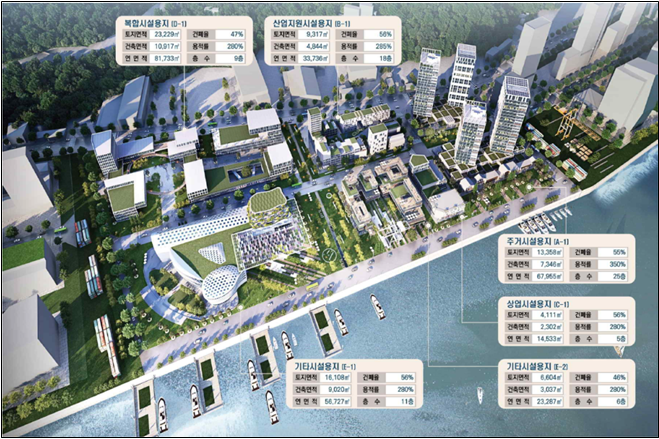
The 'Yeongdo-gu Industrial Area Revitalization Pilot Project' aims to create an innovative hub that integrates new industries, commerce, business, and residential functions. The plan includes attracting companies in connection with Busan's marine industry development plan, as well as coffee and cultural industries based on the waterfront.
In the Haeyang-ro area of Yeongdo-gu, the project will develop four buildings, including residential complexes, mixed-use facilities, and industrial facilities, with a site area of 89,578 square meters, a total floor area of 277,971 square meters, and three basement levels to 25 above-ground floors.
The project cost is estimated at approximately 290.2 billion KRW, with expected effects including 194.1 billion KRW in production inducement, 82 billion KRW in value-added inducement, and the creation of 1,325 jobs. The project developer is Korea Land & Housing Corporation.
The city plans to prepare detailed project plans and spatial restructuring plans for the selected leading projects in consultation with the project developers by early next year. Subsequently, related administrative procedures such as public notice for resident review, city council opinion gathering, and deliberation by the Central Urban Planning Committee will be carried out.
The 'Spatial Restructuring Plan' refers to a plan that preliminarily reviews the impact of the spatial innovation zone plan on land use, transportation, infrastructure, and landscape in the surrounding area.
The city is establishing a new Busan-style urban planning system to resolve the rigidity of existing zoning and to enhance the efficient use of underutilized and low-use areas within the city, aiming to build a 'Global Hub City' in line with the rapidly changing economic and social structures of the Fourth Industrial Revolution era.
The new Busan-style urban planning system will first utilize the spatial innovation zone system to grant greater flexibility to the existing rigid urban planning framework, making it easier to create regional innovation hubs by integrating industry, commerce, culture, and residential functions.
The city also aims to revitalize outdated urban industrial areas, which are often seen as declining, by enabling the integration of industry, commerce, culture, and residential functions, thus breathing new life into these areas.
The ongoing public contribution negotiation district unit plan will encourage harmonious planning with surrounding areas while introducing anchor facilities such as industrial and commercial facilities to drive the development of adjacent regions.
Additionally, to focus administrative efforts on urban spatial changes and operate organizations more efficiently, the city reorganized and established new departments as of July 1, 2024.
The Urban Planning Bureau was reorganized into the Urban Spatial Planning Bureau, the Urban Planning Division into the Urban Spatial Planning Division, and the Facility Planning Division into the Urban Spatial Creation Division. A new Spatial Innovation Team was established within the Urban Spatial Planning Division.
Mayor Park Hyungjoon stated, "As we prepare an urban planning system that reflects Busan's unique characteristics in line with new changes of the era, we will accelerate the establishment of the new Busan-style urban planning system, starting with these selected projects. Such changes in urban space will accelerate the creation of Busan as a 'Global Hub City' and further revitalize the stagnant local economy, driving the development of underdeveloped areas."
© The Asia Business Daily(www.asiae.co.kr). All rights reserved.

















