The Constitutional Court has ruled that the provision in the Labor Union Act requiring the designation of a representative union to negotiate when two or more labor unions are formed at a single workplace, known as the 'single negotiation window' system, does not violate the Constitution.
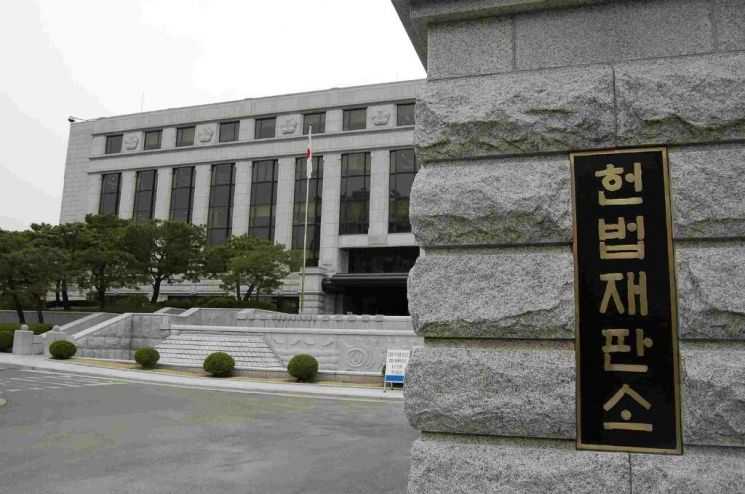
The Court also upheld as constitutional the provisions that recognize the union with the majority of members as the representative when multiple unions fail to autonomously select a negotiation representative, and that only the representative union can lead collective actions.
According to the legal community on the 2nd, the Constitutional Court made a constitutional ruling with a 5 (constitutional) to 4 (unconstitutional) vote in a constitutional complaint case concerning Article 29, Paragraph 2 of the Labor Union Act and Article 29, Paragraph 2 of the Labor Relations Adjustment Act, which contain these provisions.
The petitioners, including the Korean Confederation of Trade Unions (KCTU) and the Metal Workers' Union, argued that these provisions infringe on the collective bargaining rights and collective action rights of unions excluded from or failing to become the representative union, as well as newly formed unions after the unification.
In response, the Constitutional Court stated, "Even unions that are restricted from exercising collective bargaining rights because they are not the representative union are recognized as subjects who share in the results of collective bargaining conducted through the representative union," and added, "The single negotiation window system is an inevitable institution required to substantially guarantee collective bargaining rights aimed at realizing appropriate working conditions based on the principle of labor-management equality."
Furthermore, the Court explained, "To protect other unions that are not the representative union, discrimination against unions participating in the single negotiation window procedure is prohibited," and "This is to supplement problems that arise when the single negotiation window system is uniformly enforced." Regarding the provision that the majority union becomes the representative, the Court noted, "It is a reasonable method in itself to have the union with more workers negotiate as the representative," and pointed out that "the possibility for minority unions to become the majority union is also open by including 'delegation or alliance of two or more unions.'"
However, four justices?I Eun-ae, Kim Ki-young, Moon Hyung-bae, and Lee Mi-seon?dissented, arguing that these provisions violate the Constitution by breaching the principle of proportionality. These justices stated, "It is unconstitutional to completely restrict the independent exercise of collective bargaining rights by minority unions without properly establishing institutional measures to minimize infringement on their collective bargaining rights," and criticized that "the duty of fair representation alone does not sufficiently guarantee the procedural participation rights necessary to minimize infringement on minority unions' collective bargaining rights."
© The Asia Business Daily(www.asiae.co.kr). All rights reserved.

















