Christine Lagarde, President of the European Central Bank (ECB), dismissed the possibility of additional rate cuts in July, stating that there is not yet sufficient evidence to confirm that the inflation threat has disappeared. Currently, the market expects the ECB, which has taken the lead in shifting monetary policy ahead of the U.S. Federal Reserve (Fed), to implement one or two additional rate cuts within the year.
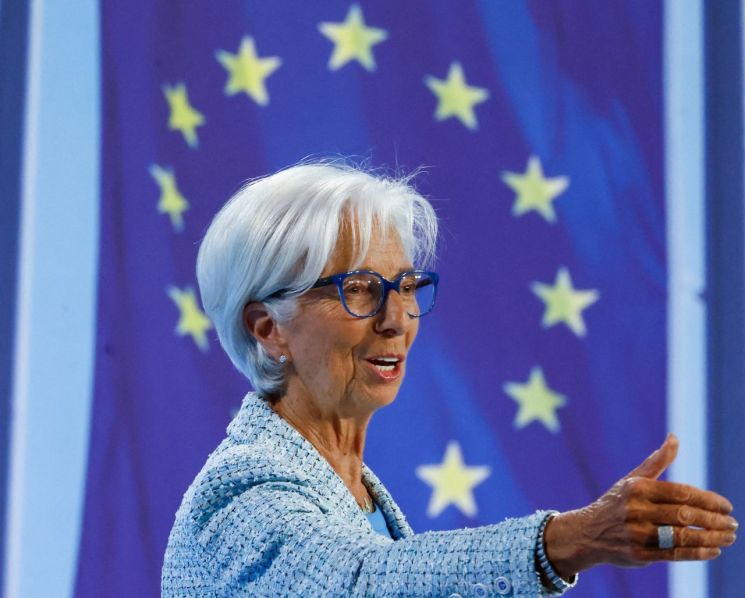
According to Bloomberg and other sources, President Lagarde said at the opening of the ECB Annual Forum held in Sintra, Portugal, on the 1st (local time), "We still face various uncertainties regarding future inflation." She pointed out, "There is uncertainty about how it will evolve in connection with profits, wages, and productivity, and whether the economy will be hit by new supply-side shocks." She also indicated a cautious policy approach going forward, saying, "It will take time to collect enough data to confirm that the inflation risk has passed."
This statement is interpreted as supporting the ECB’s decision to hold rates steady at the upcoming monetary policy meeting this month. The ECB cut all its key policy rates by 0.25 percentage points in June. However, it raised its forecasts for both Eurozone inflation and economic growth this year, leading to assessments of a 'hawkish cut.'
President Lagarde explained, "A strong labor market means we can take time to gather new information," adding, "We must also keep in mind that growth prospects remain uncertain." She emphasized that a 'soft landing' is still not guaranteed. She added, "All of this supports our determination to make policy decisions at meetings based on data."
While the market places weight on one or two additional cuts this year, the Eurozone Consumer Price Index (CPI) is scheduled to be released on the afternoon of the 2nd. The current consensus estimates a 2.5% inflation rate, slightly lower than the previous month. The day before, the Bank for International Settlements (BIS) also warned that central banks should be cautious about cutting rates to prevent the risk of inflation rebounding.
Gediminas ?imkus, Governor of the Bank of Lithuania, who also attended the forum, said, "I think the argument for a July cut has disappeared," but added that two additional rate cuts within the year are possible. He diagnosed, "Monetary policy remains restrictive," and "there is room to move." He also said, "We knew the final phase of disinflation would be difficult and challenging," and "We are not underestimating the stickiness of inflation."
Pierre Wunsch, Governor of the National Bank of Belgium, said in a Bloomberg TV interview at the Sintra Forum that confidence is needed that inflation is moving toward the 2% price stability target for two additional cuts to occur this year. While he called the market’s expectation of one or two additional cuts this year "reasonable," he cautioned, "Theoretically, it is always an option. While urging caution, we need to focus more on meetings where we can obtain more information."
The market is also watching the potential impact of political risks surrounding the early French general election on the ECB’s monetary policy. Some speculate that the ECB might intervene through bond purchase programs such as the Transmission Protection Instrument (TPI) to prevent political turmoil from affecting financial markets. However, there was no specific mention of France in Lagarde’s opening remarks that day. Governors Wunsch and ?imkus drew a line on the possibility of intervention, saying there is no disorderly situation yet.
© The Asia Business Daily(www.asiae.co.kr). All rights reserved.
![User Who Sold Erroneously Deposited Bitcoins to Repay Debt and Fund Entertainment... What Did the Supreme Court Decide in 2021? [Legal Issue Check]](https://cwcontent.asiae.co.kr/asiaresize/183/2026020910431234020_1770601391.png)