Shinhan Financial Group Holds Analyst Day
Invites Japanese Value-Up Experts
National Pension Service Fund Management Head Also Visits Japan
Value-Up Growth Boosts Earnings of Japan's Top 3 Financial Groups
Stock Prices Rise, Increasing Shareholder Returns in a 'Virtuous Cycle'
"Must Strengthen Internal Capabilities," Analysts Say
Financial industry figures are visiting Japan, which has succeeded in corporate value-up. They invited value-up-related personnel for lectures or held meetings with related organizations. Japan has been running value-up programs for over a decade, successfully enhancing corporate value, as evidenced by the three major financial groups' stock prices reaching record highs last year. Despite the external environment of low growth and low interest rates, the success in value-up is attributed to strengthening internal capabilities, leading to analyses that domestic financial holding companies should actively refer to this.
According to the financial sector on the 2nd, Shinhan Financial Group held the 'Shinhan Financial Group Analyst Day' in Tokyo, Japan, for two days starting from the 27th of last month. Shinhan Financial Group invited Japanese capital market experts to this event, most of whom were involved in corporate value-up programs. On the first day of the seminar, they invited Yoshio Horimoto, Director of the Japanese Financial Services Agency, and Katsumi Ao, Director of the Tokyo Stock Exchange. They were responsible for the practical work of the program and introduced related policies. On the second day, they visited Mizuho Research Institute and Kiraboshi Financial Group to share excellent cases related to enhancing corporate value. Jin Ok-dong, Chairman of Shinhan Financial Group, explained the significance of the event, stating, "The Korean corporate value-up program is an important task to gift a sustainable future to our next generations."
Heads of value-up related organizations are also visiting Japan. Seo Won-ju, Chief Investment Officer (CIO) of the National Pension Service Fund Management Headquarters, visited Singapore and Japan in mid-last month. At that time, Seo held a meeting with the Government Pension Investment Fund (GPIF), one of the world's largest pension funds. GPIF manages assets worth 2,000 trillion yen, investing 25% of that, 500 trillion yen, in Japanese domestic stocks. This corresponds to 6-7% of the total market capitalization of the Japanese stock market. The industry believes that since the shareholder rights exercise team leader of the pension fund also accompanied the trip, they likely shared cases related to the value-up program with Japan's GPIF and sought cooperation. The shareholder rights exercise team oversees the exercise of voting rights and fiduciary responsibility activities of the National Pension Service.
GPIF contributed to enhancing Japanese corporate value by establishing the Stewardship Code (guidelines for institutional investors' voting rights exercise). Instead of managing assets internally, GPIF entrusted external asset managers but required them to follow the Stewardship Code, which includes principles such as considering long-term returns, thereby achieving profits.
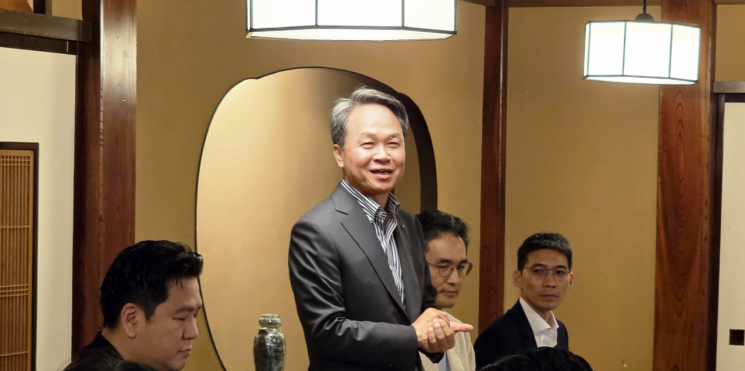 Jin Ok-dong, Chairman of Shinhan Financial Group, visited a dinner event with analysts on the afternoon of the 27th to express his gratitude. [Photo by Shinhan Financial Group]
The reason financial institutions visit Japan to listen to opinions related to value-up is that Japanese companies have not only enhanced their value through value-up programs but also improved their performance. According to the Woori Financial Management Research Institute and others, last year, the net income of Japan's three major financial groups (Mitsubishi UFJ Financial Group, Sumitomo Mitsui Financial Group, and Mizuho Financial Group) reached a record high of 3.1 trillion yen (approximately 26.5757 trillion KRW), a 26.4% increase from the previous year. Although interest income decreased, non-interest income, centered on fee income, surged sharply. Non-interest income increased by 36.3% year-on-year due to a favorable Japanese stock market, increased fees related to overseas loans, and active partnerships with global investment banks (IBs). Interest income also grew by 3.9%, supported by strong overseas interest income (2.49 trillion yen in 2022 → 2.69 trillion yen last year), considering one-off factors.
Along with strong performance, shareholder return policies were actively implemented, improving both stock prices and PBR (price-to-book ratio). Stock prices grew by 65.1% to 88.8% from March last year to last month, and PBR also rose to 0.77?0.93. A PBR below 1 means the company's value in the stock market is undervalued to the extent that it does not reach the value of the company's assets.
Lee Kyung-hoon, Senior Researcher at Woori Financial Management Research Institute, analyzed that the three major Japanese financial groups overcame the long-term challenges of Japan's low growth and low interest rates by pioneering overseas markets and improving non-interest income domestically. The three companies strengthened retail banking businesses in high-growth countries such as Southeast Asia and steadily developed their Corporate and Investment Banking (CIB) capabilities mainly in countries with developed capital markets. The researcher stated, "Domestically, we need to develop various products and services to respond to the expanding asset management demand due to aging and establish proactive strategies to prepare for market and regulatory changes."
© The Asia Business Daily(www.asiae.co.kr). All rights reserved.

















