Chinese and Global Automakers: Reverse Joint Ventures Instead of Joint Companies
US and European Tariffs May Have Limited Impact on Chinese Electric Vehicle Restrictions
There has been an increasing number of cases recently where Western automakers collaborate with Chinese companies to learn about electric vehicle technologies. Considering that China mandated joint ventures with foreign automakers to acquire know-how when it opened its market in the early 20th century, the situation has now reversed.
Lee Ho, a senior researcher at the Korea Automotive Technology Institute, pointed this out in the industry analysis report titled "Changes in Global Automakers' Cooperation with China" on the 2nd. Since the Chinese government opened its market in 2001, it required local companies to hold more than 50% equity in joint ventures for the production and sales of vehicles in China. This joint venture requirement was partially abolished from 2018 for some sectors such as new energy vehicles and has now been completely eliminated.
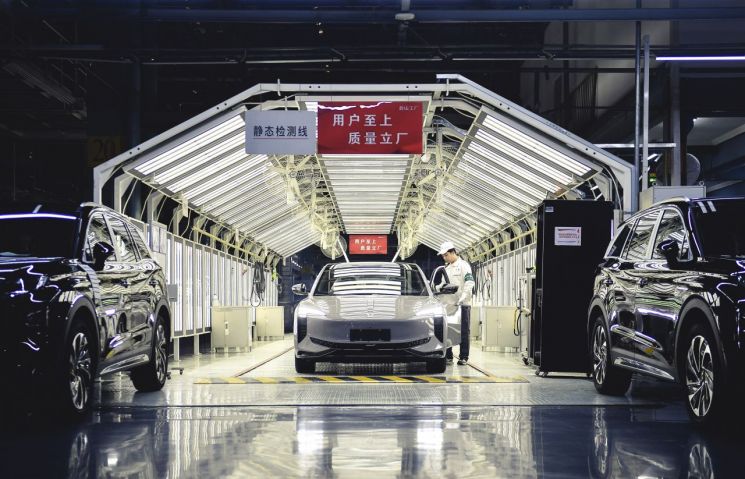 Hongqi electric vehicle production line of Di Yi Automobile, a luxury brand in Changchun, Jilin Province, China
Photo by Yonhap News
As the pace of electrification accelerates, there have been more cases of foreign automakers purchasing complete vehicle platforms from Chinese companies or learning technologies from them. Toyota and Subaru produce their first mass-produced electric vehicle, the bZ4x, through joint ventures with Chinese companies FAW and Guangzhou Automobile Group (GAC). The bZ3, jointly developed by Toyota and Chinese BYD, is produced and sold locally through a joint venture with FAW.
Mercedes-Benz produces small electric vehicles at Smart, a joint venture with Geely, China’s largest private automaker. German Volkswagen has signed a technology cooperation agreement covering platforms and software with Chinese electric vehicle startup XPeng. Two electric vehicles developed on the XPeng platform are planned to be launched under the Volkswagen brand in 2026.
There are also cases where Chinese technology is being adopted more proactively. Stellantis acquired a 21.3% stake in Chinese company Lingpao as of the end of 2023 and established a joint venture, Leapmotor International, to produce and sell vehicles outside China. The joint venture recently began pilot production of a newly developed electric vehicle at Stellantis’ plant in Poland last month and plans to start mass production in September.
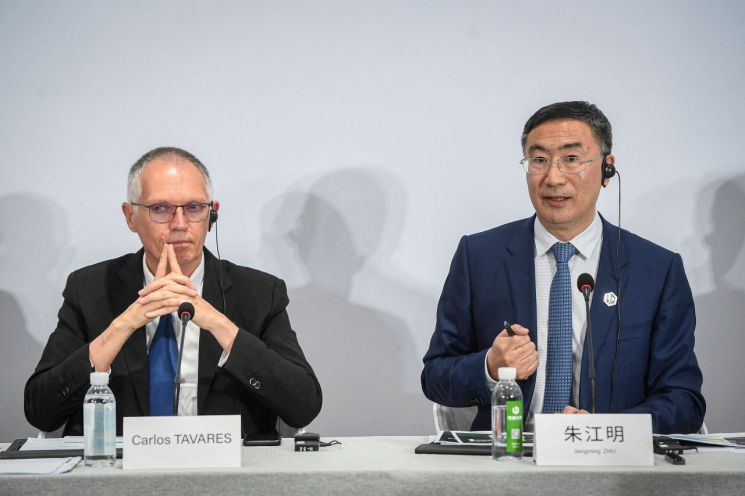 Carlos Tavares, CEO of Stellantis, and Zhu Jiangming, CEO of Lingpao, are speaking at a press conference held last May.
 [Photo by Yonhap News]
Renault announced plans to develop an electric version of its long-standing compact car model, the Twingo, in collaboration with a Chinese engineering company, aiming for a 2026 release. It will be produced at Renault’s factory in France with a price below 20,000 euros.
Since these joint ventures have different intentions and purposes compared to the past, some refer to them as "reverse joint ventures" or "reverse joint venture companies." However, given the need to shorten new car development cycles and the focus on user environments utilizing advanced information and communication technologies rather than traditional factors like driving performance, it is premature to conclude that the overall technological superiority has been reversed.
To understand the underlying changes, it is necessary to examine the price competitiveness of Chinese electric vehicle companies, Lee Ho emphasized. He explained, "If the source of competitiveness is seen as factors such as massive subsidies from the Chinese government and low production costs, the tariff increases currently being pursued in the US and Europe could serve as effective countermeasures. However, if it is viewed as the technological know-how accumulated by dominating the low-priced electric vehicle market and the low costs secured through intense competition among numerous companies, the effectiveness of countermeasures like tariffs is limited."
© The Asia Business Daily(www.asiae.co.kr). All rights reserved.



















