The Electronics and Telecommunications Research Institute (ETRI) has launched a research project on AI-based policy functions that will contribute to public decision-making, including supporting policy execution decision-making by national and local governments both domestically and internationally.
On the 1st, ETRI announced that it signed a memorandum of understanding (MOU) with the International Institute for Applied Systems Analysis (IIASA) in Austria to establish a cooperative research framework on AI-based policy intelligence to assist public policy decision-making.
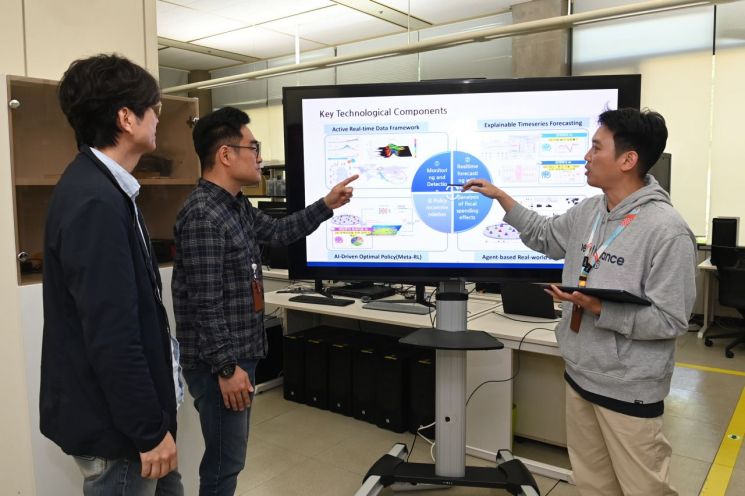 ETRI researchers are sharing mutual opinions on the utilization plans in the field of artificial intelligence policy intelligence digital twin. Photo by Electronics and Telecommunications Research Institute of Korea
Based on the agreement, the two organizations will collaborate to advance the MABM (Macro Agent-based Model) for fiscal policy decision-making by government functions. Furthermore, they plan to strengthen international cooperative research to address global challenges such as population, climate, and environmental changes.
Through this, ETRI expects to establish a virtual national economic and social common framework in the process of formulating various public policies, enabling reliable policy decision-making by virtually setting and experimenting with policy elements that are difficult to handle in reality.
For example, after detecting changes in economic indicators through monitoring within the real national economic system, a virtual national economic simulation is operated using technologies such as digital twins, allowing policy simulation experiments and forecasting within the system. This series of fiscal and economic digital twin frameworks can assist decision-making for policy execution.
In particular, ETRI anticipates that by inputting and synchronizing fiscal data and macro/micro data, an AI decision-making agent will be able to derive optimal policies.
Currently, ETRI possesses numerous research and development (R&D) projects and core technologies related to ▲analysis and prediction of national economic and social phenomena ▲AI technology for national policy decision-making ▲policy intelligence convergence platform technology.
IIASA conducts research on environment, energy, climate change, economy, technology, and policy with the aim of developing sustainable solutions by addressing complex problems through systems analysis.
Lee Yeon-hee, Director of ETRI’s Fiscal and Economic Policy Intelligence Research Center, stated, “We will ensure that technological cooperation with IIASA leads to scientific system analysis and prediction of complex problems and collaborative modeling research for developing sustainable policy intelligence solutions.”
Poledna Sebastian, Research Group Leader at IIASA, said, “Cooperation with ETRI will serve as an opportunity to expand the scope by applying recently developed models used in monetary policy to fiscal policy analysis and decision-making by government functions.”
© The Asia Business Daily(www.asiae.co.kr). All rights reserved.
![Clutching a Stolen Dior Bag, Saying "I Hate Being Poor but Real"... The Grotesque Con of a "Human Knockoff" [Slate]](https://cwcontent.asiae.co.kr/asiaresize/183/2026021902243444107_1771435474.jpg)
















