Amazon and Intel CEOs "Giants at the Forefront of AI Semiconductors"
Seeking to Enhance AI Semiconductor Competitiveness... Transitioning to AI-Centered Businesses
Choi Tae-won, chairman of SK Group, met with the CEOs of Amazon and Intel in the United States to explore ways to expand AI businesses such as large language models (LLM) and industrial artificial intelligence (AI).
According to SK Group on the 1st, Chairman Choi met with Andy Jassy, CEO of Amazon, last week at Amazon's headquarters in Seattle to discuss cooperation in AI and semiconductors. CEO Jassy is an AI and cloud expert who served as CEO of Amazon Web Services (AWS) and has been Amazon's CEO since 2021.
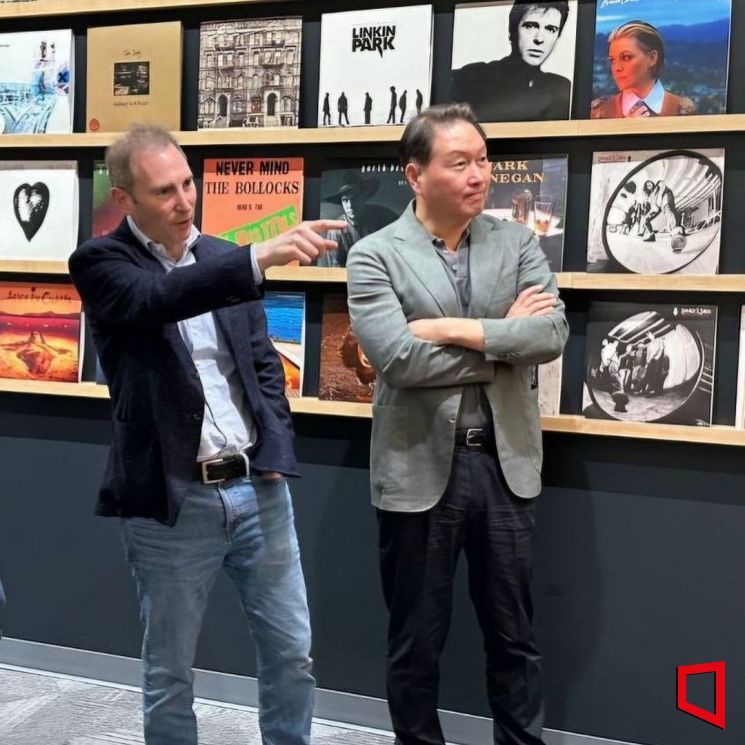 Chairman Chey Tae-won of SK Group (right) met with Andy Jassy, CEO of Amazon, at Amazon's headquarters in Seattle to discuss AI (artificial intelligence) and semiconductor collaboration. (Provided by SK Group)
On the same day, Chairman Choi posted a photo on his Instagram with CEO Jassy and Pat Gelsinger, CEO of Intel, saying, "Giants at the forefront of AI semiconductors," and added, "As they shake the world with tremendous power and speed, we must also match their pace step by step."
Chairman Choi added, "I hope many unicorns (unlisted companies valued at over 1 billion KRW) will emerge in Korea, like Anthropic created together by SK Telecom and Amazon, and Gauss Labs, a joint venture of SK Hynix and Intel." Gauss Labs is SK Hynix's industrial AI specialized subsidiary.
Amazon is expanding its business across the entire AI spectrum, from semiconductor design to services, by developing its own AI semiconductors specialized for machine learning (ML) training and inference, called 'Trainium' and 'Inferentia.' These semiconductors, developed for AI, require high-performance high-bandwidth memory (HBM). SK Hynix began mass production and customer delivery of the world's first 5th generation HBM, 'HBM3E,' in March this year, leading the AI memory semiconductor market.
Chairman Choi also met with CEO Gelsinger at Intel's headquarters in San Jose to discuss cooperation in the semiconductor field. They highly valued the long-standing semiconductor partnership between SK Hynix and Intel and explored ways to expand advanced semiconductor manufacturing cooperation in the AI era.
SK Hynix, in collaboration with Intel, developed the world's fastest server DRAM 'DDR5 MCR DIMM' with speeds exceeding 8GB per second in December 2022. In January last year, they became the first in the world to certify compatibility between the 10nm-class 4th generation (1a) DDR5 server DRAM and Intel's server CPU, the '4th generation Intel Xeon Scalable Processor.' They have continued their partnership by publishing white papers and more.
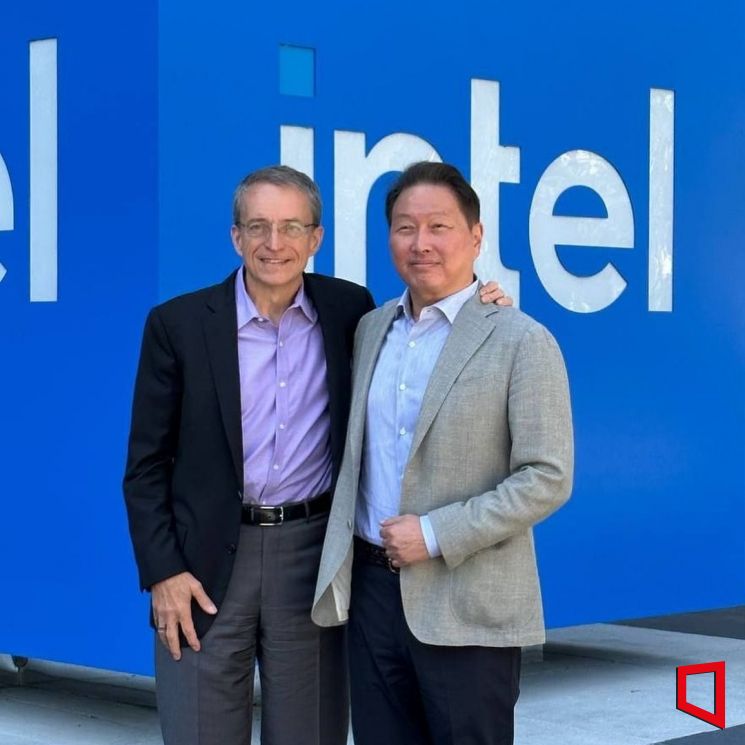 Chairman Chey Tae-won of SK Group (right) met with Pat Gelsinger, CEO of Intel, at Intel's headquarters in San Jose, USA, to discuss semiconductor collaboration. (Provided by SK Group)
Intel holds a high market share in the server CPU market and has recently strengthened its AI competitiveness by launching the AI accelerator 'Gaudi 3.' It is also expanding its foundry (semiconductor contract manufacturing) business and is recognized as having world-class competitiveness across the entire spectrum from AI semiconductor design to production.
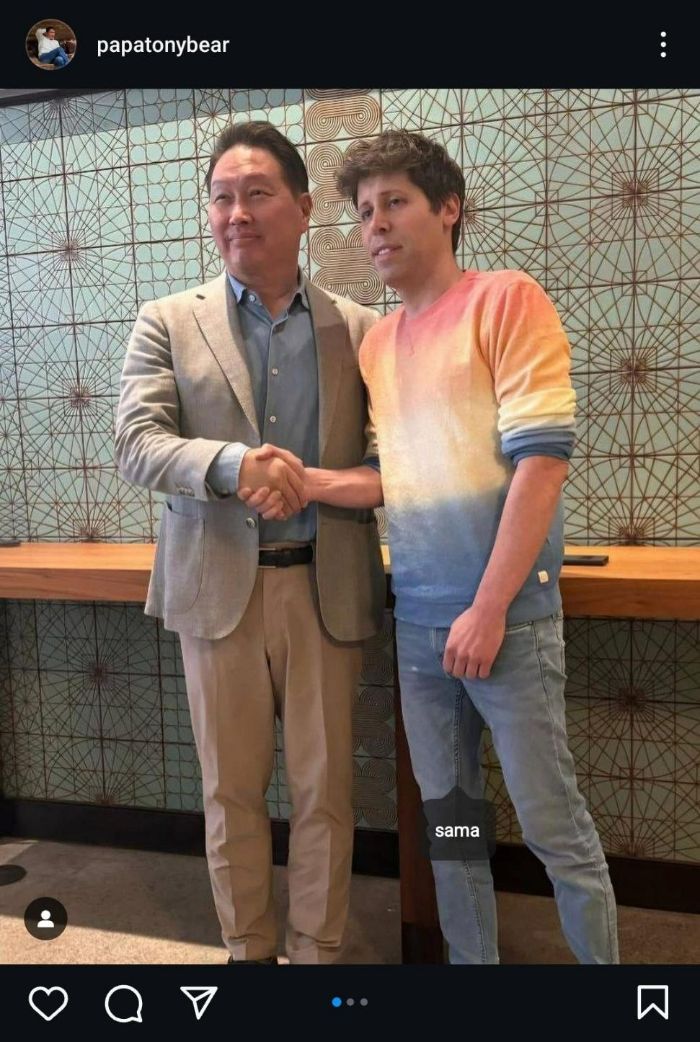
Chairman Choi, who departed for a business trip to the U.S. on the 22nd, has been meeting consecutively with local IT industry figures such as Sam Altman, CEO of OpenAI, and Satya Nadella, CEO of Microsoft (MS). He has concretized SK's AI competitiveness enhancement plans and AI business direction focused on 'people,' from semiconductors to services, with AI leaders.
In April, he met Jensen Huang, CEO of Nvidia, and in June, Wei Zhejia, chairman of TSMC, continuing efforts to build cooperative networks and seek joint business opportunities with big tech leaders.
Meanwhile, SK Group announced at its management strategy meeting held on the 28th and 29th of last month that it plans to secure 80 trillion KRW in investment funds by 2026 to invest in future growth sectors such as AI and semiconductors. SK Hynix plans to invest a total of 103 trillion KRW to strengthen its semiconductor business competitiveness, including 82 trillion KRW over five years until 2028 in AI-related business areas such as HBM.
An SK official said, "We plan to actively foster an 'AI ecosystem' encompassing everything from semiconductors to services to contribute to strengthening national competitiveness and human progress."
© The Asia Business Daily(www.asiae.co.kr). All rights reserved.



















