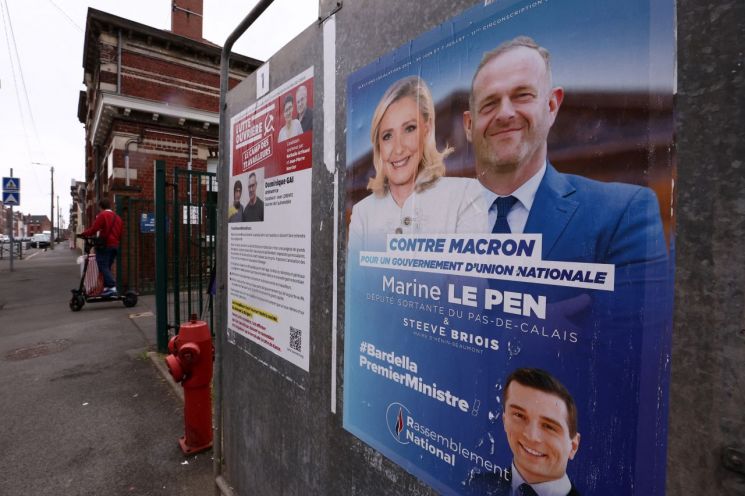
"There was nothing surprising." "A significant part was already priced in." When the exit poll results showed that the far-right party Rassemblement National (RN) ranked first in the first round of the early French parliamentary elections held on the 30th (local time), the market generally showed little reaction. With attention focused on whether RN will secure a majority of seats, market uncertainty is expected to continue until the second round of voting on July 7.
According to Bloomberg News, Andrea Tueni, Head of Trading at Saxo Bank France, said about the exit poll results of the first round of the early parliamentary elections released on Sunday night, "This is not surprising to the market," and added, "There is no reason for a sharp drop." He does not expect a major shock in the market on Monday, July 1, stating, "What is certain is that uncertainty will continue throughout this week, and there is no reason to confirm an upward trend."
Daniel Barella, Chief Investment Officer at Pictet Galland & Cie SA, also gave a similar assessment, saying, "The election results are quite consistent with the poll forecasts." Bloomberg News noted that after President Emmanuel Macron announced the early elections, the French stock and bond markets had sharply declined over the past three weeks, indicating that concerns about the far-right party's possibility of coming to power had already been largely priced in.
Meanwhile, in the Asian foreign exchange market on the same day, the euro's value rose slightly. Early in the session, the euro traded at a level 0.3% higher against the dollar. Fiona Cincotta, Senior Market Analyst at London City Index, said, "There was nothing surprising," but added, "The slightly smaller margin of votes compared to the polls may have helped the euro's slight rise in value at the market open."
Alexander Baradez, Senior Market Analyst at Paris IG, said, "If there had been any panic, it would have been confirmed in the foreign exchange market by now," adding, "That is not the case." Bloomberg News pointed out that this level is slightly lower than before the European Parliament elections and emphasized that it is important to closely watch the opening of the French bond market rather than the foreign exchange market. Since the announcement of the early elections, concerns about far-right rule have increased, and the spread between French government bonds and safe-haven German bonds (10-year) has widened to levels seen during the 2017 elections when 'Frexit' fears were high.
The key issue now is whether RN will secure a parliamentary majority. In the exit poll, RN led the left-wing coalition New Popular Front (NFP) and President Macron's ruling party Renaissance's Ensemble coalition, but it remains uncertain whether RN can secure a majority in the second round. The market fears that if RN comes to power, populism and expansionary fiscal policies will increase spending and worsen France's fiscal deficit problem. France's fiscal deficit was 5.5% of GDP last year, the second highest in the Eurozone after Italy. Public debt exceeded a staggering 110%.
Joachim Clement of Liberum Capital said, "If a coalition forms to oppose RN, it could lead to euro strength." Analysts believe that if the left-wing coalition and centrists unite to block far-right rule and unify candidates, it will support a relief rally in the euro.
Bloomberg News also analyzed that from a market perspective, a 'Hung Parliament' where no party secures an outright majority might be the best outcome. If RN secures a parliamentary majority and begins implementing major pledges, an increase in debt, a sharp drop in the French stock market, and euro weakness are inevitable. Earlier, S&P Global downgraded France's credit rating for the first time in 11 years.
Some speculate that the European Central Bank (ECB) might intervene with its Transmission Protection Instrument (TPI) to mitigate the impact of political turmoil in Europe on financial markets. The TPI is a bond-buying program designed to prevent a sharp rise in sovereign bond yields of specific countries. However, ECB officials, including President Christine Lagarde, have stated that they are monitoring the situation but do not yet see the need for TPI intervention.
© The Asia Business Daily(www.asiae.co.kr). All rights reserved.

















