National Assembly to Hold Government Questioning from 2nd to 4th
Impeachment Report Procedure for Broadcasting Commissioner Kim Hong-il on 2nd
Impeachment Process Expected to Align with Consecutive Plenary Sessions
The government questioning, a means for the National Assembly to check and monitor the government, has been utilized not only for its original purpose but also as a tool for the opposition party's offensive against the ruling party. There is a proviso that cases such as impeachment and motions to dismiss cabinet members must be processed within 72 hours after 24 hours have passed since the report to the National Assembly. The government questioning sessions, which are held consecutively for three to four days in the plenary session, can be used as a 'timing for offensive.'
On the 1st, the political circles referred to this week as the opposition party's 'Super Week' for offensive against the ruling party. This is because the first government questioning of the 22nd National Assembly, as well as the impeachment motion against Kim Hong-il, Chairman of the Korea Communications Commission, the special prosecutor law for Chae Sang-byeong, and the Broadcasting Act are expected to be processed. In particular, since the impeachment motion against Chairman Kim was submitted on the 27th of last month, it will be reported at the first plenary session on the 2nd and then proceed to be processed in the plenary session after 24 hours.
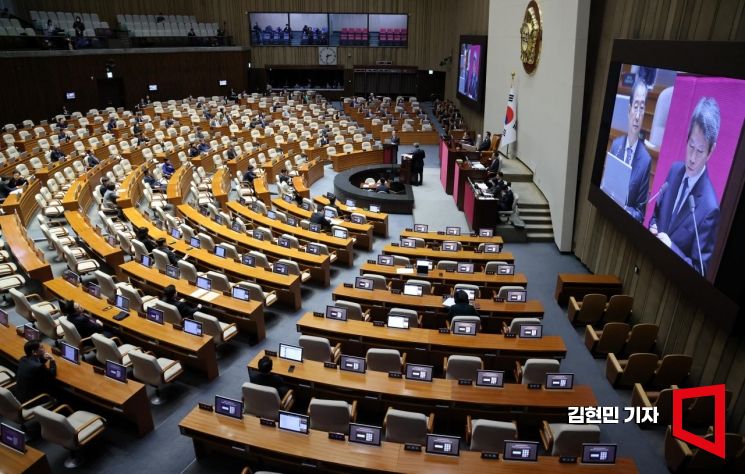 Prime Minister Han Duck-soo is responding to a question from Lee In-young, a member of the Democratic Party of Korea, during the government questioning session at the National Assembly plenary meeting on the 22nd. Photo by Kim Hyun-min kimhyun81@
In the past, impeachment motions or dismissal motions were frequently discarded due to expiration of deadlines. Although the impeachment or dismissal motions were reported to the plenary session, the plenary session schedule could not be set within 72 hours after 24 hours had passed. The opposition party resolved this issue by utilizing negotiation group speeches or government questioning. They scheduled consecutive plenary sessions and submitted motions to change the agenda to include the items. Previously, during the impeachment of Minister of the Interior and Safety Lee Sang-min, the opposition reported it on February 6, 2023, the day of the political sector government questioning, and voted on February 8, 2023, the day of the social sector government questioning, passing the motion. At that time, the opposition added an agenda item that was not originally on the plenary session schedule by using a motion to change the agenda. Similarly, during the dismissal motion against former Foreign Minister Park Jin in 2022, the opposition used the negotiation group speech schedule held over two days to proceed with processing after 24 hours of reporting.
In the case of Chairman Kim, unless he voluntarily resigns like former Chairman of the Korea Communications Commission Lee Dong-gwan, a similar procedure is expected to be followed. A National Assembly Secretariat official said, "If the vote is not held within 72 hours after the report, it will be discarded, so the National Assembly Act will be followed." It is expected that the voting procedure will proceed after a motion to change the agenda.
© The Asia Business Daily(www.asiae.co.kr). All rights reserved.
![Clutching a Stolen Dior Bag, Saying "I Hate Being Poor but Real"... The Grotesque Con of a "Human Knockoff" [Slate]](https://cwcontent.asiae.co.kr/asiaresize/183/2026021902243444107_1771435474.jpg)
















