Daejeon Association Maintains Position on 'Medical School Expansion Cancellation'
"2000 Trainees Not Feasible, Environment Improvement Secondary"
"Residents Await Government's Change of Stance"
As the medical community and the government remain at an impasse over whether to reconsider the increase in medical school admissions for next year, the possibility of resigned residents participating in discussions seems remote. This is because the Emergency Response Committee of the Korean Intern Resident Association (KIRA) has not budged an inch from its seven demands, including the complete reconsideration of the medical school admission increase.
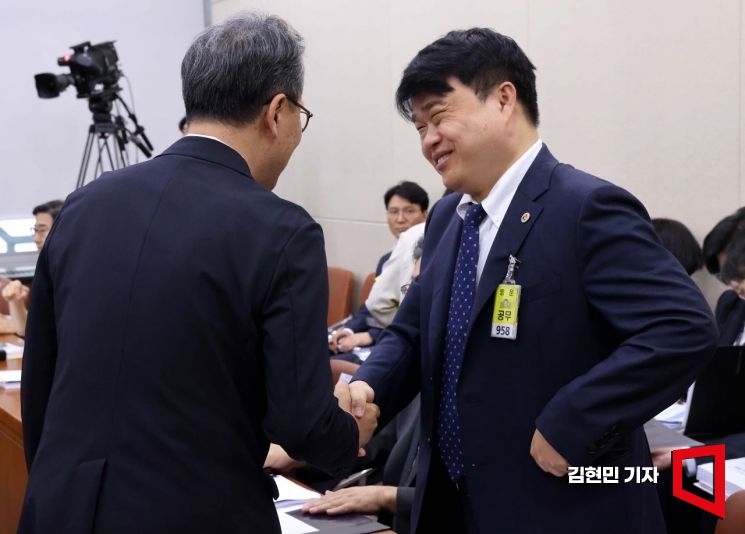 Park Min-su, Vice Minister of Health and Welfare (left), and Lim Hyun-taek, President of the Korean Medical Association, are shaking hands at the hearing on the emergency situation in the medical sector held by the Health and Welfare Committee at the National Assembly on the 26th of last month. Photo by Kim Hyun-min kimhyun81@
On the 26th of last month, at a hearing on the medical community's emergency situation, Minister of Health and Welfare Cho Kyu-hong responded to a question from Park Joo-min, Chair of the National Assembly Health and Welfare Committee, regarding the medical community's demands by saying, "Since the medical school admission quota for 2025 has already been finalized and examinees and parents are preparing accordingly, it is practically difficult to accept the Korean Medical Association's demands."
On the other hand, the medical community unanimously stated that without adjustments to next year's quota, it would be impossible to persuade the residents. Lim Hyun-taek, President of the Korean Medical Association (KMA), said at the National Assembly hearing on the medical community's emergency situation, "We must be able to persuade residents and students who have already left hospitals and schools. If there is no room for adjustment in the 2025 quota, it will be impossible for residents and medical students to return." Park Hyung-wook, Vice President of the Korean Academy of Medical Sciences, also said, "The government unilaterally proceeded with the increase process without grounds and just told residents and medical students to accept the increase simply because it was finalized. Moreover, the younger generation these days is different. It is difficult for the younger generation to accept the government's intentions as they are."
The consensus within the medical community is that without adjusting the 2025 medical school quota, residents cannot be called to the negotiation table. Mr. A, who was active in KIRA during the 2020 medical-government conflict, said, "The idea of increasing the medical school quota by 2,000 is so unreasonable that without adjustments to next year's increase, there seems to be no other way to persuade the residents. It seems the residents are hoping the government will present some conditions, such as a change in stance."
Mr. B, a resident who resigned from a university hospital in Jeonbuk, said, "I firmly believe that a complete reconsideration is necessary, but there are moderate residents around me who do not absolutely oppose the increase in medical school admissions," adding, "If an agreement is reached on an increase of about 500 for next year, they would like to return."
While the government maintains its position that next year's increase must be upheld, opinions have been raised that promises to improve the training environment for residents lack effectiveness. Oh Seung-won, a professor at Seoul National University Hospital Gangnam Center and public relations officer of the Emergency Response Committee of Seoul National University College of Medicine and Seoul National University Hospital, said, "From individual residents' perspectives, improving the training environment seems to be a secondary issue. Many say that even if the environment is tough, as long as they can learn well, enduring hardships is not a big problem," adding, "Their biggest concern seems to be that they cannot properly train the increased 2,000 residents. That is why the increase itself is considered an important issue."
Furthermore, even though some residents have resigned individually, KIRA's stance still holds significant meaning for them. Mr. A said, "Unless a symbolic and representative figure (not just a general resigned resident) accepts the government's proposal, residents will not show any movement. Currently, that symbolic figure is Emergency Committee Chair Park Dan," adding, "General residents who have resigned individually can communicate with Chair Park Dan through their respective hospital resident emergency committee chairs." Mr. B also said, "All believe that resident representation lies with Emergency Committee Chair Park Dan."
© The Asia Business Daily(www.asiae.co.kr). All rights reserved.

















