Contract for Technology Transfer of Carbon Reduction Developed Independently by KBR
Carbon reduction technology developed by a government-funded research institute in Korea will be transferred to the largest global engineering company in North America. This is regarded as a case proving the excellence of Korea's chemical process technology on a global scale.
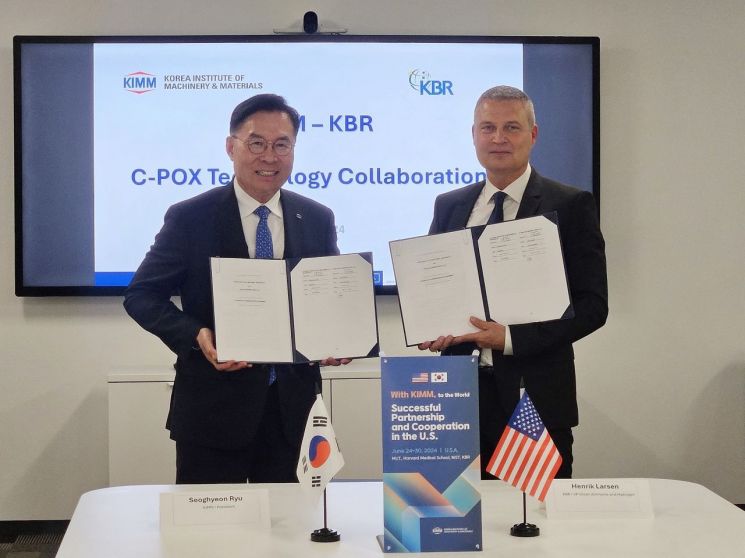 Ryu Seok-hyun, Director of the Korea Institute of Machinery and Materials (left), visited KBR in Houston, USA, on June 28, signed a technology transfer agreement with Vice Chairman Henrik Larsen, and took a commemorative photo. Photo by Korea Institute of Machinery and Materials
The Korea Institute of Machinery and Materials (Director Ryu Seok-hyun) announced on the 1st that it signed a technology transfer contract for the 'CPOx' technology with the global engineering company KBR (Kellogg Brown & Root) on the 28th of last month.
KBR is a global company in engineering, procurement, construction (EPC), and services in industries such as chemical and energy. According to the Institute, most of Korea's refining and petrochemical plants receive engineering services from KBR. This increases the possibility that the Institute's carbon reduction technology will be distributed not only domestically but also to chemical companies worldwide through KBR.
The CPOx technology, first devised by the research team led by Principal Researchers Lee Dae-hoon and Cho Sung-kwon at the Semiconductor Equipment Research Center of the Autonomous Manufacturing Research Institute, supplies methane generated during the process as a heat source to the catalyst regenerator of the catalytic NCC process instead of fuel oil, thereby reducing carbon dioxide (CO2) emissions.
The NCC process is fundamental in the petrochemical field, where naphtha, produced during crude oil refining, is decomposed at high temperatures to produce basic hydrocarbons such as ethylene and propylene, which are basic raw materials for petrochemicals. While the NCC process operates at a high temperature of 850 degrees Celsius, the catalytic NCC process can operate at a relatively lower temperature of 650 degrees Celsius, resulting in energy savings.
KBR adopted the technology developed by the Institute when a chronic abnormal combustion problem occurred during the replacement of the heat source needed for the catalyst regenerator in the catalytic NCC process from fuel oil to methane to achieve carbon reduction and economic feasibility.
According to the Institute, the CPOx technology can solve the abnormal combustion problem, secure carbon emission rights, and reduce the production cost of olefins, which are raw materials for plastics. This is the reason why KBR reached out to the Institute.
Director Ryu Seok-hyun said, “It is very meaningful that, amid threats to corporate competitiveness due to carbon border taxes and other carbon emissions regulations, our institute has achieved technology transfer results related to carbon emission reduction with independent technology to a global company like KBR.”
The research on CPOx technology was conducted with support from the Ministry of Science and ICT’s National Science and Technology Research Council under the project “Large-scale Convergent Plant Technology for Securing Energy and Chemical Raw Materials” (hosted by the Korea Research Institute of Chemical Technology, Future Leading Convergent Research Group, led by Director Park Yong-gi).
© The Asia Business Daily(www.asiae.co.kr). All rights reserved.

















