SCFI Surpasses 3700... Doubled Compared to Early Year
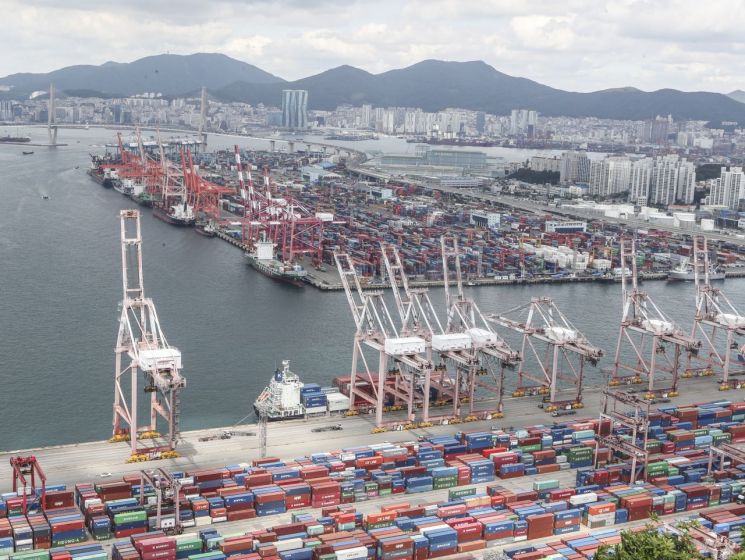
The Shanghai Containerized Freight Index (SCFI), which indicates the freight rate levels of international maritime shipping routes, has risen for 12 consecutive weeks, surpassing the 3700 mark for the first time in about two years. The possibility of expanding emergency response measures at the inter-ministerial level to support logistics costs and supply additional vessels has also increased.
According to industry sources on the 1st, the SCFI recorded 3714.32 as of the 28th. It rose 6.87% compared to the previous week, marking 12 consecutive weeks of increase. The SCFI reaching the 3700 level is the first time since early August 2022, about two years ago. After surpassing 3000 at the end of May, it increased by 22% within a month. Compared to last year when it hovered around the 1000 level, this is more than a threefold increase.
This is due to the ongoing "Red Sea crisis" caused by attacks on vessels by Yemen's Houthi rebels, which have blocked the Red Sea route since the end of last year. As ships detour around the Cape of Good Hope in South Africa instead of the Suez Canal, the sailing distance and time have increased, leading to a shortage of available shipping capacity. The situation worsened as the Panama Canal also faced disruptions due to severe drought.
By route, the East Coast of the Americas recorded $9,274 per 1FEU (one 12m container), up $997 from the previous week. The West Coast of the Americas rose $657 to $7,830. The Mediterranean route was $5,387 per 1TEU (one 6m container), up $532. The Europe route increased by $544 to $4,880. South America rose $296 to $8,854. The Middle East route fell $182 to $2,711. Australia and New Zealand decreased by $9 to $1,397.
With international maritime freight rates rising sharply, there is a possibility that the emergency response measures at the inter-ministerial level will be raised. The Ministry of Trade, Industry and Energy has been implementing phased response measures since the beginning of the year as freight rates rose due to the ongoing Red Sea crisis. Based on the SCFI's all-time high of 5109, response levels are raised at 2700 (Level 2), which is about half, and 3900 (Level 3), which is about three-quarters. Earlier, on the 14th of last month, the 42nd Economic Relations Vice-Ministerial Meeting decided to urgently deploy three temporary vessels and seven newly built container ships in the second half of the year. To reduce the freight burden on export companies, 20.2 billion won in export vouchers to be supported in the second half will be executed early, and additional freight support measures will be reviewed considering future freight rate trends.
© The Asia Business Daily(www.asiae.co.kr). All rights reserved.

















