BBC Highlights Parents' Efforts to Understand Reclusive Children
Recently, as the number of reclusive youths who cut off social relationships and live confined to their rooms increases in South Korea due to employment difficulties, parents trying to understand such children are even experiencing solitary confinement, the British BBC reported on the 30th (local time).
In a Seoul-based article titled "Why parents in South Korea lock themselves up in prison cells at the Happiness Factory," BBC highlighted the efforts of Korean parents to understand their reclusive, isolated children.
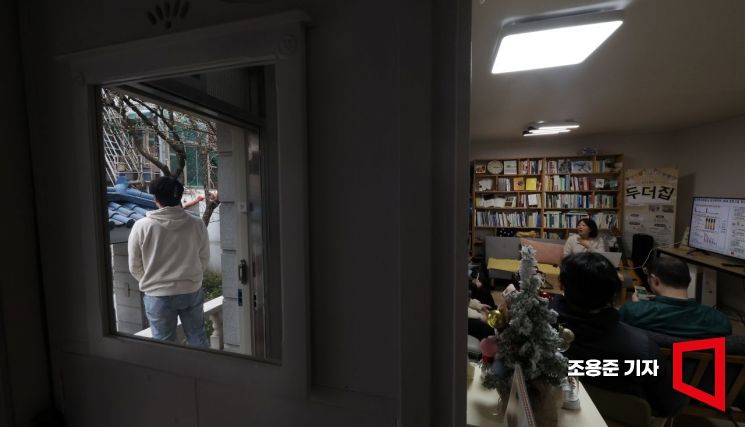 A space for reclusive youth, the nonprofit organization Seeds. (The photo is not directly related to the article content) / Photo by Jo Yongjun jun21@
BBC introduced cases of participants in parent education programs run by non-profit organizations such as the Youth Foundation, Blue Whale Recovery Center, and Happiness Factory. Most of these participants have children who are isolated and reclusive youths, often called 'hikikomori.'
This 13-week program, which started in April, teaches ways to communicate better with their children. Among the activities is a three-day solitary confinement experience at the Happiness Factory training facility in Hongcheon-gun, Gangwon-do. The purpose is to help parents understand their children more deeply through isolation.
BBC cited research results from the Korea Institute for Health and Social Affairs and the Ministry of Education, stating that 5% of South Korean youths aged 19 to 34, about 540,000 people, are in isolated and reclusive states. The reasons include employment difficulties (24.1%), interpersonal relationship problems (23.5%), family issues (12.4%), and health problems (12.4%).
BBC reported that in South Korea, "the perception of children's achievements as the parents' success causes the entire family of reclusive children to be drawn into the quagmire of isolation," and "many parents also feel guilt by interpreting their children's hardships as parenting failures."
The outlet pointed out that as the view that youths' isolation and reclusion are family problems spreads, it results in parents themselves becoming isolated from those around them.
Kim Ok-ran, director of the Blue Whale Recovery Center, said, "Because they cannot openly discuss the issue of their children's isolation and reclusion, parents isolate themselves as well, even skipping family gatherings during holidays."
© The Asia Business Daily(www.asiae.co.kr). All rights reserved.
![Clutching a Stolen Dior Bag, Saying "I Hate Being Poor but Real"... The Grotesque Con of a "Human Knockoff" [Slate]](https://cwcontent.asiae.co.kr/asiaresize/183/2026021902243444107_1771435474.jpg)










