Due to the collapse of the pediatric medical system, it has been revealed that 7 out of 10 children's hospitals are struggling to transfer critically ill and emergency pediatric patients to tertiary general hospitals.
On the 30th, the Korean Association of Children's Hospitals disclosed this reality of children's hospitals at a press conference urging measures to address the pediatric emergency room situation at COEX in Gangnam-gu, Seoul.
The Association announced the results of a survey conducted from the 27th to the 29th of this month, in which 50 out of 117 children's hospitals participated. According to the survey, 72% of respondents said it is very difficult to transfer critically ill pediatric patients who arrive by ambulance to tertiary general hospitals.
When asked how many hospitals they contacted per patient when transferring critically ill emergency patients to university hospitals, 90% said five or fewer hospitals, which was the most common response. Six to ten hospitals accounted for 6%. About 50% of critically ill patients were transferred to hospitals outside their residential area in the past month.
Long-distance transfers outside the patient's residence pose a risk of not providing timely and appropriate treatment. The Association pointed out that this indicates an urgent need for measures to transport and accommodate critically ill pediatric patients.
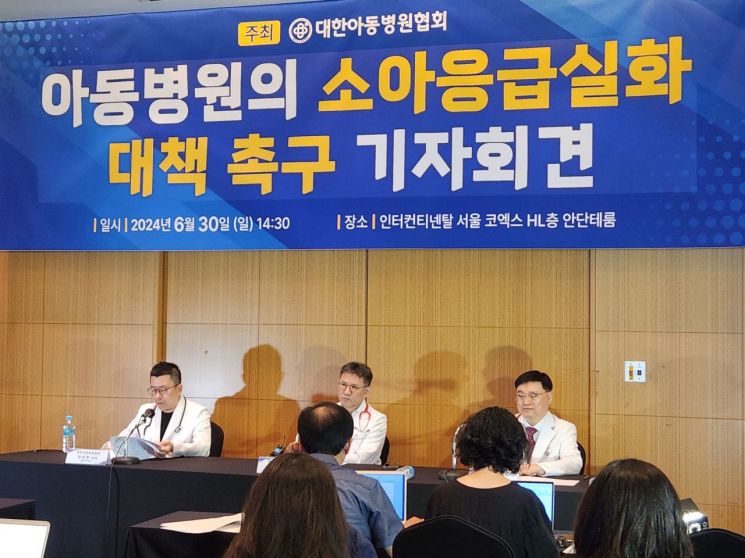 The Korean Pediatric Hospital Association held a press conference on the 30th at the InterContinental Seoul COEX in Gangnam-gu, Seoul, urging measures to prevent pediatric hospitals from becoming pediatric emergency rooms.
 [Photo by Korean Pediatric Hospital Association]
Additionally, the Association mentioned that 90% of children's hospitals are performing the substitute role of pediatric emergency rooms. Regarding the number of emergency patients arriving by ambulance each month, 56% answered five or fewer, 22% said six to ten, 4% said eleven to fifteen, and 6% said sixteen or more.
The Korean Association of Children's Hospitals explained that as the overall pediatric medical system collapses, including the closure of pediatric emergency rooms in large hospitals, children's hospitals without emergency and critical care systems are forced to take on the role of pediatric emergency rooms.
Jung Sung-kwan, Vice President of the Korean Association of Children's Hospitals and Chairman of the Woori Children’s Medical Foundation, said, "Children's hospitals face a double burden of having to deploy multiple doctors and nurses and bear legal responsibility when emergency patient transfers are not possible. When pediatric emergency patients arrive by ambulance, general medical care cannot be provided at all, causing delays and dissatisfaction among general patients."
Choi Yong-jae, President of the Korean Association of Children's Hospitals and Director of Uijeongbu Ttuntun Children's Hospital, also emphasized, "A response system between children's hospitals and the Fire Department should be established to respond quickly to pediatric emergency patients, and additional human and material support is needed for children's hospitals to treat pediatric emergency patients. The government should focus its efforts on developing policies to revive the currently critical state of pediatric healthcare."
© The Asia Business Daily(www.asiae.co.kr). All rights reserved.
![Clutching a Stolen Dior Bag, Saying "I Hate Being Poor but Real"... The Grotesque Con of a "Human Knockoff" [Slate]](https://cwcontent.asiae.co.kr/asiaresize/183/2026021902243444107_1771435474.jpg)
















