Japanese Research Team Develops 'Artificial Skin'
"Heals Itself When Wounded"
Eyes are attached to a jelly-like type of material. Sometimes it even shows a slight smile, like a person with an expression. It turned out to be a technology applying the "engineered skin tissue made from living cells," developed for the first time in the world by a Japanese research team, to a humanoid robot.
Foreign media such as the BBC reported on the 26th (local time) about a paper announced the day before by Professor Takeuchi Shoji's research team at the Graduate School of Information Science and Technology, University of Tokyo. The paper, published in 'Cell Reports Physical Science,' a sister journal of the prestigious academic journal Cell, deals with artificial skin developed in the laboratory using living cells.
This artificial skin was made by mimicking human skin, and it is not easily torn and can regenerate itself even when wounded. The research team imitated human skin muscles and tissues composed of collagen and elastin by drilling multiple small holes and covering the pores with a gel containing collagen.
The artificial skin has a soft texture like real skin. It is also characterized by being resistant to tearing and capable of self-regeneration when injured. Therefore, it is expected to be utilized in the cosmetics industry as well as in beauty and plastic surgery fields in the future. However, it seems that more time will be needed before this technology becomes commercialized.
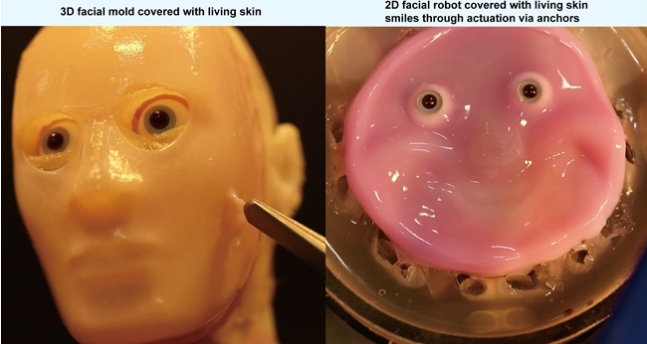 Artificial skin developed by Professor Takeuchi's research team at the University of Tokyo, Japan
 [Photo by University of Tokyo]
Professor Takeuchi Shoji of the University of Tokyo explained, "Inspired by the human skin-ligament structure, we created specially designed V-shaped perforations on solid materials and attached the artificial skin to the robot," adding, "This means that the artificial skin’s flexibility and strong adhesion method allow the skin not to tear or peel off and to move together with the robot’s mechanical components."
The researchers evaluated that they have opened the way to creating humanoids (human-shaped robots) that can make facial expressions with their own skin. The BBC reported, "The current prototype is probably closer to jelly than human skin."
Netizens described the photos released related to this skin as both fascinating and creepy. Related SNS posts included opinions such as "The smiling face is not bad," "It looks like a monster from a horror movie," and "It’s like an AI imitating a human, but somehow it’s a bit creepy."
© The Asia Business Daily(www.asiae.co.kr). All rights reserved.


















