Representative Preliminary Selection Ratio: Central 50%, Rights 25%, People 25%
The Democratic Party's Presidential Election Preparation Committee (Jeonjunwi) has postponed the decision on the election method in case former Democratic Party leader Lee Jae-myung runs unopposed. Instead, in line with the principle of a party centered on its members, it was decided to reflect party members' votes more in the preliminary primaries and other stages.
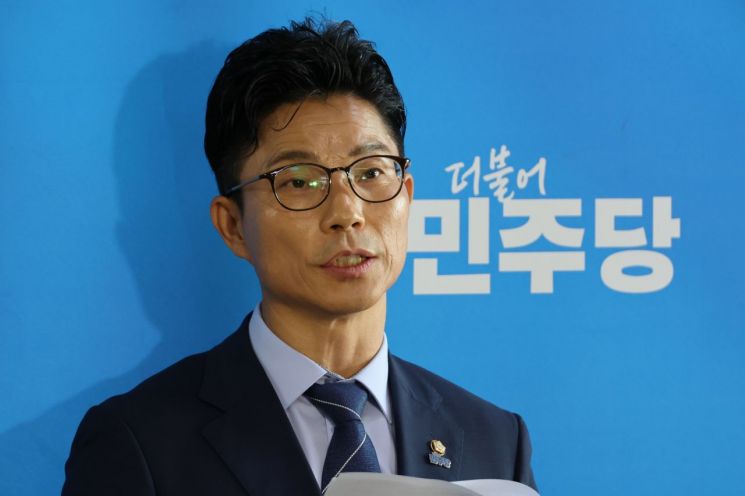 Jeong Eul-ho, spokesperson for the Democratic Party of Korea's National Party Members' Convention Preparation Committee, is briefing on the results of the meeting regarding the new leadership election method at the National Assembly in Yeouido, Seoul, on the afternoon of the 28th.
 [Photo by Yonhap News]
Jeong Eun-ho, spokesperson for the Democratic Party's Jeonjunwi, told reporters at the National Assembly in Yeouido, Seoul on the 28th, "This is not the time to discuss (the case of a single candidate for party leader)," adding, "We agreed to discuss it after seeing the status of party leader candidate registrations." He continued, "There was no contentious issue during the discussion," and said, "If the central party appears to set a single candidate first in the media, it might place a burden on other potential candidates."
The Democratic Party's constitution and regulations do not have clear provisions regarding the case when there is only one candidate for party leader. As the possibility of Lee's solo candidacy increases, it is known that the party is weighing options between a yes/no vote or an acclamation method. Lee Chun-seok, chairman of Jeonjunwi, said on KBS Radio's 'Jeonggyeok Sisa' on the morning of the same day, "There will likely be controversy over whether to secure procedural legitimacy through a yes/no vote to elect the party leader or to simply acclaim and end it."
The Democratic Party decided to increase the participation ratio of party members in the preliminary primaries for party leader and Supreme Council members. For the party leader preliminary primary, the previous ratio of 70% central committee members and 30% public opinion polls was changed to 50% central committee members, 25% party members with voting rights, and 25% public opinion polls. The party leader preliminary primary is scheduled for the 14th of next month and will be held if there are four or more candidates.
For the Supreme Council preliminary primary, the ratio was changed from 100% central committee members to 50% central committee members and 50% party members with voting rights. If there are nine or more candidates for Supreme Council members, a preliminary primary will be held. The vote value ratio between delegates and party members with voting rights for electing the party leader and Supreme Council members was set at 19.1 to 1. The Democratic Party's constitution stipulates that the vote reflection ratio between delegates and party members with voting rights should be less than 20 to 1.
The primaries will be conducted in a regional tour format. Although a one-shot primary method where voting and counting are done at once per region was considered, voting and counting by party members with voting rights will be conducted at each city/provincial party convention site. The nationwide delegate voting results and public opinion polls will be disclosed on the day of the party convention. To ensure broad participation, the nationwide delegate voting will be conducted online.
Spokesperson Jeong said, "Jeonjunwi considered how to enable the collective intelligence of party members to participate more," adding, "The decision-making power in leadership elections, which used to be held by lawmakers and party leadership, has been returned to party members with voting rights."
© The Asia Business Daily(www.asiae.co.kr). All rights reserved.

















