Active Use of Umbrellas, Raincoats Only for Lower Body
Ample Gloves and Towels, Club Care After Rounds
Calm 'Pre-Shot Routine', Compact Swing
This is unwelcome news for weekend golfers. On the 27th, the rainy season began in Jeju. It is expected to move northward through the southern regions up to the metropolitan area. With global warming, the entire country is shifting to a subtropical climate, making it likely that unpredictable guerrilla downpours will occur locally. However, amateur golfers are not the type to just stay at the practice range during the rainy season. It is also an opportunity to enjoy a refreshing round while getting wet. You can heal through walking golf in nature. If you also participate in the ‘Golf Course Grass 10,000 Steps Walking Challenge’ organized by Asia Economy, the joy doubles.
Since 2023, Asia Economy has been promoting the nationwide brain health project called Hamanhacheon (One Day 10,000 Steps, One Day 1,000 Characters) exercise. Starting from the 15th of last month, the ‘Golf Course Grass 10,000 Steps Walking’ event has been held contactlessly. This event runs until July 14. Through a lottery, participants can win free passes to Seowon Hills, a prestigious golf course in Paju, as well as Ping Boston bags, TaylorMade TP5X golf balls, Titleist golf caps, and Lapaz UV protection patches. Those with the highest participation can also receive Dunlop XXIO drivers, Voice Caddie CL2 devices, and Srixon hybrids. This is a welcome event for weekend golfers to take care of their health and receive gifts.
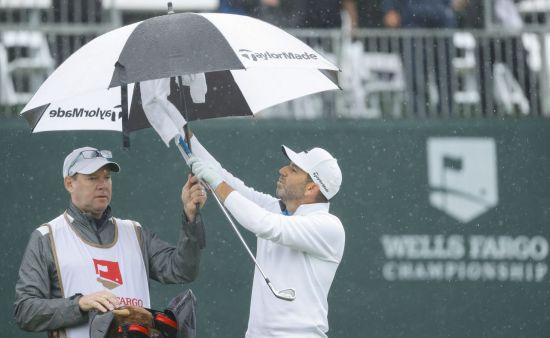
Many golfers enjoy the challenge of playing in the rain. However, caution is necessary for safety, such as lightning during rainy rounds. Thorough preparation, including equipment checks, is essential. When it rains, it becomes a ‘battle against moisture.’ Raincoats and umbrellas are always kept in the golf bag. Gloves are brought in ample quantities to prevent mishits caused by slippery grips. Using gloves specifically designed for rainy rounds is also wise. Even if they get wet, a quick shake will dry them fast, recovering more than the investment cost. If you dislike this, use regular gloves. Synthetic leather gloves are better than sheep leather. Change gloves every 3 to 4 holes. Although it may be bothersome, wipe the grip with a towel after every shot. Hang the towel and wet gloves inside the umbrella.
 If water or foreign substances get on the club, it can negatively affect the distance. Frequently wipe the club head using a towel.
Only wear rain pants. This allows for a relatively comfortable swing and prevents interference from the protruding part of the raincoat around the belly during putting. If wearing a raincoat top, remove both sleeves. Focus on a comfortable swing. During severe weather, thorough warm-up is necessary. Arrive early at the golf course and warm up sufficiently. Maintain body temperature by drinking warm tea at the shelter. During the round, be careful not to slip on slopes when going up and down the teeing ground. Avoid forcing yourself to retrieve balls in out-of-bounds (OB) areas or water hazards.
Even when it rains, occasional sunlight can be harsh. Golf courses, along with ski resorts, have high grass reflectivity, making them among the sunniest places. Sunscreens should have a sun protection factor (SPF) of at least 50. Apply thickly at first, and reapply every 3 holes considering washing off by rain and sweat. The neck is also important because you lower your head every time you putt. If you dislike the sticky feeling of sunscreen on your hands, choose powder or spray types. Hats are also important. Wear a hat with a wide brim if possible. Waterproof models are best. Recently, waterproof models have been released. Although somewhat expensive, they serve as a ‘mini umbrella.’ If you finish playing early, minimize your exposure to the rain.

If thunder and lightning strike, you must stop the round immediately. The probability of being struck by lightning is only one in 600,000, but there have been fatal accidents caused by lightning strikes on golf courses. Golf courses are especially prone to lightning because negatively charged clusters descend to the ground seeking the shortest path. That path is the fairway. Holding a golf club there is ‘an act of suicide.’
Heavy rain interferes with your swing. You tend to grip the club too tightly, causing your whole body to stiffen. Also, it is easy to lose grip at the moment of impact. Make your swing more compact than usual. During the rainy season, the fairway is wet, so do not expect the ball to roll. There is no need to tee the ball high. Use at least one club longer for irons. Choose clubs generously. Grip lower and swing three-quarters. Accuracy also improves.
When taking shots, maintain your usual ‘pre-shot routine.’ Rushing shots to avoid getting wet can lead to failure. If you hit an OB or other penalty, you will get wetter by taking an extra shot. Play the short game aggressively. Since the green is wet, you can aim directly for the pin even without a sand wedge. Approach the hole generously with the feeling of hitting the pin using a pitching wedge. If water is pooled or standing water interferes with your stance, it is considered ‘casual water’ and relief is granted. If the ball is embedded in the fairway surface, pick it up, clean it, and drop it without penalty.
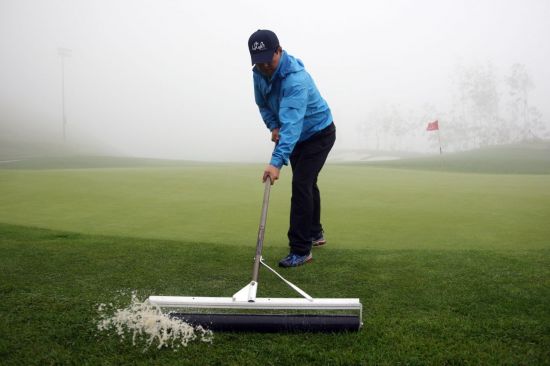
Be aggressive in bunker shots as well. Sand soaked with water is hard. With the clubface square, strike just behind the ball to gain sufficient distance. For putting, stroke boldly with the feeling of overshooting the hole. The friction from moisture is surprisingly strong. Golf courses do not mow the grass during the rainy season to prevent pests and diseases. Ignore small slopes and make strong putts that cut through the water flow.
It’s not over yet. Take care of your clubs after working hard in the rain. Remove moisture and debris from irons completely. Wash grips with lukewarm water and detergent. Wipe off moisture thoroughly with a dry towel, then roll them in newspaper and stand them up. Be careful to prevent rust inside the club shafts. Wipe wet caddie bags with a dry towel and store them in a well-ventilated place. After removing moisture from golf shoes, insert newspaper inside. Dry them in the shade to avoid deformation. Also, dry umbrellas and worn raincoats well.
© The Asia Business Daily(www.asiae.co.kr). All rights reserved.
![User Who Sold Erroneously Deposited Bitcoins to Repay Debt and Fund Entertainment... What Did the Supreme Court Decide in 2021? [Legal Issue Check]](https://cwcontent.asiae.co.kr/asiaresize/183/2026020910431234020_1770601391.png)

















