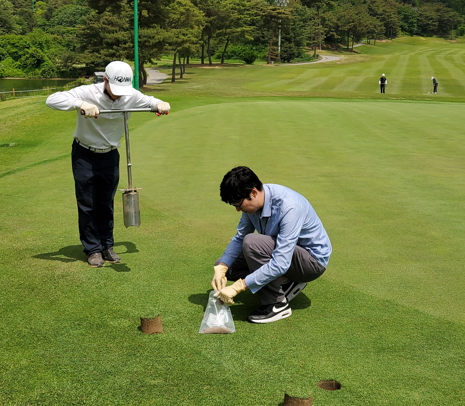
Gyeonggi Province will conduct pesticide residue inspections at golf courses within the province in the second half of this year.
On the 28th, the Gyeonggi-do Institute of Health and Environment announced that it will carry out pesticide residue inspections from July to September at 169 golf courses across the province.
For this purpose, the Institute will collect soil samples from the fairways and greens of the golf courses and test a total of 25 types of pesticides related to water quality in ponds, including final runoff water, such as carbendazim and chlorothalonil. In particular, chlorothalonil, which is widely used at domestic golf courses, has been added as a new item for monitoring starting this year.
The Institute plans to notify the relevant city and county authorities of the inspection results and take measures to impose fines of up to 10 million KRW under the Water Environment Conservation Act if highly toxic pesticides are used on golf course turf and trees.
Gwon Bo-yeon, director of the Gyeonggi-do Institute of Health and Environment, stated, "As pesticide use is increasing at golf courses to address landscaping management issues such as turf and trees, we will continue to conduct pesticide residue inspections on soil and final runoff water to do our best to protect residents' health and prevent environmental pollution."
Detailed information on pesticide usage and residue levels at golf courses can be found through the Ministry of Environment's Soil and Groundwater Information System (sgis.nier.go.kr).
© The Asia Business Daily(www.asiae.co.kr). All rights reserved.

















