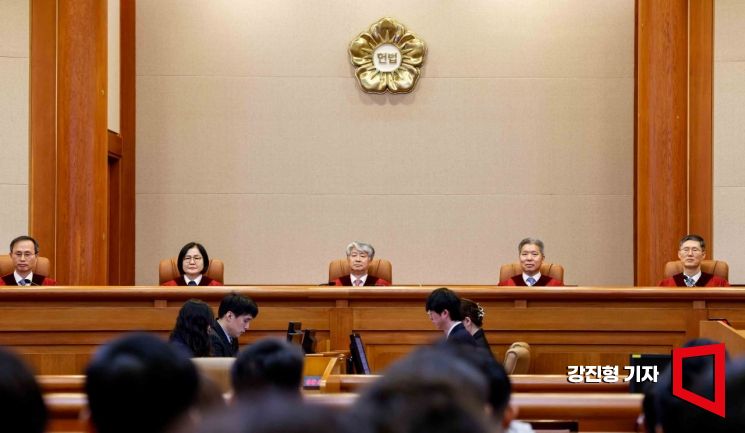
The Constitutional Court has ruled that the provision in the Public Official Election Act that punishes defamation against not only candidates but also those intending to become candidates excessively infringes on political freedom of expression and is unconstitutional.
On the 27th, the Constitutional Court decided by a 6 (unconstitutional) to 3 (constitutional) vote that the part of Article 251 (Defamation of Candidates) of the Public Official Election Act concerning 'persons intending to become candidates' is unconstitutional.
Article 251 (Defamation of Candidates) of the Public Official Election Act states, "A person who publicly states facts by speech, broadcasting, newspapers, communications, magazines, posters, campaign documents, or other methods with the purpose of electing or preventing the election of a candidate (including a person intending to become a candidate), his/her spouse, direct ascendants or descendants, or siblings, shall be punished by imprisonment for up to three years or a fine of up to 5 million won. However, if the facts are true and concern the public interest, no punishment shall be imposed."
The Constitutional Court judged, "It is difficult to see this as the minimum means to protect the honor of persons intending to become candidates or to achieve the legislative purpose of ensuring fair elections." It added, "This provision does not distinguish whether the 'defamation' content is false or true as long as it is factual. If the defamation against a person intending to become a candidate concerns true facts or facts that are not proven to be false, regulating this under the Public Official Election Act is an excessive restriction on political freedom of expression."
Furthermore, the Court stated, "If issues are raised about the public suitability of a person intending to become a candidate, rebutting such claims should allow voters to obtain information to properly assess the candidate's ability, qualifications, and morality. Nevertheless, punishing such acts under the defamation prohibition clause may lead to rampant lawsuits among those intending to become candidates, making future elections appear more disorderly and limiting voters' opportunities to obtain information to properly judge candidates' abilities, qualifications, and morality."
It concluded, "While the political freedom of expression restricted by the defamation prohibition clause is very significant and substantial, the public interest achieved by prohibiting defamation through factual statements, such as protecting honor or ensuring election fairness, is somewhat abstract and unclear, and it is difficult to see it as greater than the political freedom of expression restricted."
However, Justices Lee Jong-seok, Lee Eun-ae, and Jung Hyung-sik dissented, stating, "What this provision targets is merely slander, personal attacks, and black propaganda against persons intending to become candidates," and "Punishing such acts is a necessary restriction on the freedom of election campaigning and political freedom of expression."
The petitioner in this case, Mr. A, ran as a candidate in the 7th simultaneous local elections in June 2018 but was defeated. After being fined for publicly spreading false information and defaming other people who intended to run as candidates, he filed a constitutional complaint.
Mr. A also filed a constitutional complaint against Article 250, Paragraph 2 of the Public Official Election Act concerning the crime of spreading false information, specifically regarding "persons intending to become candidates who have publicly spread false information." However, the Constitutional Court unanimously ruled that "this provision is necessary to guarantee election fairness and does not excessively restrict political freedom of expression."
© The Asia Business Daily(www.asiae.co.kr). All rights reserved.
![Clutching a Stolen Dior Bag, Saying "I Hate Being Poor but Real"... The Grotesque Con of a "Human Knockoff" [Slate]](https://cwcontent.asiae.co.kr/asiaresize/183/2026021902243444107_1771435474.jpg)










