Statute of Limitations for Inheritance Recovery Claims under Civil Law: 10 Years
"Unconstitutionality of Article 999 Paragraph 2 and Part of Article 1014 of the Constitution"
The Constitutional Court has ruled that the current Civil Act, which applies a 10-year statute of limitations to the right to claim inheritance recovery when a child who becomes a co-heir after belatedly learning of the death of their biological parents claims the value equivalent to the inheritance share they should have originally received from other co-heirs, is unconstitutional.
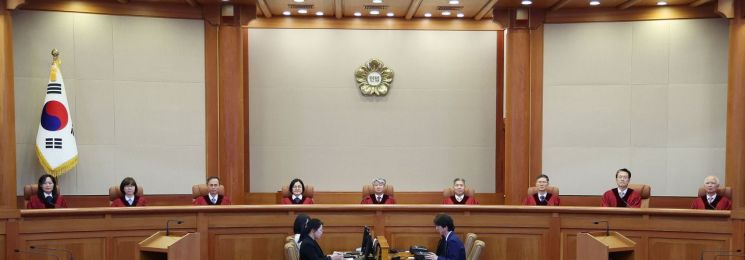 Chief Justice Lee Jong-seok of the Constitutional Court and the justices are seated in the Grand Bench of the Constitutional Court in Jongno-gu, Seoul, on the 27th.
 [Image source=Yonhap News]
On the 27th, the Constitutional Court decided by a 7 (unconstitutional) to 2 (constitutional) vote that the part of Article 999, Paragraph 2 of the Civil Act concerning Article 1014, which stipulates that the right to claim inheritance recovery expires 10 years after the date of the infringement of inheritance rights, violates the Constitution.
The petitioner, Ms. Kim (55, female), learned of her biological father’s existence in February 2019 from her mother. However, this was about 21 years after her biological father had already passed away in January 1998. In September 2020, Ms. Kim filed a lawsuit seeking recognition as the biological child of her deceased father, and the Seoul Family Court confirmed her status as a biological child in December 2021.
Article 1014 of the current Civil Act stipulates that when a person becomes a co-heir through recognition or a final court decision after the commencement of inheritance and requests the division of the inheritance property, if other co-heirs have already divided or otherwise disposed of the property, the new co-heir has the right to claim payment equivalent to their share of the inheritance. However, Article 999 of the Civil Act states that the right to claim inheritance recovery expires if '3 years have passed since the day the infringement was known, or 10 years have passed since the day the infringement of inheritance rights occurred.'
Ms. Kim’s case involves belatedly learning about her father who died 21 years ago. Since she was unaware of her biological father’s existence, she argued that it is impossible to hold her responsible for the '10 years after death' limitation, and that the relevant provision of the Civil Act, which deprives her of even the opportunity to recover inheritance, fundamentally blocks the right to inheritance recovery. She filed a constitutional complaint in December 2021.
The Constitutional Court stated, "From the perspective of existing co-heirs who have already received the inheritance property, it may be distressing to have to return a portion of that property after a considerable period due to the addition of a co-heir through recognition or a final court decision." However, it explained, "The purpose of Article 1014 is to guarantee the inheritance rights of the newly added co-heir, even if belatedly, through an indirect and compromise form of 'claim for payment of value.' Completely depriving the possibility of exercising the right to claim payment of the inheritance share value contradicts the intent of Article 1014 of the Civil Act." The Court concluded that "the challenged provision exceeds the limits of legislative formation and infringes upon the petitioner’s property rights and right to request a trial."
However, Justices Lee Jong-seok and Lee Young-jin dissented, arguing that the relevant Civil Act provision does not infringe upon petitioner Ms. Kim’s property rights or right to request a trial. The two justices pointed out, "If the right to claim payment of the inheritance share value could be exercised against existing co-heirs even after 10 years have passed since the infringement of inheritance rights, existing co-heirs would have no way to predict when a new co-heir might appear and exercise their rights even after 10 years." They further noted, "This would cause unexpected financial losses after the inheritance property has already been divided or disposed of, resulting in indefinite instability of legal status."
© The Asia Business Daily(www.asiae.co.kr). All rights reserved.

















