"Undecided on Whether to Lower the Top Tax Rate"
Deputy Prime Minister and Minister of Economy and Finance Choi Sang-mok on the 27th identified inheritance tax as the most urgent issue among discussions on the reform of comprehensive real estate tax, corporate tax, and inheritance tax, stating that he is considering to what extent it will be reflected in the July tax law revision proposal.
At the Editors' Forum hosted by the Newspaper and Broadcasting Editors Association held at the Press Center in Jung-gu, Seoul, Minister Choi said, "If asked which is the most urgent, personally, the inheritance tax is something I need to think about more," adding, "Overall, the burden of inheritance tax is at a high level."
Minister Choi said, "The system itself has not been reformed for over 20 years, so there is a basic recognition that it needs to be rationally reformed," but refrained from specific comments, saying, "There are various opinions on which should be prioritized as urgent."
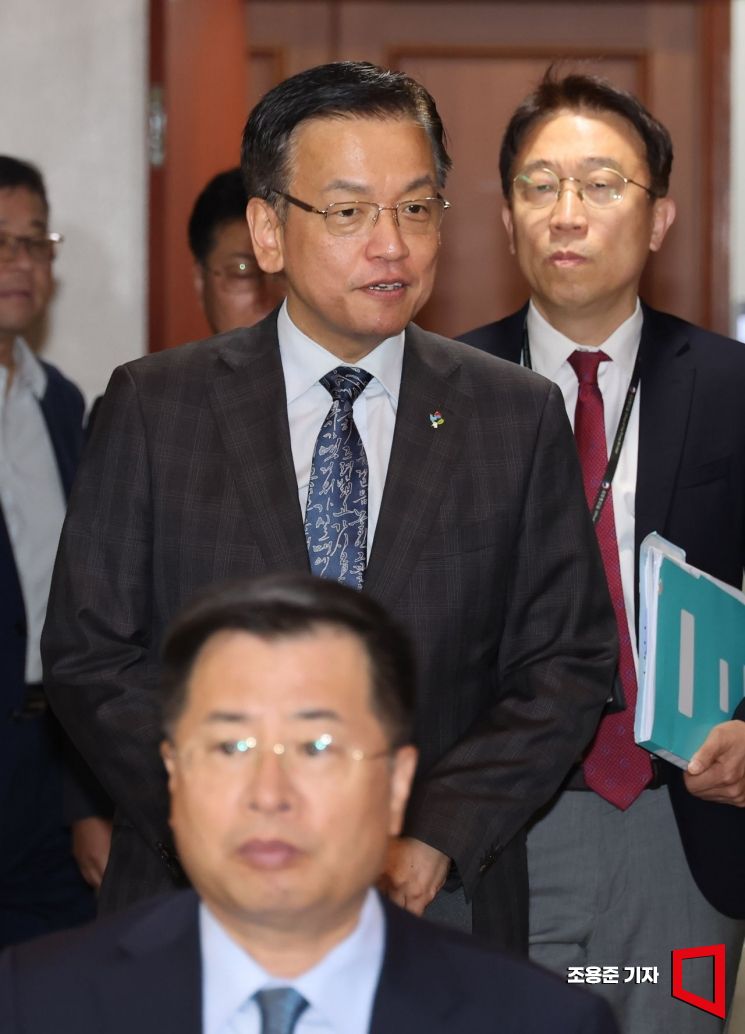 Choi Sang-mok, Deputy Prime Minister for Economic Affairs and Minister of Economy and Finance, is attending the 1st Supply Chain Stabilization Committee held at the Government Seoul Office in Jongno-gu, Seoul on the 27th. Photo by Jo Yong-jun jun21@
Referring to detailed issues of inheritance tax such as the major shareholder surcharge, business succession deduction, and conversion to inheritance acquisition tax, he said, "It is difficult to say now which tasks will be included," and added, "We will listen to opinions by distinguishing between urgent and non-urgent matters." Regarding the reduction of the top tax rate, he said, "I agree with the position that excessive parts should be eased in light of global standards," but maintained a cautious stance, saying, "It is still undecided whether the top tax rate part will be included in the tax law revision proposal."
Regarding the comprehensive real estate tax, he mentioned, "The burden has been greatly eased under this government, but there are many areas to improve in the overall system and other aspects," and about corporate tax, he said, "There has been controversy over whether it is high compared to global competition since the past."
On criticisms about revenue reduction due to tax cuts, he said, "If tax incentives that promote investment and consumption among economic agents are not supported, there will be no revenue reduction," adding, "It is expected to have positive effects while experiencing revenue reduction due to tax measures." He emphasized, "One might say that taxes should be raised because fiscal conditions are poor, but that is not the only answer," and added, "We are considering dividing the roles of fiscal expenditure, tax support, and tax expenditures to achieve positive effects."
Regarding the 'value-up' policy to increase corporate value, he said, "We are considering tax incentives," explaining, "It concerns corporate tax or dividend income tax issues related to shareholder return activities such as shareholder dividends and treasury stock cancellation."
Minister Choi said, "There are also talks about revising the Commercial Act regarding directors' duty of loyalty to shareholders," emphasizing, "It is natural that companies have concerns, but constructive discussions are important." He added, "If constructive discussions take place, consensus will be reached on improving governance," and emphasized, "We will discuss with related ministries and try to include it in policy."
When asked if there are plans to link the revision of the Commercial Act with tax policy, he drew a line, saying, "We will not do that." He also added, "The responsible department is the Ministry of Justice," and said that the process of discussing governance improvement itself could send a positive signal to foreign investors.
Minister Choi pointed out, "There are various reasons for the Korea discount, but fundamentally, the competitiveness of listed products on the stock market, that is, companies, is the most important," adding, "Corporate growth potential, profitability, and industry diversification are important, but looking at the changes in market capitalization over the past 10 years, the U.S. has changed a lot, but we have changed only two companies."
Forecasting inflation in the second half of the year to be in the low to mid 2% range, he said, "We will include structural efforts such as the agricultural and food distribution structure in the dynamic economy roadmap."
© The Asia Business Daily(www.asiae.co.kr). All rights reserved.
![Clutching a Stolen Dior Bag, Saying "I Hate Being Poor but Real"... The Grotesque Con of a "Human Knockoff" [Slate]](https://cwcontent.asiae.co.kr/asiaresize/183/2026021902243444107_1771435474.jpg)
















