The value of the Japanese yen has fallen to its lowest level in about 38 years, approaching the 161-yen range per US dollar. Earlier interventions by Japanese authorities to control the exchange rate have proven ineffective. There are also forecasts that if the US inflation data released later this week exceeds market expectations, the dollar-yen rate could reach 161-162 yen. It is assessed that unless the US Federal Reserve (Fed) cuts interest rates, it will be difficult for Japanese authorities’ interventions to reverse this yen depreciation trend.
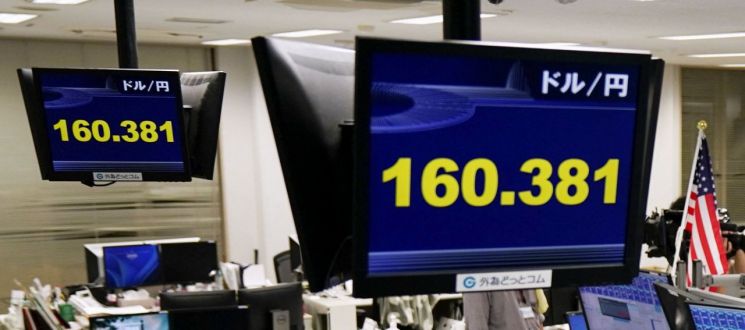
In the US New York foreign exchange market on the 26th (local time), the yen exchange rate briefly surpassed 160.8 yen per dollar. As a result, the yen’s value dropped to its lowest level since December 1986. The dollar-yen rate exceeding the psychological threshold of 160 yen is the first time in about two months since April 29. On the same day, the euro-yen rate also recorded 171.79 yen, marking the lowest yen value in the past two months. Despite verbal intervention by Masato Kanda, Director-General of the Japanese Ministry of Finance, who said "necessary measures will be taken against excessive movements," the yen depreciation trend could not be halted.
Notably, the yen’s value on this day fell even further compared to just before the Japanese authorities’ market interventions on April 29 and May 2. The Nihon Keizai Shimbun reported, "The effect of suppressing yen depreciation from the two market interventions has ended after two months," and described Japan’s attempt to prevent excessive yen depreciation despite a still-robust US economy and persistent US-Japan interest rate differentials as a miscalculation. According to the Bank of Japan, the scale of market interventions between April 26 and May 29 was approximately 9.7885 trillion yen (about 84.9367 trillion won). Immediately after, the effect of the market interventions partially appeared, and the yen’s value fluctuated from around 160 yen per dollar to the mid-150 yen range.
Recent analyses suggest that the yen depreciation trend will not stop until the US Fed eases its long-term monetary policy. While US economic indicators remain robust, Fed officials have issued warnings emphasizing caution regarding interest rate cuts due to concerns about inflation rebounding. On the previous day, Fed Governor Michelle Bowman stated, "It is not yet the appropriate time for rate cuts." Additionally, local assessments in Japan suggest that the authorities’ passive response is also fueling yen depreciation. Earlier, the market interpreted the Bank of Japan’s (BOJ) announcement to concretely decide on the scale of bond purchase reductions at the July meeting during the June meeting as dovish (favoring monetary easing).
Accordingly, evaluations suggest that additional interventions by Japanese authorities to defend the exchange rate will have little effect. Thomas Piotakis, Global FX Head at Barclays, also said, "Considering the previous intervention scale and its very short-term impact, repeated interventions do not hold much significance," and added, "As long as the US-Japan interest rate gap remains large, pressure on the yen will continue." Bob Sabaji, Head of Market Strategy at BNP Mellon Capital Markets, also pointed out that nothing will be effective until the Fed takes monetary easing measures, and even if additional interventions occur, they will not have a significant impact. He added that from a big-picture perspective, Japan’s dollar demand needs to decrease, but "Japan’s long-term interest rates need to rise sufficiently or US rates need to fall sufficiently, and neither is happening."
Currently, the market expects the yen exchange rate to fluctuate this week depending on the US Personal Consumption Expenditures (PCE) price index, an inflation indicator closely watched by the Fed. If the May PCE price index released on the 28th exceeds expectations, it could strengthen hawkish (favoring monetary tightening) forecasts surrounding the Fed and deepen yen depreciation to the 161-162 yen range per dollar. Some even predict that the 170 yen per dollar level is not far off. Vasilis Karamanis, FX strategist at Bloomberg Economics, noted, "If the dollar-yen rate breaks through 163 yen, it will be a trick for the Japanese Ministry of Finance."
Bloomberg News reported, "The US PCE price index will be a major catalyst for yen movements," and added, "The endless plunge in the yen’s value extremely demonstrates US financial dominance. Japan’s market intervention failure is all about the Fed." However, some foreign media also noted that with the Liberal Democratic Party leadership election scheduled for September, the government would likely want to actively defend the yen exchange rate.
© The Asia Business Daily(www.asiae.co.kr). All rights reserved.

















