"Self-Development Time Lacks Life Balance"
"Now Is the Time to Improve Efficiency"
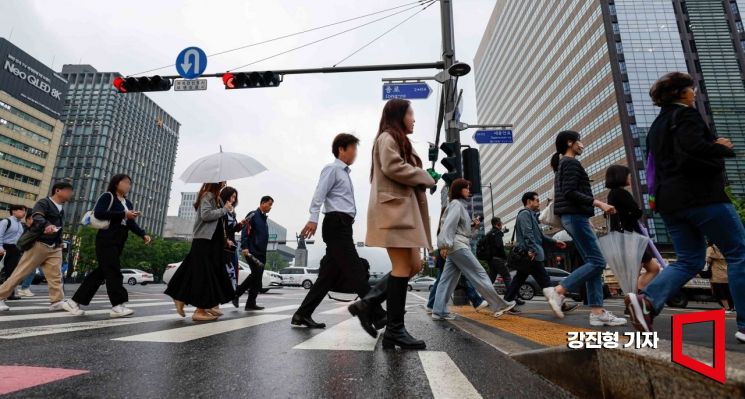 On the 7th, with rain falling for the third consecutive day, office workers who finished their holidays are heading to work at the Sejongno intersection in Jongno-gu, Seoul. Photo by Jinhyung Kang aymsdream@
Regarding the introduction of the four-day workweek, which has become a hot topic, Kim Jong-jin, director of the Working Citizens Research Institute, argued, "It is more important to work efficiently even if the working hours are shorter," while Kim Dae-jong, professor of business administration at Sejong University, emphasized, "If working hours are reduced and productivity and efficiency decline, South Korea's competitiveness will also fall."
On the 27th, Kim Jong-jin stated on CBS Radio's 'Kim Hyun-jung's News Show,' "It has been almost 30 years since the implementation of the five-day workweek," and pointed out, "In an aging society where health, quality of life, and caregiving have become important, we have no time for self-development or work-life balance." He added, "For a sustainable society, a change in the way we work, such as adopting a four-day workweek, is necessary."
Kim also explained, "It is more important to work efficiently even if for a shorter time," citing reports from British and American media that "experiments with a four-day workweek in 60 companies actually increased productivity by 1.4%."
On the other hand, Professor Kim viewed that if working hours are reduced, productivity will decline, leading to lower efficiency. He pointed out, "South Korea's productivity ranks among the lowest among the 35 OECD countries," and criticized, "Korean workers drink coffee and run bank errands during working hours." He further explained, "The reason many companies like Hyundai Motor and Naver have abolished remote work and returned to office work is that efficiency was only about 70% of the previous level."
Professor Kim also emphasized that the four-day workweek is premature, mentioning that half of all Korean workers are divided into regular and irregular employment, and that 88% of all workers are employed by small and medium-sized enterprises. He predicted, "While public officials and public enterprises might benefit from a four-day workweek, small and medium-sized enterprises will face even more difficult situations."
© The Asia Business Daily(www.asiae.co.kr). All rights reserved.

![Clutching a Stolen Dior Bag, Saying "I Hate Being Poor but Real"... The Grotesque Con of a "Human Knockoff" [Slate]](https://cwcontent.asiae.co.kr/asiaresize/183/2026021902243444107_1771435474.jpg)















