Launch of Supply Chain Stabilization Committee on the 27th
100 Additional Economic Security Items Designated for Management
5 Trillion Won Fund to Be Established in the Second Half of the Year
The government held the first meeting of the Supply Chain Stabilization Committee to prevent a second element water crisis, deciding to increase the number of economic security items requiring supply stability from 200 to 300 and to establish a fund worth 5 trillion won. Tax benefits will also be promoted to secure stable resources. Financial support plans will be prepared for domestic production of key items such as graphite.
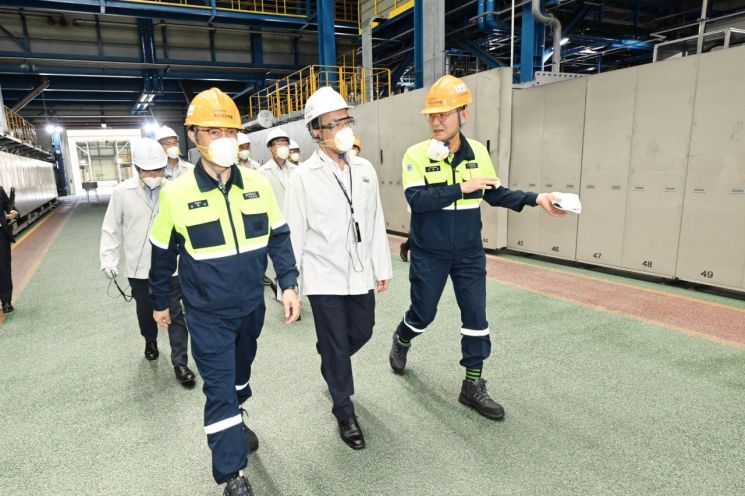 Deputy Prime Minister and Minister of Economy and Finance Choi Sang-mok visited the POSCO Future M Sejong Plant located in Sejong City on June 24 to promote self-reliance in raw materials for core industries (secondary batteries). He toured the production process and listened to explanations from related personnel.
Choi Sang-mok, Deputy Prime Minister for Economy and Minister of Strategy and Finance, held the first meeting of the Supply Chain Committee at the Government Seoul Office on the 27th. The Supply Chain Committee is a pan-government control tower established to formulate economic security policies such as securing global supply chains. It was launched on this day to systematically manage materials, equipment, software, etc., that have a high dependency on specific countries or regions overseas. The committee is chaired by the Deputy Prime Minister for Economy and consists of 25 members in total, including 19 government members and 6 private members. The Supply Chain Committee is composed of the Economic Security Items Service Expert Committee, the Foreign Economic Strategy Expert Committee, and the Stockpile Expert Committee.
At the first meeting held that day, the Supply Chain Committee decided to systematize the approximately 200 economic security items that had been managed arbitrarily and increase them to 300. Until now, about 200 items including graphite have been managed arbitrarily, but 100 additional items in manufacturing, defense, and livelihood sectors will be added. Services will also be included as economic security item services. Two new fields, logistics (shipping and aviation) and cybersecurity, will be newly included in the management targets.
The 300 economic security items will be reviewed annually, and new designations will be made. The item designation criteria, which had been managed sporadically, will be re-verified annually based on factors such as foreign dependency and the possibility of domestic production and import substitution. This is to prevent supply disruptions by considering changes in domestic and international economic conditions and environments. Going forward, target items will be evaluated by risk level and classified into three stages for response. For industries with absolute dependency on specific countries and where domestic production and alternative imports are difficult, performance goals will be set and pan-government measures will be established.
However, the specific items and services managed by the Supply Chain Committee will not be disclosed to the public. Economic security items refer to materials, raw materials, parts, software, etc., with high import dependency on specific countries or regions. Publicly listing the supply of items with high foreign dependency that are essential for stable economic operation or citizens’ lives could adversely affect our economy.
Plans for domestic production of key items such as element water will also be prepared. Choi Ji-young, Director of International Economic Management, stated, “Domestic production of element water has been difficult due to environmental aspects,” and added, “We will review support measures for domestic production.” Financial support plans will also be created to enable domestic production of key items such as graphite and anhydrous hydrofluoric acid.
Tax benefits will also be promoted. The requirements for investment tax credits for acquiring overseas resources through foreign subsidiaries will be relaxed. Currently, tax benefits are provided by deducting 3% of the investment amount from corporate tax only for overseas subsidiaries 100% invested solely by Korean companies; this shareholding requirement will be eased. When resources produced through overseas resource development by our companies are introduced domestically, plans to provide tariff benefits will also be reviewed. Specific tax benefit plans will be included in the tax law amendment bill to be announced next month.
A 5 trillion won Supply Chain Stabilization Fund will also be launched in the second half of the year. The fund will select companies contributing to the introduction, production, and provision of economic security items designated by the Supply Chain Committee as ‘leading operators’ and provide focused support. The fund will support costs incurred by these companies to diversify supply chains or expand stockpile volumes.
© The Asia Business Daily(www.asiae.co.kr). All rights reserved.

















