UNIST Professors Choi Wonyoung and Min Seungkyu's Team Develops Nano-Level Controllable Metal-Organic Framework
A new solid material that can be controlled at the nanometer scale has been developed.
This breakthrough is expected to open new prospects in specific fields such as digital data storage, where precise mechanical movement is required.
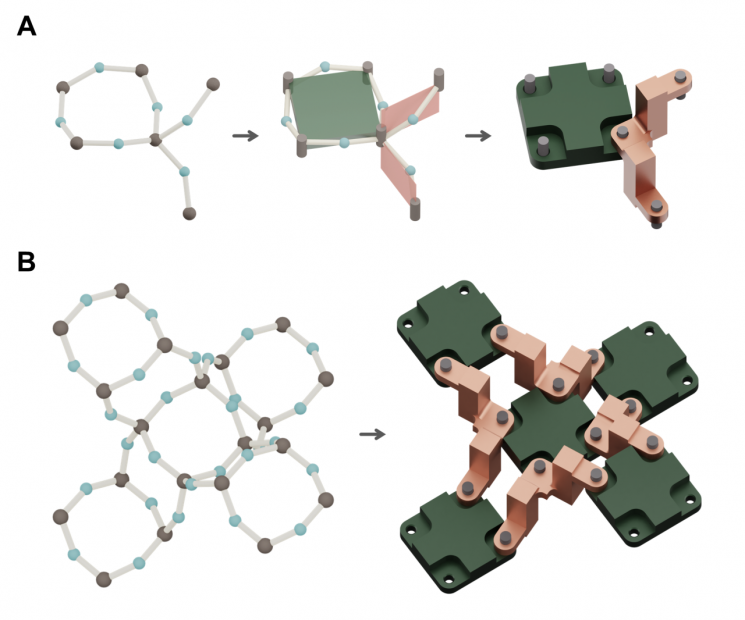
The research teams led by Professor Choi Wonyoung and Professor Min Seungkyu from the Department of Chemistry at UNIST (President Lee Yonghoon) have developed a metal-organic framework (MOF) that operates like a machine. They demonstrated that by replacing molecular-level machine components, the mechanical movement can also be precisely controlled at the nanoscale.

Driven by the needs of everyday life and various industries, machines have continuously evolved. While the design of molecular-scale devices has improved their mechanical properties, controlling machines composed of solid-state molecular structures remains a significant challenge.
The research team selected appropriate metal nodes and organic ligands to create a mechanical linkage framework, where each square block is connected by linking parts. The developed metal-organic framework, a zeolitic imidazolate framework (ZIF), can be assembled into various structures depending on the characteristics of its constituent components.
By measuring the diffraction phenomenon of X-rays, which are waves like radio waves or light, the team confirmed that the developed framework moves like a machine. The framework exhibited the ability to convert rotational motion into linear motion in response to temperature changes and solvent molecules.
They also confirmed that by replacing the connecting parts of the machine, precise movement at the nanometer scale could be controlled. The framework made with zinc metal nodes and imidazole organic ligands showed the highest elasticity and flexibility among metal-organic frameworks.
The researchers analyzed that these unique mechanical properties are due to the mechanical linkage structure of the fabricated ZIF. Even when using the same materials, the flexibility of the framework varies depending on how the components are connected.
Such characteristics are typical of machines that assemble parts in various forms to achieve desired movements, and are expected to be widely utilized in the field of nanomaterial development.
Nam Juhan, the first author and researcher, stated, "Through this study, we discovered new possibilities for designing porous solid machines that can be controlled at the molecular level. By understanding the motion of ZIFs, we have suggested potential applications in various fields where nanoscale mechanism control is essential."
Professor Choi Wonyoung commented, "Realizing machine-like movement at the molecular level means we have discovered a new material with unique mechanical properties. Further exploration of various molecular machine components and the operating principles of mechanical linkage structures will open new avenues in specific applications such as digital data storage."
The research results were selected as a Hot Paper and published online on June 14 in Angewandte Chemie International Edition, a prestigious journal in the field of chemistry. The research was supported by the National Research Foundation of Korea (NRF), the Korea Evaluation Institute of Industrial Technology (KEIT), and UNIST.
The research team included Nam Juhan, Jin Eunji, Lee Suchan, and Cho Hyejin from Professor Choi Wonyoung's group, and Kim Seokjin from Professor Min Seungkyu's group as a joint participant.
© The Asia Business Daily(www.asiae.co.kr). All rights reserved.


















