Rapid Thermal Runaway Reaching 1000 Degrees in Seconds
33% of Electric Vehicle Fires Occur While Parked or Stopped
Underground Parking Lots Hinder Fire Truck Access, Increasing Damage
Office worker Nam Mo-ssi (29) decided to postpone purchasing an electric vehicle after watching the fire incident at the Arisel factory in Hwaseong-si, Gyeonggi-do, which occurred on the 24th. Nam said, “I have always hesitated to buy an electric car because I felt uneasy after seeing fire-related news about electric vehicles,” adding, “After witnessing the battery factory fire this time, my anxiety grew even more, so I am considering other options instead of an electric car.”
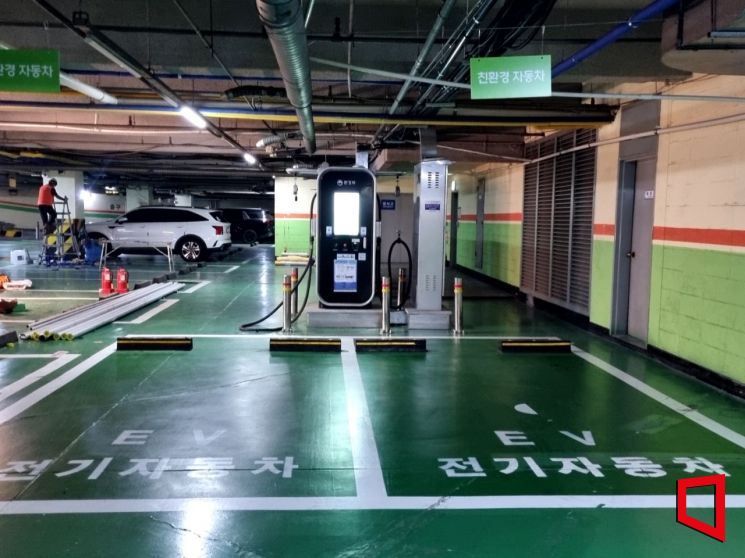 An electric vehicle charging station installed on the basement level 1 of a building in Dadong, Jung-gu, Seoul. Although the area around the charging station was checked, no fire extinguishing equipment for electric vehicle fires was found.
 [Photo by Seongah Sim]
Housewife Han Mo-ssi (56) also felt increased anxiety after seeing the factory fire news and suddenly recalling the underground parking lot of her apartment. Han said, “Over the past few years, the number of electric vehicles charging in the apartment’s underground parking lot has noticeably increased, but I often saw cars parked at charging stations long after charging was completed,” expressing her concern, “Seeing the fire spread instantly in the factory fire CCTV footage, I worry that electric vehicles left unattended at charging stations might lead to accidents.”
Recently, the danger of lithium has become a hot topic due to the Arisel factory fire. Lithium is used in rechargeable lithium batteries found in cameras, laptops, and computers. Especially with the commercialization of electric vehicles, lithium demand has surged to the extent that it is called “white oil.” According to the Ministry of Land, Infrastructure and Transport, a total of 591,597 electric vehicles were registered nationwide as of last month. According to data from the National Fire Agency, about 18% of electric vehicle fires from 2021 to 2023 occurred during charging, and about 33% occurred while parked or stopped.
In fact, in November last year, a fire broke out in an electric vehicle charging in a residential parking lot in Hamdeok-eup, Jeju-si, and it took about three and a half hours to fully extinguish. In June last year, an electric vehicle caught fire within three seconds after colliding with the tollgate shock absorber at the West Busan tollgate on the Namhae Expressway in Gangseo-gu, Busan. The driver and one passenger both died inside the vehicle in this accident.

Batteries containing lithium experience a “thermal runaway” phenomenon where the temperature rapidly rises to 1000 degrees Celsius. Lithium is difficult to extinguish with water during a fire and produces flammable gases, increasing the risk. When lithium comes into contact with water, gases generated during the chemical reaction expand, causing secondary damage. Also, even if the fire appears to be out, heat continues to be generated inside, requiring a long time to fully extinguish. According to the Gyeonggi-do Fire and Disaster Headquarters, the Arisel factory fire took about 22 hours to be completely extinguished.
When an electric vehicle fire occurs in an underground parking lot, the damage is even greater. According to the National Fire Research Institute, specialized equipment such as suffocation fire blankets, mobile water tanks, and overhead spray monitors are necessary to respond to electric vehicle fires. Rapid on-site entry by firefighters equipped with such equipment is crucial, but underground parking lots are disadvantageous for fire trucks to enter, potentially delaying firefighting efforts.
Professor Lee Ho-geun of the Department of Future Automotive Studies at Daeduk College pointed out, “The biggest problem is that there is currently no efficient method to extinguish electric vehicle fires,” adding, “When a fire breaks out, there is no way other than waiting for the thermal runaway phenomenon to end after the battery’s energy is fully expended.”
He also advised, “Charging electric vehicle batteries to about 85% and avoiding the use of rapid chargers can prevent up to 99% of fires,” recommending, “It is better to park electric vehicles above ground and use slow chargers more frequently rather than rapid chargers.”
© The Asia Business Daily(www.asiae.co.kr). All rights reserved.
![Clutching a Stolen Dior Bag, Saying "I Hate Being Poor but Real"... The Grotesque Con of a "Human Knockoff" [Slate]](https://cwcontent.asiae.co.kr/asiaresize/183/2026021902243444107_1771435474.jpg)

















