Professor Ban Kwonsu of Dong-A University Presents on 'China Sponge City'
Design Strategies for Climate Change Adaptive Waterfront Spaces
Busan Metropolitan City Corporation (BMC, President Kim Yonghak) announced on the 26th that it held the 4th meeting of the ‘BMC Waterfront City Working Group’ on the 17th, under the theme ‘Exploring Climate Change Adaptive Waterfront Space Design Strategies through China’s Sponge City Case Studies’.
This working group was launched in March this year to explore sustainable waterfront space creation plans with resilience and adaptability that can be practically applied to development projects planned by the corporation. The group holds regular monthly meetings.
The 4th meeting was held under the theme ‘Exploring Climate Change Adaptive Waterfront Space Design Strategies through China’s Sponge City Case Studies,’ presented by Professor Ban Kwonsu from the Department of Landscape Architecture at Dong-A University.
Professor Ban introduced cases of China’s sponge city, including policies and integrated urban water management projects such as Xi'an Fengxi New Town, Xi'an Annan Ecological Park, and Qingyang District Wastewater Circulation Project.
He then proposed climate change adaptive waterfront space creation strategies based on climate change impact assessments that evaluate the vulnerability of Korea’s waterfront areas and predict potential damages caused by climate change.
Professor Ahn Byungcheol from the Department of Forest Landscape Architecture at Wonkwang University argued that Busan has the potential to implement a sponge city by utilizing its rivers and coastlines, and that technological advancements such as retention and exclusion systems capable of absorbing water and mitigating extreme rainfall and floods are necessary.
Professor Kwon Taejeong from the Department of Urban Planning Engineering at Dong-A University emphasized the need to introduce the concept of Low Impact Development (LID) from the land use planning stage and to review designs that utilize waterfront green spaces and roads as a single retention area.
Han Youngsook, CEO of Site Planning Co., Ltd., explained that establishing a water quality and flood control management system in Korea is a prerequisite for developing an advanced water management system. She added that, as seen in China’s sponge city cases, a structural approach combining national tasks is effective when waterfront space development and urban ecosystem restoration are integrated across architecture, landscape architecture, and urban planning.
Professor Shim Jisoo from the Department of Landscape Architecture at Pusan National University stated that in order to benchmark large-scale projects like China’s sponge city, Korea must prepare technical management measures and consider drainage systems that address external flooding and sea level rise in Busan’s waterfront areas.
Kim Yonghak, President of Busan Metropolitan City Corporation, said, “Busan also needs to establish an integrated water management system focused on flood prevention and water resource management through the absorption, storage, and reuse of rainwater within the city. Through the operation of the working group, we will continue to discover innovative policies and ideas to respond to climate change and do our best to develop into a sustainable waterfront city.”
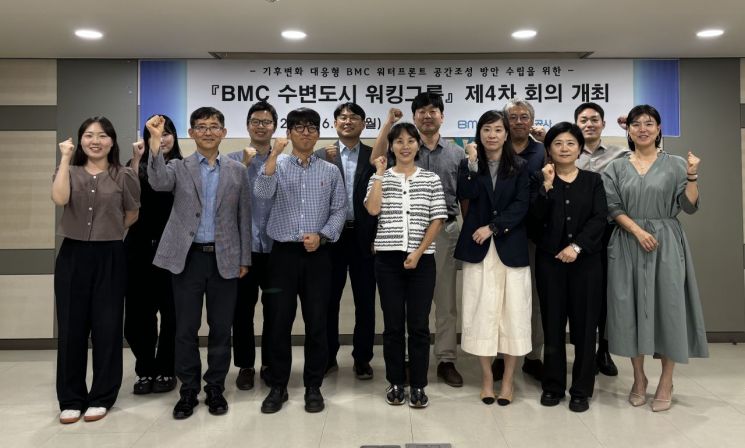 Busan Urban Corporation is holding the 4th meeting of the 'BMC Waterfront City Working Group' and taking a commemorative photo.
© The Asia Business Daily(www.asiae.co.kr). All rights reserved.

















