Preparation and Community Unity Turned Crisis into Opportunity.
Focused Administrative Efforts on Securing National and Provincial Budgets... Secured 240.5 Billion KRW for 88 Projects
Emerging as a Key Tourist Destination in Yeongam-gun Even After Sangdaepo Festival
Selected for Two Consecutive Years in the 8th Local Government Term with the Highest 'SA' Grade in Pledge Implementation Evaluation
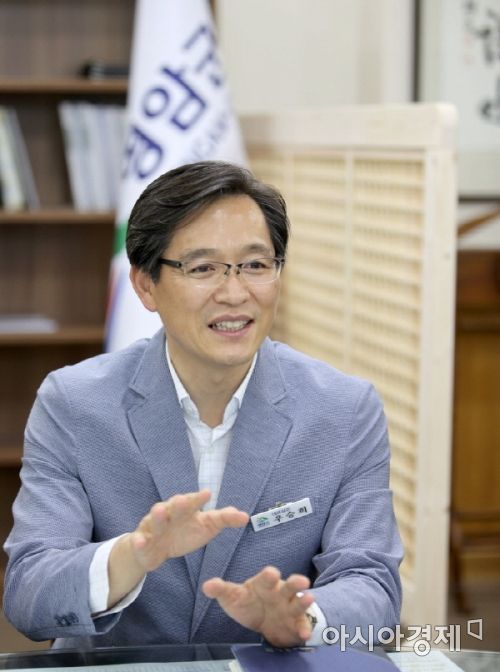
In July 2022, the 8th term of the Yeongam County government (Governor Woo Seung-hee) was launched under the slogan "A Greater Yeongam Leaping Forward through Innovation." The goal of Yeongam County's innovation and leap was to create a city where ordinary citizens live well and to realize the common sense that "citizens are the owners of county administration."
Over the past two years, Yeongam County's innovation has brought remarkable changes to the local community, boosting the pride of its citizens. The county's preparation and the unity of the local community turned crises into opportunities, and familiar resources of Yeongam added new value.
In particular, the quality of life for Yeongam citizens has undergone a qualitative transformation. Innovation accelerated the long-delayed changes in Yeongam, and the county kept its promises to its citizens well.
The pride of Yeongam citizens has increased.
Yeongam Wangin Cultural Festival was selected as Korea's representative cultural tourism festival for four consecutive years; the rate of Hanwoo (Korean beef) grade 1+ or higher reached 77%, ranking first in Jeollanam-do; it won the grand prize at the 2023 Korea Rice Festa; the Yeongam Moonlight Festival was selected among Korea's Top 100 Night Festivals; and in 2024, it swept three weight classes at the Gangneung Dano Jangsa Ssireum (Korean wrestling) competition. Over the past two years, Yeongam citizens had many reasons to hold their heads high.
Previously considered a peripheral area, Yeongam County has attracted nationwide attention in various fields since the 8th term. Supporting this, the official Yeongam County Instagram and other SNS subscribers increased by 258% from 14,158 in 2022 to 36,530 in 2023. Last year, the average monthly number of Yeongam County SNS searches exceeded 6,700, a 38.4% increase compared to the previous year.
This nationwide interest was directly reflected in the hometown love donation fund raised by Yeongam County last year. Yeongam County collected 8,794 cases amounting to 1.236 billion KRW, ranking second among all basic local governments nationwide and third overall among basic and metropolitan governments.
Yeongam County's unique hometown love fund thank-you gifts and fund utilization projects also attracted great attention. The "Yeongam County Folk Ssireum Team Champion Meal Date Ticket" and "F1 Racer and Circuit Experience Ticket" were popular as creative thank-you gifts making full use of local resources. The hometown love fund utilization project "Mom's Movie Theater," which invited village elders aged 65 and over to a theater in Yeongam-eup to watch movies, was reported in national daily newspapers, making donors proud.
Yeongam County's preparation and local community unity turned crises into opportunities.
Last year, the central government drastically cut local allocation tax. While most local governments nationwide complained of financial difficulties, Yeongam County boldly opened the era of an 800 billion KRW budget. Despite budget expansion, it maintained a sound fiscal policy with zero debt.
Additionally, to overcome low financial independence, administrative efforts focused on securing national and provincial subsidies. As a result, Yeongam County secured a budget of 240.5 billion KRW for 88 projects and is steadily progressing with long-awaited projects for its citizens. This amount is more than three times the 78.7 billion KRW secured two years ago.
Notable achievements include 40 billion KRW for the National Mahan History and Culture Center, 28.2 billion KRW for the Ministry of Agriculture, Food and Rural Affairs' Rural Agreement, 17.8 billion KRW for Wolchulsan Ecological Exploration Center, 15 billion KRW for the Safety Experience Center, 23.5 billion KRW for comprehensive flood damage living area maintenance, 22 billion KRW for natural disaster risk improvement district maintenance, and 15.2 billion KRW for the regional specialized rental smart farm project.
First, Yeongam County won the fierce competition among several local governments from Chungcheong-do to Jeolla-do in a public contest to attract the Cultural Heritage Administration's "National Mahan History and Culture Center." In this process, Yeongam County's thorough preparation and the united strength of the local community shone. Above all, the joint effort of local companies, organizations, and the Yeongam County Council in the battle to attract the National Mahan History and Culture Center, the foothold of "Mahan's heart, Yeongam," was crucial. It is said that the unified voice of the local community greatly influenced the Cultural Heritage Administration's decision.
The National Mahan History and Culture Center, which will become a research cluster for Mahan studies, will be established in 2027 in Nabul-ri, Samho-eup, on a 40,000㎡ site with one basement floor and two above-ground floors, totaling 10,000㎡ in floor area. It will be developed as a comprehensive cultural space equipped with archives, a cultural heritage specialized library, research and education facilities, and exhibition and experience halls.
Yeongam County, selected as the site for the National Mahan History and Culture Center, also succeeded in attracting the Wolchulsan National Park Ecological Exploration Center. Here too, the synergy effect of Yeongam County's public and private sectors' attraction activities became a catalyst for rewriting history 35 years after Wolchulsan was designated a national park in 1988.
With the ecological exploration center, by 2026, an ecological resource experience facility equipped with education halls, living quarters, and natural playgrounds will be established near the Wangin Doctor Historic Site in Donggurim-ri, Gunseo-myeon, Yeongam County. These facilities will provide ecological welfare services combining education, tourism, and welfare based on the ecology of Wolchulsan National Park to visitors from across the country.
Yeongam County, selected for the rural agreement last year, signed an agreement with the Ministry of Agriculture, Food and Rural Affairs in April this year. A total regional investment of 40.3 billion KRW, including 28.2 billion KRW in national funds, will be made. The projects include revitalization of central areas in Yeongam-eup and Deokjin, Geumjeong, Sinbuk, Sijong, Dupo, and Gunseo-myeon, establishment of basic living bases, and provision of rural care services.
With the selection of the regional specialized rental smart farm project, a total project cost of 22.7 billion KRW, including 15.2 billion KRW in national and provincial funds, will be invested. By next year, 4.4 hectares of rental smart farms and 3.4 hectares of infrastructure will be established in Jangseon-ri, Deokjin-myeon. This smart farm, which will be a cradle for youth entrepreneurship, will cultivate high-demand crops such as tomatoes, melons, paprika, and cucumbers.
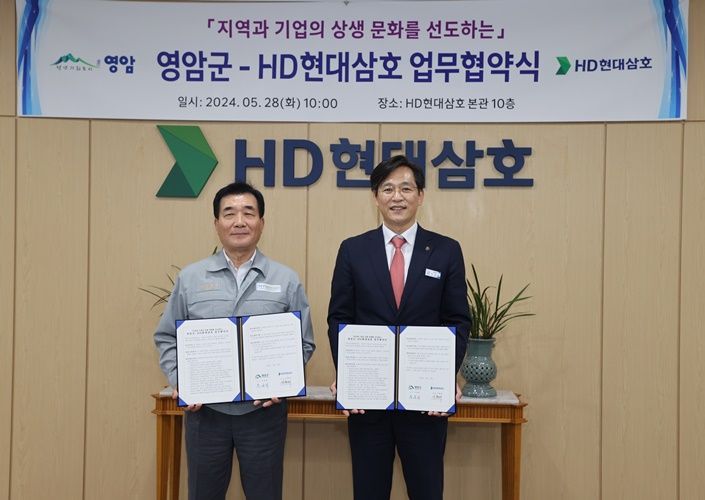 Yeongam-gun is signing a win-win cooperation agreement with HD Hyundai Samho and taking a commemorative photo. [Photo by Yeongam-gun]
New value was added to familiar resources.
While attracting external innovation resources such as national and provincial subsidies, Yeongam County added new value to internal local resources. The outstanding ecological environment of Wolchulsan and Yeongsan River, and the skilled citizens producing top-quality agricultural and specialty products from fertile land, have met the necessary conditions for revitalizing the local economy but have not been sufficient conditions.
Because a significant portion of the added value generated from good ecological environments and agricultural specialty products was leaking out to the metropolitan area and large cities, revitalizing the local economy was elusive. This is why Yeongam County focused on the "local circular economy," which has emerged as the optimal solution for local economic revitalization.
The essence of the local circular economy, summarized as "Let's use our own first" or "self-reliance," is to organize the local economic ecosystem so that the added value produced within the region is first used for local consumption and investment. To this end, Yeongam County began to re-examine the familiar local resources.
First, this spring, the Yeongam Wangin Cultural Festival rediscovered Sangdae-po (상대포) in Gurim Village, Gunseo-myeon. Sangdae-po, an international port connecting China and Japan from Baekje to Joseon, had seen a decline in visitors after the creation of a historical park several years ago. Yeongam County installed nighttime landscape lighting there last year and held a night event during the Wangin Cultural Festival in March. Notably, the live landscape performance "Wolin Cheongang" was staged, along with the fireworks show "Nakhwa Yusu."
The transformation of Sangdae-po expanded the space of the Wangin Cultural Festival, which had been centered at the Wangin Doctor Historic Site. At the same time, it became a symbol of festival content diversification. Sangdae-po, showcasing its new appearance, is emerging as a key tourist destination in Yeongam County even after the festival. It is also gaining attention as a healing spot where Yeongam citizens can enjoy leisure under beautiful night lighting.
Last year, Yeongam County signed a win-win business agreement with the Daebul Industrial Complex Management Association to jointly work on expanding the resident population, hiring local talent, and discovering hometown love fund projects. In continuation, in May this year, it also signed a win-win business agreement with HD Hyundai Samho, a regional anchor company.
In both agreements, companies agreed to prioritize purchasing local agricultural specialty products such as Yeongam rice and to provide employee bonuses using Yeongam Love Gift Certificates, laying the foundation for the local circular economy. They also promised to invigorate the local community by prioritizing local talent employment, participating in public-private welfare services, and sharing talent donation resources.
The path for Yeongam companies and employees to prioritize consuming local agricultural specialty products has opened. As the saying goes, "Even if you have a thousand beads, they are treasures only when strung together," Yeongam farmers, despite producing top-quality agricultural specialty products nationwide, have always worried about sales channels. Now, under the name of the local circular economy, they can secure a strong market in the form of local companies.
Yeongam County requested that the Hotel Hyundai in Samho-eup also use the name "Yeongam." Until now, Hotel Hyundai included "Mokpo" in both its location and name. Despite having good tourism infrastructure, the reality that it could not say it was in Yeongam was a source of regret for local residents. It is anticipated whether Yeongam County's request will result in a direction satisfying both Hotel Hyundai and local residents. Furthermore, Yeongam County is also discussing marketing of specialty product gift sets and development of tourism products with Hotel Hyundai.
At the Acro Country Club in Geumjeong-myeon, Samho Makgeolli has been introduced, quenching the thirst of golf enthusiasts nationwide and serving as an ambassador promoting Yeongam. Yeongam Makgeolli, which took a place previously monopolized by Gwangju Makgeolli, is another symbol of the local circular economy taking root. This is also an unprecedented event in Yeongam County before the 8th term.
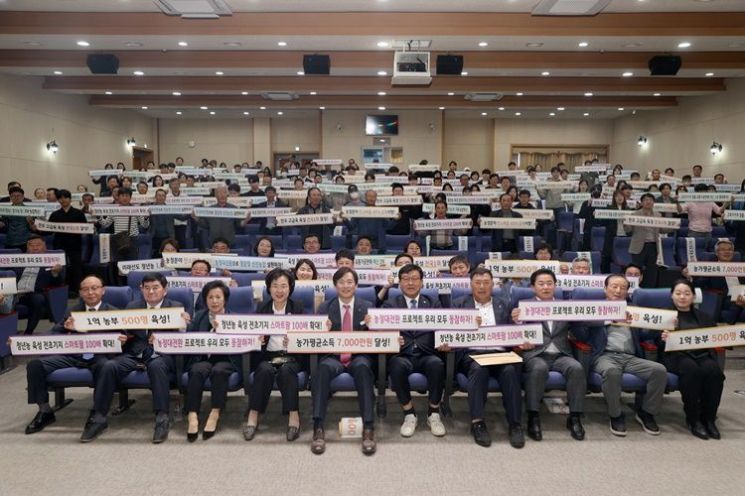 On the 19th of last month, a performance was held at the Yeongam County Office during the Yeongam Agricultural Policy Transformation Project public hearing. [Photo by Yeongam-gun]
The lives of Yeongam citizens have undergone a qualitative transformation.
The changes in the lives of Yeongam citizens during the 8th term are evident in various statistical figures. The ultra-poor households with a monthly average income below 500,000 KRW drastically decreased from 9.6% in 2021 to 2.7% in two years. During the same period, the high-income group earning over 4 million KRW per month increased by more than 10 percentage points from 14% to 24.7%, and the unemployment rate decreased from 2% to 1.3%.
At the same time, Yeongam County's integrity rating recovered to grade 2. The reduction of ultra-poor households and increase in high-income groups are indicators of resolving social polarization and evidence that the lives of Yeongam citizens are undergoing a qualitative transformation.
Expansion of transportation infrastructure supporting internal movement within Yeongam County has also greatly contributed to improving quality of life. This year, Yeongam County introduced and operates the "Yeongam Call Bus," a demand-responsive transport system (DRT). This bus, which comes upon reservation, currently helps students in Samho-eup and workers in the Daebul Industrial Complex commute efficiently while achieving both budget savings and carbon emission reductions.
Innovation accelerated the delayed changes in Yeongam.
As indicated by the county administration slogan "A Greater Yeongam Leaping Forward through Innovation," the 8th term of Yeongam County opened with a focus on innovation. To invigorate the stagnant local community and promote the delayed changes in Yeongam, the innovation policy has been steadily pursued over the past two years.
A representative area where Yeongam County's innovation was effective is subsidies. The restructuring of expenditure budgets and enhancement of local fiscal soundness and efficiency in the 8th term attracted national attention. The Ministry of the Interior and Safety recognized Yeongam County's innovation with a ministerial award in the "Korea Local Finance Awards." Particularly, it gave high marks for innovation in subsidy management.
Yeongam County first stopped support for similar overlapping projects, projects with unclear effects, projects lacking demand, and over-supported projects. It raised the mandatory self-payment ratio for subsidy project participants and organizations to induce self-reliance and drastically reduced populist and event-type subsidy projects, tightening the reins of innovation toward sustainable projects. The county plans to continue this innovation policy going forward.
Innovation also solved long-standing issues that the local community had not resolved for decades. A representative case was last year's agreement with Yeongam Police Station, which laid the groundwork for fulfilling local residents' wishes to restore Yeongam Eupseong Fortress.
In 1986, Yeongam Police Station was built on the site of the old Yeongam Eupseong Fortress. After gathering local opinions, Yeongam County designated the current police station site as the core restoration site for Yeongam Eupseong Fortress. Furthermore, it sought a solution by providing a new site for construction and relocation and finalized the matter through an agreement with the police station. This innovation, achieved through resident opinion gathering and public institution cooperation, found a way for local cultural heritage and the citizens' safety institution to coexist.
The decision on the site for Yeongam Public Library is also an example of innovating conventions. Yeongam County changed the initial plan to relocate near Gichan Land in Yeongam-eup and moved the library site to the Gyodong district, where urban development was scheduled in 2022. This was in response to local opinions that the previous site had poor accessibility and that residents' opinions were not properly reflected in the site selection process.
During this process, Yeongam County held preliminary explanation meetings to gather residents' opinions and ensured resident participation in selecting the new site, correcting the wrong practice. Residents who were guaranteed participation in selecting important public facility sites realized that "citizens are the owners of county administration." Currently, the Yeongam Public Library is smoothly proceeding with construction procedures in the Gyodong district along with the Culture and Arts Center.
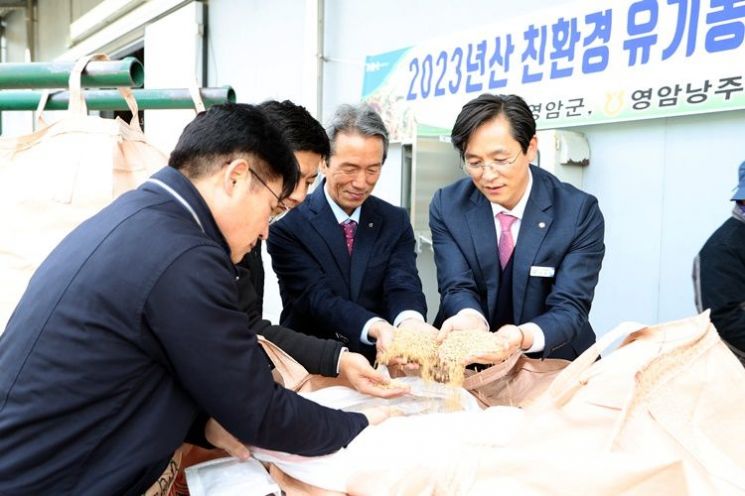 Last year, (right) County Governor Woo Seung-hee visited the first rice purchase site in Deokjin to inspect the anti-cancer rice paddy. [Photo by Yeongam County]
Yeongam County kept its promises to its citizens well.
The Korea Manifesto Practice Headquarters selected Yeongam County as the highest grade "SA" for two consecutive years in the 8th term in the evaluation of pledge implementation plans. Especially, last year, it awarded the grand prize at the national basic local government manifesto excellent case competition. This credible institution evaluated that Yeongam County's 8th term pledges are well-planned and that actual pledge implementation is progressing steadily.
Yeongam County's pledges for the 8th term include 120 projects in 10 fields, with a total investment of 1.4 trillion KRW including private capital. Over the past two years, 19 projects have been completed, including the Wolchulsan Moonlight Festival, establishment of Yeongam Energy Center and Yeongam Future Education Foundation, attraction of the Creative Convergence Education Center, establishment of Yeongam Culture and Tourism Foundation, and introduction of the Youth Training Center director position recruitment system. One hundred and one projects are underway. As of the end of last year, Yeongam County's pledge implementation rate reached 48%, significantly exceeding the national average of 31% for county areas.
Finally, Yeongam County is also preparing and promoting various blueprints to change the region's future. Representative projects include the Yeongam-type population policy "Yeongam Reconstruction Project," which aims to prevent population outflow and improve youth settlement conditions in response to local extinction; "A Good Yeongam to Raise Children," which supports and cares for life cycles from marriage to childbirth, childcare, and university; the "Agricultural Policy Great Transformation Project," a roadmap to increase farm income and leap forward as the number one sustainable agricultural life industry in Yeongam; and the "Yeongam-eup Compact City Development," aiming to restore Yeongam-eup's population to 10,000 by 2027.
As it has been from the launch to the second year of the 8th term, Yeongam County plans to continue blowing the winds of innovation throughout the local community over the next two years.
© The Asia Business Daily(www.asiae.co.kr). All rights reserved.



















