Additional Review of SoBuJang for National Strategic Technologies
Exemption from Preliminary Feasibility Study for Cluster Infrastructure Construction Project
The government will fully launch a semiconductor financial support program worth 18.1 trillion won next month to strengthen the competitiveness of the semiconductor industry. To foster 소재·부품·장비 (materials, parts, and equipment) companies, which are a weak point of the semiconductor industry, small and medium-sized enterprises (SMEs) and mid-sized companies will receive preferential interest rates up to 1.5 percentage points. Additionally, the semiconductor ecosystem fund currently being raised, amounting to 300 billion won, will begin equity investments starting next month.
On the 26th, the government announced the "Comprehensive Support Plan for the Semiconductor Ecosystem" at the Economic Ministers' Meeting chaired by Choi Sang-mok, Deputy Prime Minister and Minister of Economy and Finance. This measure concretizes the 26 trillion won semiconductor industry competitiveness enhancement plan announced at the Economic Issue Review Meeting chaired by President Yoon Seok-yeol on the 23rd of last month. It finalizes the details of the semiconductor financial support program, which accounts for 70% of the total project cost of 26 trillion won, amounting to 18.1 trillion won.
Industrial Bank to Start Loans Next Month with 2 Trillion Won Capital Increase... Up to 1.5 Percentage Points Preferential Interest Rate
The government will first implement low-interest loans worth 17 trillion won through the Industrial Bank next month. The Ministry of Economy and Finance stated, "By 2027, we will invest up to 2 trillion won in the Industrial Bank, including 1 trillion won in cash and 1 trillion won in kind, to establish a 17 trillion won low-interest loan program, and loans to semiconductor companies will begin next month." The loan limit will be supported up to the current Industrial Bank Act's credit limit for the same group, and the interest rate conditions will offer preferential rates of 0.8 to 1.0 percentage points for large corporations and 1.2 to 1.5 percentage points for SMEs and mid-sized companies compared to general loans. The support scale is larger for SMEs and mid-sized companies than for large corporations, focusing on fostering fabless (design) and 소재·부품·장비 SMEs rather than large-scale facility investments.
Together with the currently raised 300 billion won semiconductor ecosystem fund, an additional 800 billion won new fund will be raised, expanding the semiconductor ecosystem fund to a total of 1.1 trillion won. A Ministry of Economy and Finance official explained, "The semiconductor ecosystem fund, currently being raised at 300 billion won, will start equity investments next month to scale up fabless and 소재·부품·장비 companies," adding, "The new fund will raise up to 800 billion won by 2027, and additional expansion will be considered based on future corporate demand." The investment targets are fabless companies aiming for scale-up or mergers and acquisitions (M&A) in the 소재·부품·장비 sector, and the operating entity will be selected through a public offering later.

Tax Benefits: Adding '소부장' to K-Chips Act Under Review... Exemption from Preliminary Feasibility Study for Infrastructure Projects
The K-Chips Act (Tax Incentives Limitation Act), which expires this year, will be extended for three years and its application scope expanded. The government plans to complete a review within this year on whether to add advanced semiconductor 소재·부품·장비-related technologies to the scope of application through tax law amendments. Software rental and purchase costs, as well as rental fees for research and testing facilities, will also be added to the scope of application. For research personnel conducting both national strategic technology and general R&D, the tax credit will be apportioned based on research time.
Furthermore, about 5 trillion won will be intensively invested from 2025 to 2027 in areas such as research and development (R&D) and workforce training. To this end, the government aims to swiftly complete preliminary feasibility studies for large-scale R&D projects, including semiconductor-related mini-fab construction projects, and strengthen the demonstration and commercialization base of advanced semiconductors such as AI semiconductors by expanding artificial intelligence (AI) computing infrastructure.
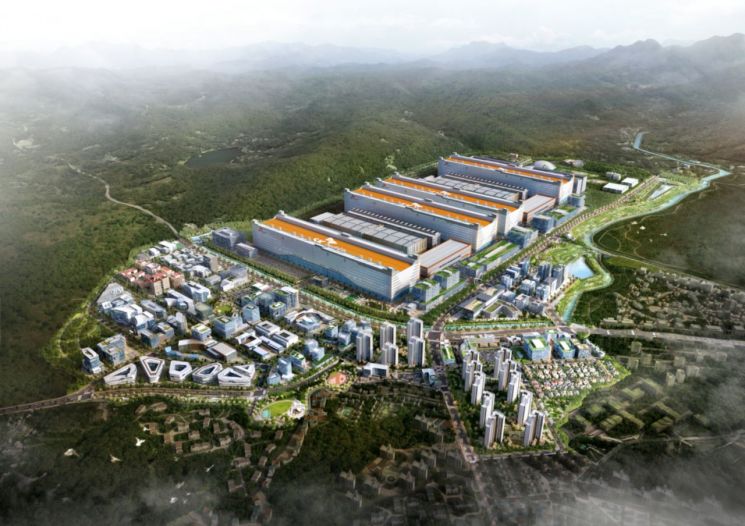
Finally, to accelerate the construction of the Yongin Semiconductor Mega Cluster, the government plans to exempt it from the preliminary feasibility study. The government has announced that it will drastically reduce the approval procedures related to the expansion of National Road No. 45 near the Yongin cluster and the construction of power transmission lines, cutting the construction period of the industrial complex from the originally expected seven years to half. To this end, the Ministry of Economy and Finance plans to pursue exemption from the preliminary feasibility study for the National Road No. 45 expansion and the integrated double-line pipeline construction project supplying water, and will share costs with related agencies such as the Korea Water Resources Corporation.
For power supply, in the first phase, an LNG power plant will be built within the industrial complex to supply 3GW of power, and in the second phase, a long-distance power transmission line will be constructed. The Ministry of Economy and Finance explained, "A detailed construction plan for the long-distance power transmission line will be established by the end of August, and the construction costs will be shared by public and private sectors."
© The Asia Business Daily(www.asiae.co.kr). All rights reserved.
![A Woman Who Jumps Holding a Stolen Dior Bag... The Mind-Shaking, Bizarre Con of a "Human Knockoff" [Slate]](https://cwcontent.asiae.co.kr/asiaresize/183/2026021902243444107_1771435474.jpg)

















