The Citizens' Coalition for Economic Justice Announces Analysis of Seoul Apartment Official Prices and Property Taxes
Seoul Apartment Official Price Realization Rate Rises from 60% Last Year to 65% This Year
Contrary to Government Freeze Policy
"Realization Rate Should Be Uniformly Applied at Over 80%" Demanded
This year, the official price realization rate (market price reflection rate) of apartments in Seoul increased by 5 percentage points compared to last year, according to an analysis. Although the government claimed to have frozen the realization rate at last year's level, the reality is different.
The realization rates varied among apartments without consistent standards, resulting in significant discrepancies in holding taxes. On the 26th, the Citizens' Coalition for Economic Justice (CCEJ) held a press conference at their auditorium in Hyehwa-dong, Jongno-gu, Seoul, to announce the results of their analysis on "Seoul Apartment Market Prices, Official Prices, and Holding Taxes," asserting these points.
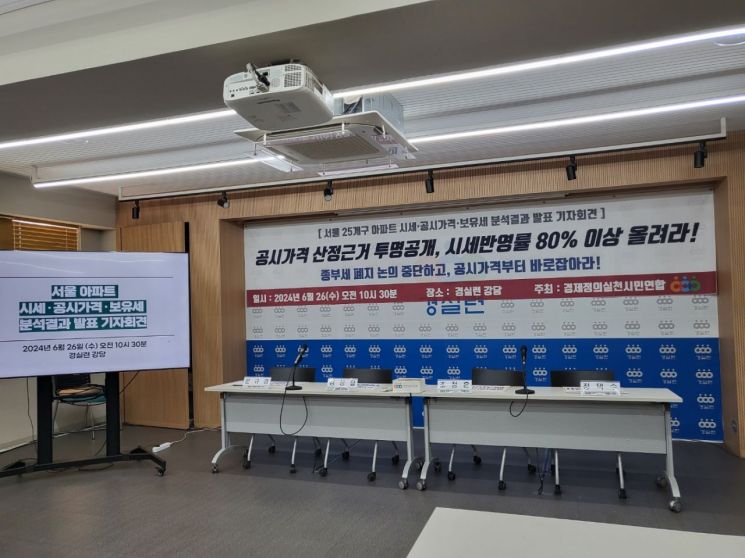 The Citizens' Coalition for Economic Justice (CCEJ) held a press conference on the 26th at the CCEJ auditorium in Hyehwa-dong, Jongno-gu, Seoul, to announce the analysis results of Seoul apartment market prices, official prices, and property taxes. Photo by Kwon Hyunji
"Seoul Apartment Realization Rate Reflected 5%p Higher"
According to CCEJ, the average realization rate for Seoul apartments this year was 65%, up 5 percentage points from 60% last year. CCEJ pointed out, "Although the government previously stated that the realization rate would be frozen, due to a sharp drop in official prices last year causing tax revenue shortages, they actually raised the official prices."
CCEJ's investigation found that last year's and this year's realization rates differed from the government's figures by 9 percentage points and 5 percentage points, respectively. The government had announced that it would apply a 69% realization rate (for multi-family housing) this year, the same as last year. The realization rate indicates how much the official price reflects the market price. For example, a 69% realization rate means that a house with a market price of 1 billion KRW would have an official price of 690 million KRW.
Differences in Realization Rates Among Apartments
The gap in realization rates among apartments in Seoul was also significant. For example, in Eunpyeong-gu, Eungam-dong, the "Baekryeonsan Hillstate 2nd Phase" had a market price of 750 million KRW this year, down 160 million KRW from 910 million KRW last year. However, the official price remained at 500 million KRW. The realization rate rose from 55% last year to 67% this year, an increase of 12 percentage points in one year.
On the other hand, in Seodaemun-gu, Bukahyeon-dong, "e-Pyeonhansesang Sinchon" saw its market price increase by 60 million KRW (from 1.31 billion KRW to 1.37 billion KRW) during the same period, but the official price only rose by 20 million KRW, causing the realization rate to drop from 65% to 63%, a 2 percentage point decrease. Additionally, in Dobong-gu, Banghak-dong's "Sindonga 1st Complex" and Gangseo-gu, Hwagok-dong's "Gangseo Hillstate" saw realization rates rise by 11 and 9 percentage points respectively during the same period, whereas in Yongsan-gu, Singye-dong's "Yongsan e-Pyeonhansesang" and Jungnang-gu, Sinnae-dong's "Sinnae Desiang Foret" each experienced a 1 percentage point decrease.
Arbitrary Realization Rates Lead to Varied Tax Burdens
CCEJ criticized that the arbitrary application of realization rates results in varying effective tax rates and holding tax burdens among apartments. Official prices are used as the basis for levying property holding taxes such as property tax and comprehensive real estate tax. Generally, as the realization rate increases, the official price rises, leading to a higher holding tax burden.
For example, in Gangdong-gu, Godeok-dong, "Godeok Raemian Hillstate" saw its effective tax rate increase by 0.04% this year compared to last year, resulting in an additional 520,000 KRW (from 1.33 million KRW to 1.85 million KRW) in holding taxes. Conversely, in Banghak-dong's "Sindonga 1st Complex," the effective tax rate decreased by 0.001% during the same period, but holding taxes increased by 30,000 KRW (from 640,000 KRW to 670,000 KRW). In Seocho-gu, Banpo-dong's "Banpo Xi" and Songpa-gu, Sincheon-dong's "Parkrio," realization rates each rose by 0.04%, resulting in additional holding taxes of 1.37 million KRW (from 8.8 million KRW to 10.17 million KRW) and 1.17 million KRW (from 2.55 million KRW to 3.72 million KRW), respectively.
CCEJ argued that the market price reflection rate should be applied equally to ensure tax fairness. Jeong Taeksu, head of CCEJ's Real Estate National Project Team, stated, "If tax assessment standards are applied arbitrarily, trust in policies will inevitably be severely damaged," and added, "The reflection rate for all real estate, including houses, buildings, and land, should be changed to apply at least 80% without exception." Jeong also urged fundamental improvements to the official price system, saying, "The fair market value ratio, which further distorts official prices that already have low market price reflection rates, should be abolished, and the basis and data for all real estate-related statistics should be transparently disclosed."
© The Asia Business Daily(www.asiae.co.kr). All rights reserved.
![Clutching a Stolen Dior Bag, Saying "I Hate Being Poor but Real"... The Grotesque Con of a "Human Knockoff" [Slate]](https://cwcontent.asiae.co.kr/asiaresize/183/2026021902243444107_1771435474.jpg)











