Wave of Condolences for Chinese Victims of Hwaseong Factory Fire
Unexpected Criticism of 'Minimum Wage' Erupts
In Hwaseong, Gyeonggi Province, where a fire broke out at a lithium primary battery factory resulting in the deaths of 18 Chinese workers, waves of mourning have spread across China, accompanied by growing criticism of China's minimum wage policies.
On the 25th, state-run media such as Huanqiu Shibao and Global Times reported, citing the Chinese Embassy in South Korea, that a preliminary investigation found that 17 Chinese nationals died in the lithium battery factory fire in South Korea the previous afternoon. The number of Chinese fatalities increased to 18 by the morning of the same day. In particular, Beijing News explained, "Among over 100 employees, most were ethnic Korean women in their 30s and 40s from Northeast China," adding, "Most of the victims who lost their lives were engaged in packaging and welding work on the second floor of the battery factory."
The tragic news from abroad has deeply saddened people in China as well. However, alongside the waves of mourning, unexpected criticism of China's labor policies has also emerged, drawing attention. On Chinese online platforms, posts such as "Why do Chinese workers, from the world's top manufacturing country, have to go abroad?" and "Reasons why Chinese workers go to South Korea mainly for IT jobs" continue to receive numerous comments.
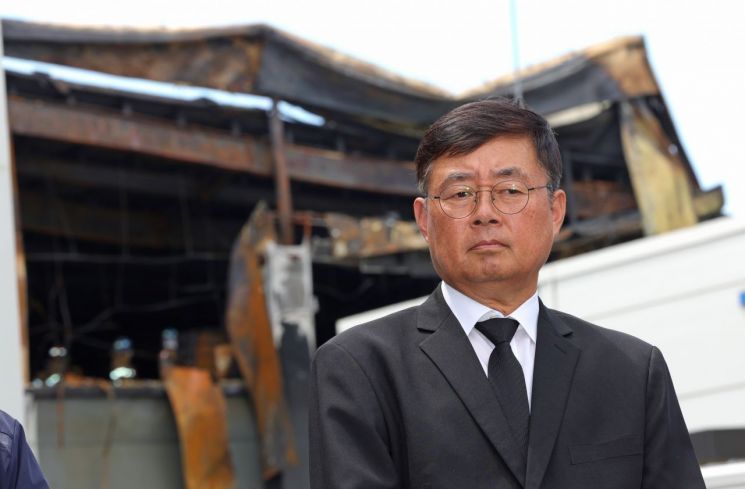 On the afternoon of the 25th, Park Soon-kwan, CEO of Esconec, read an official apology regarding the accident at Arisel, a lithium battery factory in Seosin-myeon, Hwaseong City, which resulted in 23 deaths, and answered questions from the press. On the morning of the 24th at 10:31 AM, a fire broke out at Arisel, a primary battery company located in Jeongok-ri, Seosin-myeon, Hwaseong City, causing numerous casualties.
 [Image source=Yonhap News]
Similar Living Costs but Fivefold Minimum Wage Gap Between South Korea and China... US Treasury Secretary Also Criticizes China's Low Wages
One netizen commented, "In Chinese factories, workers usually earn about 10 yuan (approximately 1,900 KRW) per hour, whereas South Korea's minimum hourly wage is 51.6 yuan (about 9,800 KRW)," adding, "Do you still not understand why they want to work abroad?" This comment received hundreds of 'likes.' Other netizens similarly criticized questions like "Why do Chinese youths go abroad?" as fundamentally foolish.
China's minimum wage varies by city size. However, even in the largest and most economically developed cities, the minimum wage is 2,490 yuan per month (about 474,000 KRW). Considering the urban living costs, which are not significantly different from other countries, this wage level is extremely low. In March, US Treasury Secretary Janet Yellen also criticized China's excessive low-price strategy for its manufactured goods, highlighting the problem of China's low wages. Although China maintains low wages to sustain its export-driven economic structure, it remains uncertain how long Chinese authorities can resist pressure to raise wages amid the possibility of deflation (a prolonged economic downturn accompanied by falling prices).
Adding to the Burden, Short Working Lifespan... "We Must Face the Reasons for Risking Overseas Work"
Moreover, dissatisfaction is emerging over China's short working lifespan. Commenters pointed out, "In developed countries, wages are high and labor shortages exist, so if willing, people can work into their 60s and 70s," noting, "During a visit to a South Korean client in April this year, there was still a driver in his 70s, but in China, even young people find it hard to get jobs." They further criticized, "Factories in China generally do not want workers over 35," and questioned, "How can people in their 40s and 50s, who have not received high-level education, sustain their livelihoods?" They emphasized, "We must clearly understand that going abroad to work despite the risks is not merely about survival."
The issue of China's short working lifespan affects both large corporations and medium and small enterprises alike. Even major companies like Huawei and Xiaomi have seen team leaders in their mid-to-late 30s and employees in their early 40s resigning. This trend leads to high-wage workers moving down to medium-sized companies, which in turn causes unemployment in medium and small enterprises.
© The Asia Business Daily(www.asiae.co.kr). All rights reserved.


















