10% Increase in Semiconductor Tax Credit Compared to Previous
Kim Tae-nyeon: "Semiconductor National Future Vision"
Agreement on Legislation with Government and Ruling Party is Key
One notable point in the Semiconductor Special Act proposed by the Democratic Party of Korea on the 25th is that the party, which had been reluctant to raise the tax credit rate due to concerns over tax cuts for the wealthy, has reversed its previous stance. The party decided to increase the tax credit rates for semiconductor investment and R&D (research and development) by 10% each compared to the existing rates. This indicates that not only the government and the ruling party but also the main opposition party agree that fostering the semiconductor industry is essential for becoming a future economic powerhouse.
The Semiconductor Special Act, led by Representative Kim Tae-nyeon of the Democratic Party on the same day, is characterized by expanding the scope of support and increasing legal binding power compared to the so-called 'K-Chips Act' proposed by the People Power Party last month. The K-Chips Act, officially titled the "Special Measures Act on Strengthening and Protecting National Advanced Strategic Industry Competitiveness," focuses on government support for semiconductor investment and R&D as a future core industry. However, while the K-Chips Act groups the semiconductor industry together with secondary batteries, advanced mobility, and other fields as national strategic technology industries for support, the Democratic Party aims to enact a special law specifically for the semiconductor industry to establish more concrete grounds for support.
Examining the Semiconductor Special Act proposed by the Democratic Party reveals measures such as △ mandating government responsibility for infrastructure development including power, water supply, and roads (Article 12 of the bill) △ expanding support targets for the semiconductor industry including materials, parts, and equipment (Article 2 of the bill) △ supporting the supply and installation costs of renewable energy facilities to implement RE100 (Article 12 of the bill). These provisions reflect the government's determination to directly resolve issues that have consistently acted as obstacles to fostering the semiconductor industry, such as cluster development.
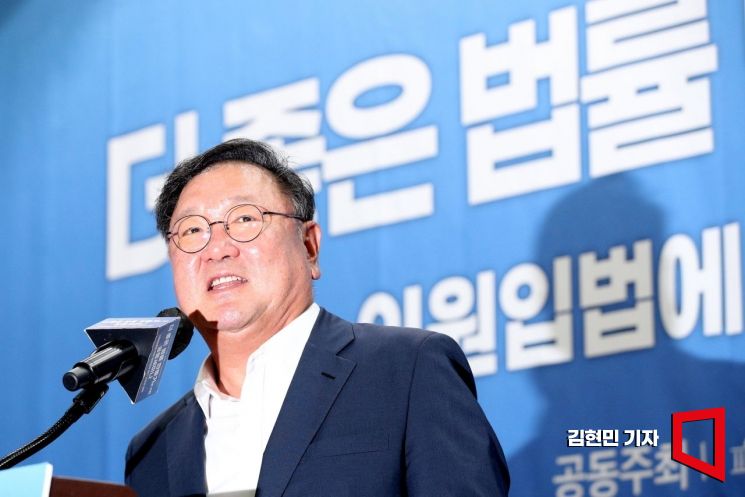 Kim Tae-nyeon, a member of the Democratic Party of Korea, is delivering a welcoming speech at a joint seminar for making better laws held at the National Assembly Members' Office Building on the 10th. Photo by Kim Hyun-min kimhyun81@
For example, a chronic problem in semiconductor cluster development lies in vested interest conflicts over power, water supply, and road maintenance between adjacent local governments. Recently, Gyeonggi Province Governor Kim Dong-yeon mentioned "the problem is water and electricity" regarding the Semiconductor Special Act promoted by Gyeonggi Province during a visit to National Assembly Speaker Woo Won-shik, highlighting the difficulty in coordinating differences between regions. If the Semiconductor Special Act passes, such issues can be addressed under government leadership.
The power supply plan through 'RE100' renewable energy also distinguishes this bill from the ruling party's approach. Right after proposing the bill, Representative Kim told reporters, "In the semiconductor war that is a race against time, transmission lines are supply routes," emphasizing, "We must swiftly pass the National Power Grid Special Act." To this end, the government and local governments will be obligated to support the installation of renewable energy such as solar power, and measures will be taken to ensure that companies do not bear the costs of renewable energy. Additionally, plans are underway to abolish solar power setback distance regulations that hinder the spread of renewable energy.
However, securing funding and reaching agreement on the bill with the government and ruling party remain key issues. Representative Kim said, "The tax benefits related to tax support will be handled by the Budget and Accounts Committee under the Restriction of Special Taxation Act, and the Semiconductor Special Act should be handled by the Industry Committee as a fiscal law," adding, "Since both the government and opposition recognize the importance of the semiconductor industry, we will expedite discussions and strive to resolve the matter within this year."
© The Asia Business Daily(www.asiae.co.kr). All rights reserved.

















