LifeSemantics announced on the 25th that its skin cancer image detection and diagnosis support software, ‘CanopyMD SCAI,’ has obtained product approval from the Ministry of Food and Drug Safety (MFDS) in South Korea.
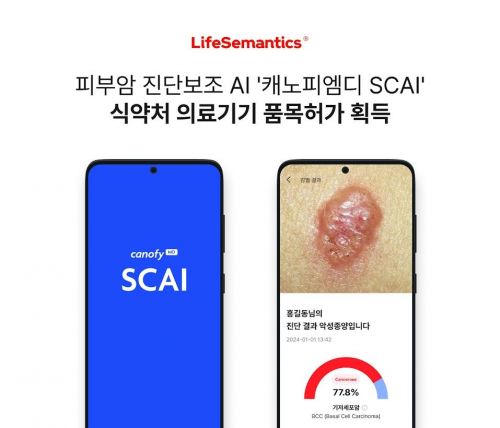
CanopyMD SCAI is a medical artificial intelligence (AI) solution that uses a smartphone camera to capture images of skin lesions in patients suspected of having skin cancer and distinguishes whether the lesions are cancerous. It is the first software medical device in South Korea to assist in skin cancer diagnosis using images. The product has demonstrated clinical superiority in all indicators, including sensitivity, specificity, and accuracy, through previously conducted confirmatory clinical trials.
CanopyMD SCAI utilizes convolutional neural network (CNN)-based image processing technology to classify malignant and benign tumors in detail. Malignant tumors include malignant melanoma, basal cell carcinoma, and squamous cell carcinoma, while benign tumors include nevi, seborrheic keratosis, actinic keratosis, liver spots, and lichen planus.
Among these, malignant melanoma is a highly fatal skin cancer that accounts for 65-75% of skin cancer deaths due to its rapid metastasis and difficulty in visual diagnosis, making early detection critically important. CanopyMD SCAI can distinguish skin cancer using only a smartphone camera, which is expected to expand the role of primary healthcare institutions. It is also anticipated to contribute to early diagnosis and treatment planning for skin cancer patients.
Following product approval, LifeSemantics plans to conduct product validation at six medical institutions, including primary healthcare centers capable of dermatology treatment and tertiary general hospitals, to verify the safety, efficacy, and usability of CanopyMD SCAI.
Meanwhile, LifeSemantics also announced that its hair density analysis AI solution, CanopyMD HDAI, has received product approval from the MFDS. This product analyzes hair density through deep learning of image data. Based on scalp images taken with a smartphone camera equipped with dermoscopy devices, it detects patient hair follicles and measures the number of follicles and the number of hairs suitable for transplantation, providing users with a practical hair loss diagnosis solution.
Hong Seung-yong, Head of Medical Device Business Division at LifeSemantics, said, “The MFDS approval of these two medical AI solutions reflects LifeSemantics’ technological capabilities,” adding, “We will continue to strive to ensure that our AI solutions are utilized in medical settings.”
© The Asia Business Daily(www.asiae.co.kr). All rights reserved.
![User Who Sold Erroneously Deposited Bitcoins to Repay Debt and Fund Entertainment... What Did the Supreme Court Decide in 2021? [Legal Issue Check]](https://cwcontent.asiae.co.kr/asiaresize/183/2026020910431234020_1770601391.png)















