Increase in Specific Company Naming
Higher Likelihood of Enforcement in Lawsuits
Court Blocks Micron Hiring After SK Hynix Resignation
Amid Intensifying Global Corporate Competition
Companies Expected to Add More Detailed Agreements
It has been revealed that cases of specifying particular competitors in detail in ‘non-compete agreements’ created by advanced companies to prevent the outflow of technical talent are increasing. This is because, in lawsuits against those who violate the agreement and move to competitors, specifying the companies concretely is more advantageous than simply labeling them as companies in the same industry.
According to industry and legal sources on the 25th, companies such as SK Hynix and Samsung Electronics list the names of competitors specifically in the non-compete agreements signed by their employees, prohibiting them from joining these companies for a certain period.
In March, the court’s approval of SK Hynix’s application for a ‘preliminary injunction on non-compete’ against former researcher Mr. A was largely due to the agreement’s specific listing of competing companies. According to the decision document of Mr. A’s preliminary injunction case obtained by Asia Economy, Mr. A signed a non-compete agreement and a ‘Confidentiality and Non-Competition Pledge on National Core Technologies’ around July 2022, when he was about to leave SK Hynix. The non-compete agreement specifically listed competitors such as Micron Technology (USA), prohibiting Mr. A from moving to these companies. SK Hynix included a clause preventing Mr. A from working at these companies for two years after his resignation. Mr. A worked as a researcher in departments responsible for memory semiconductors such as High Bandwidth Memory (HBM) at SK Hynix from 2001 to 2022, then resigned and joined Micron as an executive within less than a year. Upon learning this, SK Hynix filed for a preliminary injunction against Mr. A in August last year.
The 50th Civil Division of the Seoul Central District Court (Chief Judge Kim Sang-hoon), which heard the case, recognized the validity of the agreement by noting that the prohibited companies and period were specifically stated, and accepted SK Hynix’s request to block Mr. A’s job change. The court judged, “Considering the market share gap between SK Hynix and Micron in semiconductor-related fields including HBM, and the necessity to prevent technology leakage, the two-year non-compete period and the targeted companies appear to be reasonably set.” An industry insider said, “It is better to specify the companies that employees are prohibited from joining rather than simply stating ‘same industry’ or ‘competitor’ to ensure the enforceability of non-compete agreements in related lawsuits. Recently, many companies have been listing competitor names.”
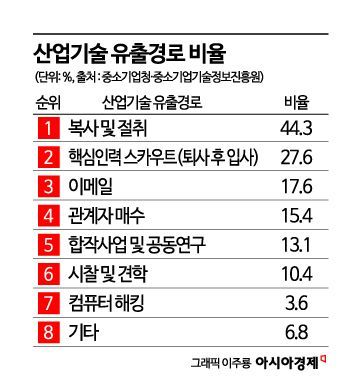
Non-compete agreements have become common among companies aiming to prevent technology leakage since the 2010s. However, the specification of competitor names in these agreements is said to be a recent development. The legal community, rather than companies, pushed for specifying competitor names. The legal sector has tended to strictly scrutinize the validity of non-compete agreements, which vary depending on each company’s circumstances, and has demanded that agreements be made more specific. However, companies were initially reluctant. The change among companies was largely influenced by intensified technological competition among global corporations and increased awareness of technology leakage domestically and internationally. They felt the need to structure agreements more meticulously. According to various ‘Industrial Technology Leakage Status’ reports investigated and published by the National Intelligence Service and the Ministry of Trade, Industry and Energy, a significant portion of technology leakage occurs through departing employees, further raising the importance of non-compete agreements that can prevent this in advance.
Companies reportedly also use ‘carrot’ policies in addition to disciplinary actions and lawsuits when technology leakage incidents occur. Samsung Electronics is known to have a policy of paying executives their salary for three years after resignation along with severance pay to discourage them from moving to competitors after leaving the company.
© The Asia Business Daily(www.asiae.co.kr). All rights reserved.

















