Chinese Authorities "Strictly Prohibit Entry to Impact Site"
"Use of Toxic Rocket Propellant Fuel"
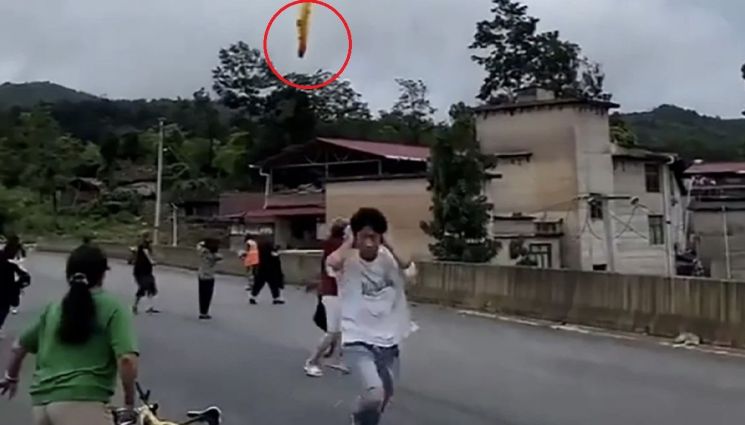 A photo taken on the 22nd showing rocket debris falling in Xianchao Village, Guizhou Province, China. The orange smoke visible in the red circle at the top of the photo indicates the falling rocket debris. It is presumed to be debris from the Long March 2C rocket launched from the Xichang Satellite Launch Center in nearby Sichuan Province on the same day. [Image source=Weibo]
In a village in Guizhou, China, rocket debris fell into a nearby village, causing residents to evacuate in a commotion. The debris is believed to be the propulsion stage of a rocket launched from a nearby satellite launch center. Chinese authorities have banned access near the debris, warning of possible toxic gas emissions, and are also preventing the distribution of photos and videos. Experts have warned that as China continues to launch rockets using toxic fuel, damage caused by falling debris could increase in the future.
According to CNN, on the 24th, videos and photos of rocket debris falling over a village spread on Chinese social networking services (SNS) such as Weibo and Kuaishou. The videos and photos were taken on the 22nd in Xianchao village, Guizhou Province, southwestern China. That day, a Long March 2C rocket was launched from the Xichang Satellite Launch Center in Sichuan Province near Guizhou. The debris is presumed to be the first stage propulsion unit of that rocket.
CNN quoted eyewitnesses at the debris crash site saying, "There was a loud explosion when the debris hit the ground, and a pungent smell spread." The debris emitted orange smoke, collided with the ground, and exploded, releasing a large amount of toxic gas.
According to investigations by Chinese authorities, no injuries were reported from this crash. Authorities also dispatched recovery personnel immediately after the launch and prohibited residents from entering the crash site due to the risk of toxic gas and explosions. They also announced a strict ban on the distribution of photos and videos.
As China accelerates its so-called "space rise" projects, including building its own space station and lunar exploration, cases of damage caused by falling rocket debris are increasing. In December last year, rocket debris fell on villages in southern Hunan Province, damaging two houses. Earlier, in 2002, a resident in Shanxi Province was injured by rocket fragments.
There have also been cases where damage was caused outside China. In 2021, a Long March 5B rocket lost control during launch and crashed near the coast of the Maldives. Fortunately, there were no casualties, but the accident occurred without prior notification of the launch, drawing international criticism. At that time, NASA issued a statement strongly criticizing China, saying, "China has failed to meet responsible standards for space launches."
Experts have warned that the orange smoke emitted from rocket propulsion debris contains highly toxic gases and dangerous carcinogens. Markus Schiller, a senior researcher and rocket expert at the Stockholm International Peace Research Institute (SIPRI), told CNN, "The traces of orange smoke indicate that highly toxic substances such as nitrogen tetroxide and unsymmetrical dimethylhydrazine (UDMH) were used as fuel in the rocket propulsion unit. These substances are very dangerous carcinogens." He added, "While the United States and Western countries have banned the use of these fuels, China and Russia continue to use them."
Since China continues to launch space rockets, concerns are growing that such damage cases will increase further. Researcher Schiller explained, "Due to the location of the Xichang Space Center, rockets must be launched mainly eastward to gain additional thrust from Earth's rotation, and in this case, the first stage propulsion units inevitably fall into densely populated villages."
© The Asia Business Daily(www.asiae.co.kr). All rights reserved.
![Clutching a Stolen Dior Bag, Saying "I Hate Being Poor but Real"... The Grotesque Con of a "Human Knockoff" [Slate]](https://cwcontent.asiae.co.kr/asiaresize/183/2026021902243444107_1771435474.jpg)











