Bank of Korea Announces 'June Consumer Sentiment Survey Results'
Consumer Confidence Index (CCSI) Turns Optimistic at 100.9 After One Month
Expected Inflation Rate Remains in the 3% Range
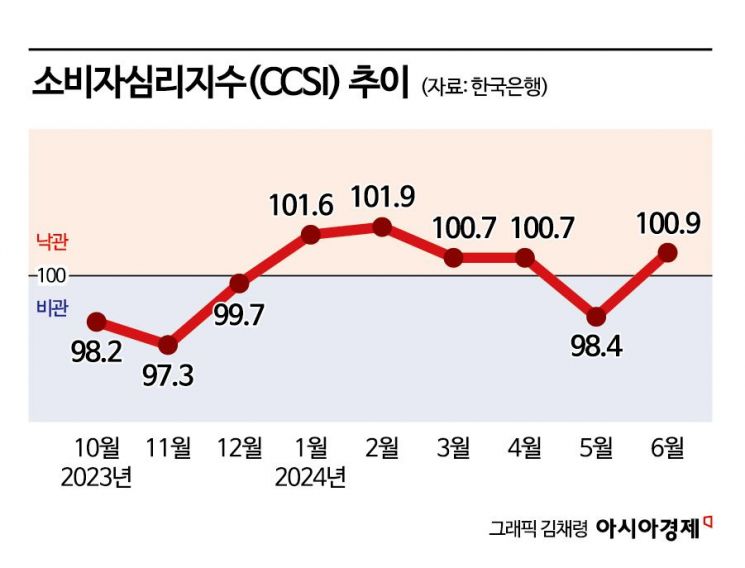
The consumer sentiment index turned optimistic after a month as export momentum continued and inflationary pressures eased. However, perceived inflation remains high, with the expected inflation rate staying in the 3% range.
According to the "June Consumer Survey Results" released by the Bank of Korea on the 25th, the Consumer Confidence Index (CCSI) for this month rose by 2.5 points from the previous month to 100.9, turning optimistic after a month. The CCSI had exceeded 100 for four consecutive months since January this year, but showed a slight decline or remained flat from March, falling below 100 for the first time this year in May.
The CCSI is a sentiment indicator calculated using six major indices that make up the Consumer Sentiment Index (CSI). A value above the long-term average (2003?2023) of 100 indicates optimistic consumer sentiment, while a value below 100 indicates pessimism.
The expected inflation rate, which reflects the anticipated consumer price increase over the next year, fell by 0.2 percentage points from the previous month to 3%. The expected inflation rate has remained in the 3% range for two years and three months since recording 3.1% in April 2022.
Hwang Hee-jin, team leader of the Statistics Survey Team at the Bank of Korea’s Economic Statistics Department, explained, "Consumer prices for food and agricultural products are showing a slowing trend compared to before, which has been reflected in the optimistic sentiment," but added, "The accumulated level of price increases remains high, so perceived inflation is still at a high level."

The Interest Rate Expectation CSI dropped 6 points from the previous month to 98, indicating a prevailing view that interest rates will decline. This is due to market interest rates falling amid expectations of policy rate cuts by major countries and the U.S. Federal Reserve’s rate cut expectations following U.S. CPI figures coming in below forecasts.
The Housing Price Expectation CSI rose 7 points from the previous month to 108. This was because the nationwide decline in apartment sale prices slowed despite tighter loan regulations, and apartment sales volumes increased.
The Price Level Expectation CSI fell by 1 point from the previous month to 146, reflecting a slowdown in price increases for agricultural products and public utility charges.
The major items expected to influence consumer price increases over the next year were agricultural, livestock, and fishery products (57.8%), public utility charges (53%), and industrial products (24.8%). Compared to the previous month, the response shares for industrial products (up 5.8 percentage points) and public utility charges (up 4.8 percentage points) increased, while the share for petroleum products decreased by 12.7 percentage points.
This survey was conducted from the 11th to the 18th of this month, targeting 2,500 households in urban areas nationwide, with 2,308 households responding.
© The Asia Business Daily(www.asiae.co.kr). All rights reserved.