Expansion of China's Production Capacity to 10 Million Units Next Year
Following Taiwan (5.8 Million Units) and Korea (5.4 Million Units)
Global semiconductor fab (factory) production capacity is expected to increase by 7% next year. In particular, advanced semiconductor production capacity is projected to grow by 17% next year. As artificial intelligence (AI) demand broadly impacts the market, the production capacity of D-RAM, a type of memory semiconductor, could also increase by 9% in the same year.
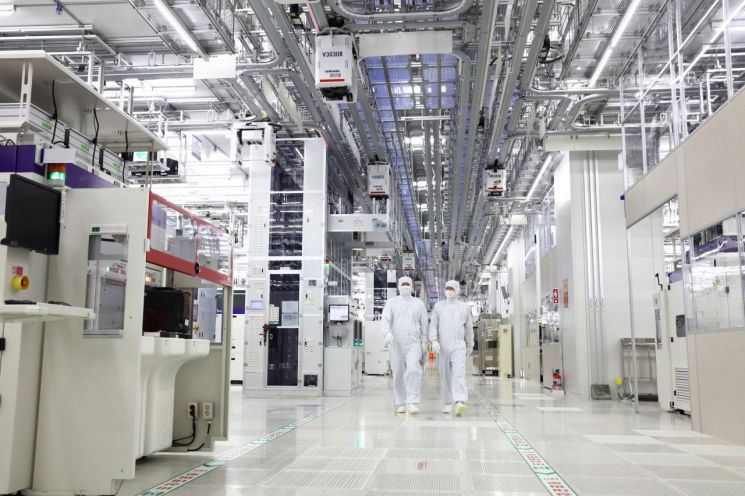
On the 24th, the Semiconductor Equipment and Materials International (SEMI) forecasted that the global semiconductor industry's production capacity in 2025 will rise by 7% compared to this year, reaching 33.7 million wafers per month (based on 8-inch wafer equivalent). With production capacity expected to grow by 6% this year compared to the previous year, the growth trend is anticipated to continue next year.
Production capacity for advanced semiconductors at 5㎚ (nanometers; 1㎚ = one billionth of a meter) or below is expected to increase by 17% next year. SEMI predicted that this growth will be prominent as Taiwan's TSMC, Samsung Electronics, and Intel produce chips using gate-all-around (GAA) based 2㎚ processes to improve power efficiency. This year, due to AI demand, production capacity for advanced semiconductors at 5㎚ or below is expected to increase by 13%.
Ajit Manocha, CEO of SEMI, stated, "The proliferation of AI from cloud computing to edge devices is accelerating competition in high-performance chip development and driving the expansion of global semiconductor manufacturing capabilities," adding, "AI is generating more semiconductor demand, encouraging semiconductor investments, which in turn creates a virtuous cycle that produces advanced AI chips."

By region, Chinese chip makers' production capacity is expected to grow by 14% next year, reaching approximately one-third of the total semiconductor industry scale at 10.1 million wafers per month. This year, it is also expected to increase by 15% compared to the previous year, reaching 8.85 million wafers per month. Despite the risk of oversupply, major Chinese companies such as Huahong Group, Nexchip, SMIC, and CXMT are investing in expanding production capacity.
Other regions are expected to show production capacity growth rates generally below 5% next year. Taiwan is projected to rank second with 5.8 million wafers per month, a 4% increase compared to this year. South Korea is expected to rank third with 5.4 million wafers per month, a 7% increase in the same year. Following are Japan (4.7 million wafers) and the United States (3.2 million wafers).
Foundry sector production capacity is expected to grow by 11% this year and 10% next year due to increased investments by Intel and expanded production capacity in China. It is projected to reach 12.7 million wafers per month by 2026.
In the memory sector, the rapid increase in demand for high-bandwidth memory (HBM) driven by AI servers is leading to unprecedented production capacity expansion. Specifically, in the D-RAM sector, production capacity is expected to grow by 9% both this year and next year. For NAND, as the market is still in recovery, production capacity is not expected to increase this year but is projected to grow by 5% next year.
© The Asia Business Daily(www.asiae.co.kr). All rights reserved.


















