Recently, the dollar-won exchange rate has approached 1,400 won, raising concerns about exchange rate instability. However, unlike the exchange rate instability in mid-April, it is analyzed that there are no issues likely to trigger financial risks.
Hi Investment & Securities stated in a report on the 24th, "The April exchange rate instability was triggered by the dollar's strength due to uncertainty in the US Federal Reserve's interest rate policy, but the current dollar strength is due to the weakness of the yen and euro," explaining this.
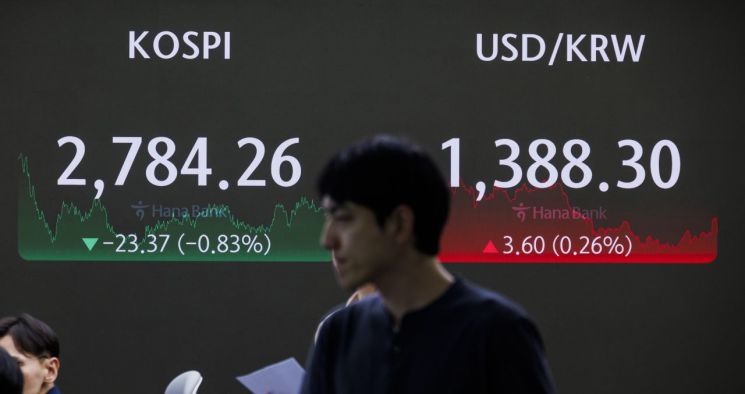
Previously, the dollar-won exchange rate rose for six consecutive trading days, closing at 1,388.3 won on the 21st. This is a level similar to the April 16 peak of 1,394.8 won.
Researcher Park Sang-hyun pointed out, "The exchange rate instability in mid-April was mainly caused by renewed US inflation concerns and uncertainty over the Federal Reserve's interest rate policy," adding, "The resulting sharp rise in US Treasury yields led to dollar strength and won value instability."
He further analyzed, "Currently, US Treasury yields are maintaining a downward stabilization trend, and with the May US consumer price index and the June Federal Open Market Committee (FOMC) meeting, some of the Fed's interest rate policy uncertainty has been resolved."
He continued, "The key difference from the April exchange rate instability is that the Fed's interest rate policy uncertainty is not the direct cause of the recent dollar-won exchange rate rise," adding, "Rather, instability in the yen and euro is directly causing the dollar-won exchange rate increase."

In fact, the dollar-yen exchange rate closed at 159.8 yen on the 21st, surpassing the April high and reaching a yearly peak. Despite verbal intervention warnings from the Japanese government, expectations of yen weakness have not diminished. The euro is similar. As of the 21st, the euro-dollar exchange rate was $1.0693, approaching the yearly low of $1.0619 (April 16). The euro's weakness has been influenced by the interest rate policy divergence between the European Central Bank (ECB) and the Fed, macroeconomic instability, and the rise of right-wing politics in Europe.
Researcher Park emphasized, "Although yen and euro weakness is leading to a rise in the dollar-won exchange rate, it is not a risk severe enough to provoke financial market instability," adding, "In April, a triple weakness phenomenon occurred with simultaneous declines in stock prices, bond prices, and the won's value, but recently, despite the won's depreciation, stock and bond prices have maintained a strong trend."
He added, "Domestic credit spreads are also maintaining stability, marking a clear difference from the April instability," but cautioned, "However, if the yen and euro weaken further, entry into the 1,400 won range for the dollar-won exchange rate cannot be ruled out, and in that case, there is a possibility of temporarily increased financial market volatility due to exchange rate instability."
© The Asia Business Daily(www.asiae.co.kr). All rights reserved.


















