"Specific Region's 'Net Inflow' Due to Private Education Factors"
Early Local Study Abroad Trend Targeting Medical Schools Also Observed
Last year, Gangnam-gu in Seoul recorded the highest net inflow of elementary school students nationwide. The inflow of elementary students to Gangnam-gu doubled compared to the previous year and was the largest in the past decade.
On the 23rd, Jongno Academy announced the results of an analysis of student data from 6,299 elementary schools nationwide as of last year, recently disclosed through the Ministry of Education and the 'School Alimi' system of 17 city and provincial education offices across the country.
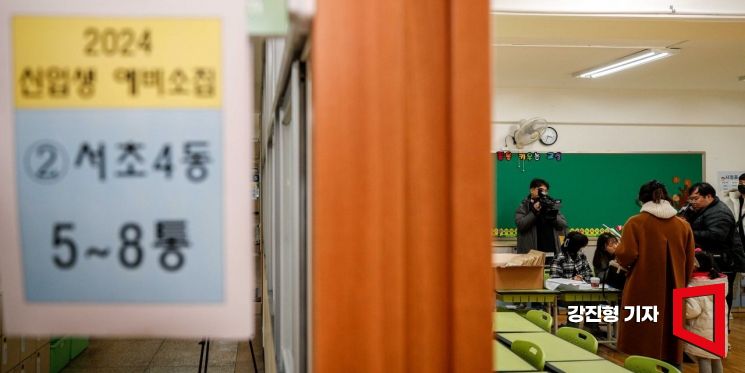 'New Student Preliminary Gathering' held at Wonmyeong Elementary School in Seocho-gu, Seoul
 Photo by Jinhyung Kang aymsdream@
The net inflow statistic for elementary schools is calculated by subtracting the number of students who transferred out from the number of students who transferred in.
Last year, the net number of elementary students who moved into Gangnam-gu was 2,199, the only district nationwide with a figure in the 2,000s, and about 3.2 times higher than Yangcheon-gu, which ranked second in Seoul.
Following were Seo-gu in Incheon with 1,929 students, Yangju-si in Gyeonggi with 1,214, Hwaseong-si in Gyeonggi with 775, Suseong-gu in Daegu with 757, Yeonsu-gu in Incheon with 748, Asan-si in Chungnam with 695, Yangcheon-gu in Seoul with 685, Gwacheon-si in Gyeonggi with 456, and Seocho-gu in Seoul with 423. Among the top 10, except for Asan-si in Chungnam and Suseong-gu in Daegu, eight were in the Seoul metropolitan area.
The reasons for the net inflow of elementary students are diverse, but a common factor cited is private education. Yangcheon-gu, ranked second in net inflow, includes Mokdong, known as a hub for private education.
Looking at the metropolitan city and provincial level, Seoul had a net outflow with 739 students transferring to other regions. The top net inflow was Incheon, which saw an increase of 1,766 elementary students.
Among the 17 cities and provinces nationwide, only six (Incheon, Daegu, Chungnam, Gyeonggi, Sejong, and Busan) experienced net inflow. The remaining 11 experienced net outflow.
Among the six non-metropolitan regions, the only area with net inflow of elementary students last year was the Chungcheong region, with 237 students.
Lim Seong-ho, CEO of Jongno Academy, focused on the 'early local study abroad' trend in anticipation of the regional talent selection for medical schools. From the 2028 academic year college admissions, students must spend a total of six years in middle and high school within the region to be eligible to apply to medical schools in that region under the regional talent selection track.
Lim said, "The occurrence of net inflow of elementary students seems to reflect high expectations for educational infrastructure," adding, "From the 2028 college entrance exam, high school grades will be relaxed from a 9-grade to a 5-grade system, while the current evaluation system for the CSAT will be maintained, increasing the influence of the CSAT on college admissions."
He also explained, "The expansion of regional talent selection will significantly affect the inflow and outflow of elementary students by region in the future, as it creates advantages and disadvantages in medical school admissions by region," and "In provincial areas, preference will rise for regions with relatively favorable educational infrastructure and advantages in the regional talent selection track."
© The Asia Business Daily(www.asiae.co.kr). All rights reserved.
![Clutching a Stolen Dior Bag, Saying "I Hate Being Poor but Real"... The Grotesque Con of a "Human Knockoff" [Slate]](https://cwcontent.asiae.co.kr/asiaresize/183/2026021902243444107_1771435474.jpg)
















