As market interest rates sharply declined amid expectations of a base rate cut, the lower bound of loan interest rates at major commercial banks fell to the 2% range. There are growing concerns that the borrowing investment frenzy might restart even before the base rate cut officially begins.
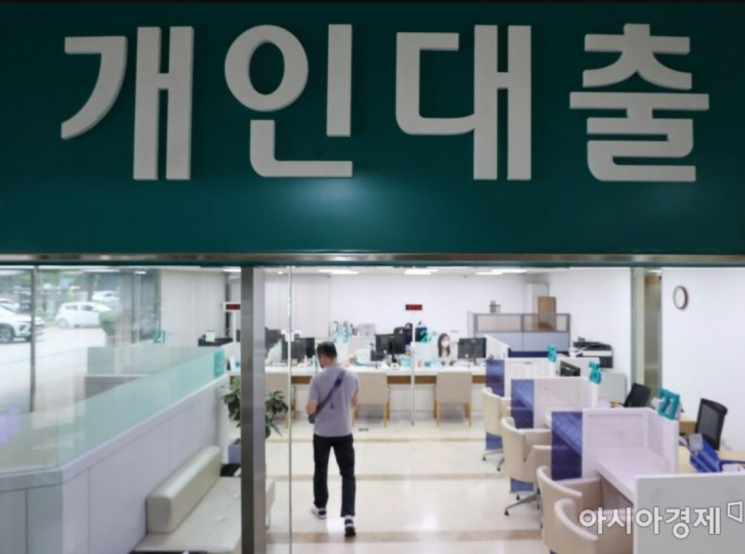
According to the financial sector on the 23rd, the mixed-type (fixed) mortgage loan interest rates (based on 5-year bank bonds) of KB Kookmin, Shinhan, Hana, and Woori Banks as of the 21st stand at an annual rate of 2.940?5.445%. Compared to May 3rd (3.480?5.868% annually), the upper bound dropped by 0.423 percentage points (p), and the lower bound fell by 0.540 p.
The interest rates for unsecured loans (credit rating 1, 1-year maturity) also decreased by 0.170 p on both upper and lower bounds, from 4.330?6.330% annually to 4.160?6.160%. This decline closely matches the drop in the benchmark rate of 1-year bank bonds (-0.172 p).
In particular, the lowest mortgage loan interest rate fell to the 2% range for the first time in about three years. Earlier, on the 19th, Shinhan Bank’s mortgage loan product (Shinhan Housing Loan) recorded a 5-year fixed rate (based on 5-year bank bonds, apartments, home purchases) lower bound of 2.98%, which further dropped to 2.95% on the 20th and 2.94% on the 21st.
This week, KB Kookmin Bank’s mixed-type mortgage loan (5-year fixed + variable rate) and periodic fixed rate will also enter the 2% range (2.99%). The 2% range for mixed-type (fixed) mortgage loans is the first time in about 2 years and 10 months for KB Kookmin Bank since late August 2021 (2.92%), and about 3 years and 3 months for Shinhan Bank since March 4, 2021 (2.96%), according to their internal time series statistics.
The variable mortgage loan interest rates (newly issued linked to COFIX, 3.740?6.732% annually) of the four major banks also fell by 0.110 p and 0.106 p on the upper and lower bounds respectively compared to a month and a half ago. Structurally, the decline in market interest rates is reflected in the COFIX benchmark with a time lag through deposit rates and others.
Compared to the end of last year, the larger drop in loan interest rates has reduced borrowers’ principal and interest repayment burdens, leading to a resurgence in household loans.
As of the 20th, the outstanding household loans at the five major banks (KB Kookmin, Shinhan, Hana, Woori, and NH Nonghyup Banks) totaled KRW 707.6362 trillion, an increase of KRW 4.4054 trillion from the end of May (KRW 703.2308 trillion), marking the third consecutive month of growth since April.
By loan type, mortgage loans and unsecured loans increased by KRW 3.6802 trillion and KRW 0.733 trillion respectively as of the 20th.
The financial authorities recently urged major banks during household debt inspection meetings to manage household loan growth within the domestic gross domestic product (GDP) growth rate. So far, the growth rate of the five major banks stands at about 2.2%, nearly reaching the Bank of Korea’s GDP growth forecast for this year (2.5%).
Therefore, these banks are highly likely to begin managing the total volume of household loans from the second half of the year by raising additional interest rates or reducing loan limits.
In a recent report on "Major Risks in Future Monetary Policy Operations," the Bank of Korea warned, "With the expansion of policy financing and the decline in mortgage loan interest rates, household loans in the financial sector returned to an increasing trend in April. Going forward, a pivot (monetary policy shift) may stimulate expectations of rising housing prices, potentially fueling an increase in household debt."
© The Asia Business Daily(www.asiae.co.kr). All rights reserved.
![Clutching a Stolen Dior Bag, Saying "I Hate Being Poor but Real"... The Grotesque Con of a "Human Knockoff" [Slate]](https://cwcontent.asiae.co.kr/asiaresize/183/2026021902243444107_1771435474.jpg)
















