Launched around 3 PM in Sichuan Province, China
Equipped with French-made equipment
A space gamma-ray burst observation satellite jointly developed by China and France was launched on the 22nd from Sichuan Province, China.
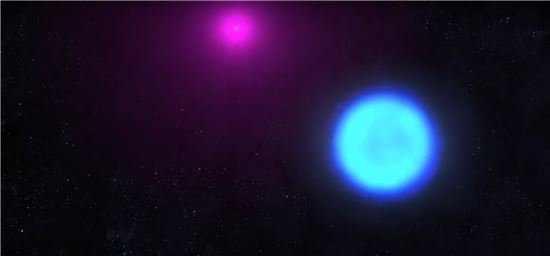 ▲A binary star system emitting 'high-energy light' gamma rays has been discovered for the first time in another galaxy. [Photo by NASA]
According to major Chinese media on the day, the China National Space Administration launched the satellite called 'SVOM' (Space Variable Objects Monitor) into space aboard a Long March 2C rocket from the Xichang Launch Center in Sichuan Province. This 930 kg satellite, equipped with four instruments?two made by China and two by France?was launched at around 3 p.m. local time in China.
Gamma-ray bursts are the most intense explosion phenomena in the universe since the Big Bang. They are known to occur during the explosion of massive supernovae or the merger process of neutron stars (binary stars).
The satellite aims to comprehensively study the electromagnetic radiation characteristics of various gamma-ray bursts to research dark energy and the evolution of the universe, as well as to observe electromagnetic signals related to gravity.
The satellite is equipped with four scientific instruments, including telescopes, of which two were developed by China and two by France. This satellite launch was achieved through nearly 20 years of joint research by scientists from both countries. France is known as an unusually active country among Western advanced nations in cooperating and researching space science with China. Previously, China and France launched their first ocean research satellite in 2018.
© The Asia Business Daily(www.asiae.co.kr). All rights reserved.

















