Government and Ruling Party Pressure Bank of Korea for Early Base Rate Cut
Bank of Korea Draws a Line, Saying It Is an Independent Decision
 Lee Chang-yong, Governor of the Bank of Korea, is delivering opening remarks at the Price Stability Target Operation Status Review Meeting held on the 18th at the Bank of Korea Annex in Seoul. Photo by Joint Press Corps
As calls from the government and the ruling party for a swift cut in the base interest rate grow louder, the Bank of Korea (BOK) is expected to face increasing dilemmas. If South Korea lowers its base rate ahead of the United States, concerns over foreign exchange market instability, a resurgence in inflation, and household debt issues could arise.
According to political circles on the 22nd, the People Power Party's Special Committee on Livelihood and Economic Stability plans to invite senior officials from the BOK and the Financial Services Commission to the National Assembly meeting scheduled for the 27th to discuss agenda items related to the base interest rate cut. From the BOK, Deputy Governor Yoo Sang-dae is expected to attend, while Kim So-young, Vice Chairman of the Financial Services Commission, is anticipated to represent the FSC.
From the BOK's perspective, which values the independence of monetary policy, attending a ruling party special committee meeting focused on interest rate cuts is itself a burdensome situation. Deputy Governor Yoo is an ex officio member of the Monetary Policy Committee and directly involved in deciding the base interest rate. Realistically, it is expected to be difficult for the BOK to discuss monetary policy directions at a ruling party meeting.
Nevertheless, the ruling party and government continue to demand a base rate cut from the BOK day after day. On the 16th, Sung Tae-yoon, Chief of Policy at the Presidential Office, appeared on a broadcast and said, "The inflation rate is stabilizing," adding, "The environment is becoming suitable for our country to lower the base interest rate." People Power Party lawmaker Song Eon-seok also argued, "Considering the hardships faced by the public due to high interest rates, it is necessary to consider lowering the base rate preemptively ahead of the United States."
Regarding the government and ruling party's demands for a rate cut, BOK Governor Lee Chang-yong drew a clear line, stating that the base interest rate cut is a matter to be decided independently by the Monetary Policy Committee. At a price explanation meeting on the 18th, Governor Lee said, "We are listening to various opinions related to monetary policy," but added, "The MPC members will listen to various opinions and make an independent decision."
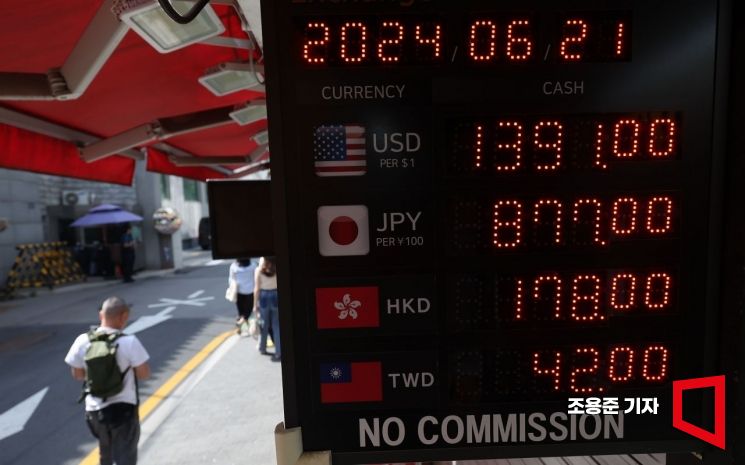 On the 21st, the won/dollar exchange rate started at 1,392.0 won, up 7.4 won. At a currency exchange booth in Myeongdong, Seoul, the won/dollar exchange rate was trading around 1,391.0 won. On this day, South Korea was excluded from the US currency watchlist again in the first half of this year, following the second half of last year. Photo by Jo Yongjun jun21@
Despite Emphasis on BOK Independence, Market Raises Possibility of Early Rate Cut
Even though the BOK has emphasized the independence of monetary policy, market views increasingly see a higher likelihood that South Korea will cut its base interest rate ahead of the United States. The market sees a high possibility that the U.S. will lower its base rate in September, while South Korea could cut it earlier in August.
Kim Jin-wook, Chief Economist at Citibank, said, "Governor Lee did not resist political pressure regarding a policy rate cut," and raised the probability of an August rate cut from 60% to 100%.
As market expectations grew, on the 19th, the 3-year government bond yield fell to 3.162%, marking the lowest point of the year. Currently, South Korea's base rate is 3.5%, but the market rate has already fallen below 3.25%, which corresponds to a scenario where one rate cut has occurred. This suggests that the market may be anticipating not just one but two rate cuts. The won-dollar exchange rate is also hovering around 1,390 won, maintaining a high level.
Gong Dong-rak, a researcher at Daishin Securities, explained, "Besides the simple expectation that the base rate might be cut ahead of the U.S., the outlook also reflects a view that future rate cuts could form a significant cycle and be implemented as a trend."
Kang Seung-won, a research fellow at NH Investment & Securities, argued, "South Korea's core inflation rate is much lower than that of Europe or Canada, and the first-quarter domestic demand rebound was likely temporary," adding, "There is a possibility that the BOK will preemptively cut the base rate in August."
Although conditions are changing, many still believe it will be difficult for the BOK to lower the base rate faster than the U.S. The interest rate differential with the U.S. currently stands at 2 percentage points, and if this gap widens further, concerns over won-dollar exchange rate increases and capital outflows could intensify. The recent upward trend in housing prices and renewed inflation concerns also make preemptive rate cuts challenging. If South Korea cuts rates first in August but the U.S. does not follow in September, issues related to monetary policy missteps could arise.
Joo Won, head of economic research at Hyundai Research Institute, said, "While some countries are moving to cut base rates ahead of the U.S., from South Korea's perspective, cutting the base rate before the U.S. could increase exchange rate concerns."
Heo Jeong-in, a researcher at Daol Investment & Securities, predicted, "If inflation settles in the mid-2% range in the second half of the year, the BOK might bring forward a base rate cut to August as a preventive measure," but added, "Considering the exchange rate situation, it will be difficult for the BOK to attempt more than two cuts within the year."
© The Asia Business Daily(www.asiae.co.kr). All rights reserved.


















