Ministry of Land, Infrastructure and Transport 2024 Smart City Development Project Contest Results
One Hub-Type and Three Small-Scale Local Governments Selected
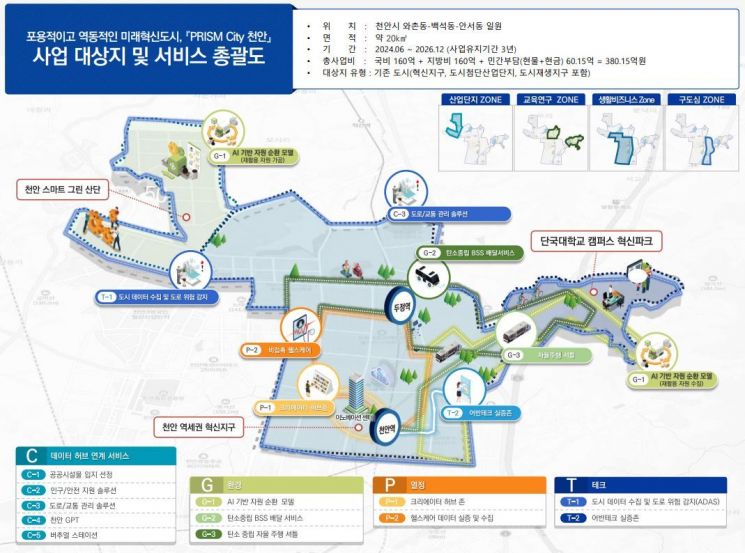 Illustration of the Smart City Development Project in Cheonan, Chungnam (Provided by the Ministry of Land, Infrastructure and Transport)
The Ministry of Land, Infrastructure and Transport announced on the 21st that, as a result of the 2024 Smart City Development Project competition, one hub-type site was selected in Cheonan-si, Chungnam Province, and three small-scale sites were selected in Gwangmyeong-si, Gyeonggi Province; Taebaek-si, Gangwon Province; and Gyeongsan-si, Gyeongbuk Province.
The Smart City Development Project is a collaborative effort between local governments and private companies to find and create innovative services tailored to regional characteristics in order to solve various problems in existing cities.
This year, the competition was divided into two types: hub-type and small-scale. The ‘hub-type’ aims to develop and demonstrate comprehensive solutions to urban problems, creating smart hubs that will lead the spread of smart cities. The ‘small-scale’ type focuses on creating cities with specialized solutions to secure resilience against environmental changes such as the climate crisis and regional extinction.
For the hub-type smart city development project, four local governments applied, resulting in a competition rate of 4 to 1. Cheonan-si, which was selected, will receive 16 billion KRW in national funding over three years (matched 1:1 with local government funds).
Cheonan-si plans to become a smart hub leading the Chungcheong region mega-city by developing the area around the station innovation district, the smart green industrial complex, and the campus innovation park into a private-friendly smart city.
They plan to support urban tech companies by establishing citizen-experience smart services such as AI-based resource circulation models, voice-based road surface analysis, and carbon-neutral autonomous shuttles, along with a digital twin-based virtual demonstration space.
For the small-scale smart city development project, local governments chose detailed types (climate crisis response type, regional extinction response type), with a total of 17 applications and a competition rate of 5.7 to 1.
The selected cities?Gwangmyeong-si (climate crisis response type), Taebaek-si (regional extinction response type), and Gyeongsan-si (regional extinction response type)?will each receive 8 billion KRW in national funding over three years (matched 1:1 with local government funds).
First, Gwangmyeong-si plans to create a carbon-neutral smart city by organically linking data-based smart services for transportation, energy, disaster, and safety in the Gwangmyeong Station area.
Taebaek-si aims to respond to the regional extinction crisis caused by rapid population decline and aging by revitalizing regional specialized industries based on smart mining innovation technology, creating an inclusive small-scale city for citizens.
The Jangseong Mining Site will be used as a smart mining demonstration space, implementing services such as mine truck operation, blockchain-based resource tracking systems, and digital creation studios to attract businesses and encourage population inflow.
Gyeongsan-si plans to address the decline in the regional economy due to the decrease in the youth population by linking and utilizing existing urban infrastructure such as Gyeongsan Imdang Unicorn Park and the Youth Knowledge Playground to create a data-driven advanced industry activation city.
They plan to establish a foundation for new business jobs by building services involving youth and citizens, including AI mobility, smart media city art solutions, youth startup smart platforms, and data eco-chain platforms.
Yoon Young-jung, Director of the Urban Economy Division at the Ministry of Land, Infrastructure and Transport, stated, “Many local governments and companies showed interest and participated in this smart city development project competition, presenting innovative solutions suitable for regional characteristics and capable of improving urban management efficiency. We hope to build smart services that citizens can experience, expand them to other regions, and grow together into sustainable cities.”
The project plan presentations of the selected local governments can be viewed on the Smart City Comprehensive Portal starting from the 25th.
© The Asia Business Daily(www.asiae.co.kr). All rights reserved.

















