Since North Korea and Russia signed a treaty stating that they will "provide military assistance to each other without delay in the event of a state of war," political circles have been engaged in heated debates over the South Korean government's announcement that it will "reconsider the issue of arms support to Ukraine."
On the 21st, Kim Jun-hyung, a member of the Progressive Party and former president of the Korea National Diplomatic Academy, criticized, "The Yoon Seok-yeol administration claims that Russia has crossed the line, but it is the Yoon administration that is now trying to cross that line." Kim mentioned that South Korea has never exported weapons to a country engaged in a regular war and said, "Providing weapons to another country while we are still in a ceasefire state with an ongoing war is a measure with neither justification nor practical benefit," adding, "If they are to reconsider, they must obtain approval through the National Assembly."
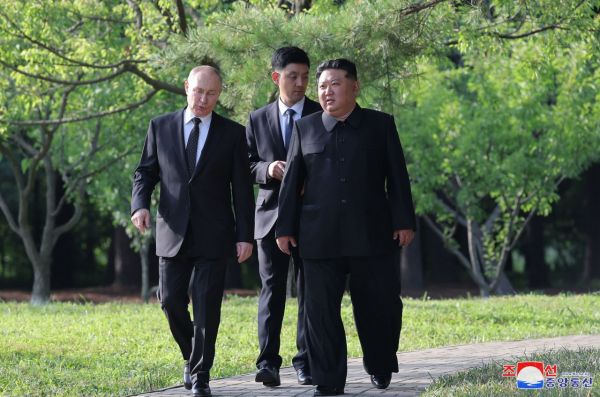
Kim stated, "Supporting Ukraine with weapons is effectively participating in the war," and added, "It is astonishing recklessness to deliberately intervene in a distant war and become an enemy of Russia."
Regarding the recently signed North Korea-Russia treaty, Kim said, "It is true that the level of security cooperation has increased, but it was defensive in nature and did not reach the level of an alliance," calling it "a rhetorical phrase without substance at this point." In particular, Kim pointed out that Russian President Vladimir Putin did not mention the word 'alliance' and noted his expression of willingness to restore South Korea-Russia relations, emphasizing, "If we want to prevent North Korea-Russia solidarity, improving relations with Russia is a better approach." He stressed, "Forming close relations with all neighboring countries for peace and stability is the destiny of the Korean Peninsula," urging a more cautious response to Russia. He also indicated that strengthening the South Korea-U.S.-Japan alliance as a countermeasure to North Korea-Russia closeness should be approached carefully, calling it "a dangerous act that risks repeating the tragedy of proxy wars on the front lines of great power hegemonic struggles 74 years ago."
Kim Geon, a member of the People Power Party and former head of the Ministry of Foreign Affairs' Peace Negotiation Headquarters for the Korean Peninsula, expressed that since a security crisis has occurred, unity is necessary in security matters.
Kim referred to the 'security consolidation effect,' a phenomenon where, when a nation's security is seriously compromised, people unite and cooperate around national leaders without exception, explaining, "This phenomenon occurs because otherwise the survival of the community cannot be guaranteed."
Regarding the recent North Korea-Russia closeness, Kim explained, "There may be domestic political motives and an effect of wielding the Russia card against China, but the important point is that it is pressure to give up denuclearization efforts because there is no hope of stopping North Korea's nuclear development for us and the international community." He emphasized, "Our response is clear. Everyone must unite to show that we will never yield to such pressure," adding, "When the ruling and opposition parties, as well as the international community, demonstrate unity, the two most isolated leaders in the world will realize that their attempts can never succeed."
© The Asia Business Daily(www.asiae.co.kr). All rights reserved.

















