Mindangjeong to Resolve 150,000t of Private Rice Stocks
Expansion of Import Safety Insurance and Agricultural Direct Payments
Promotion of Livestock Act Amendment Reflecting the Purpose of the Hanwoo Act
On the 21st, the People Power Party and the government decided to establish an income and management safety net for farmers through measures such as purchasing rice stockpiles and promoting consumption, full introduction of income stabilization insurance, and expanding the agricultural direct payment budget to 50 trillion won.
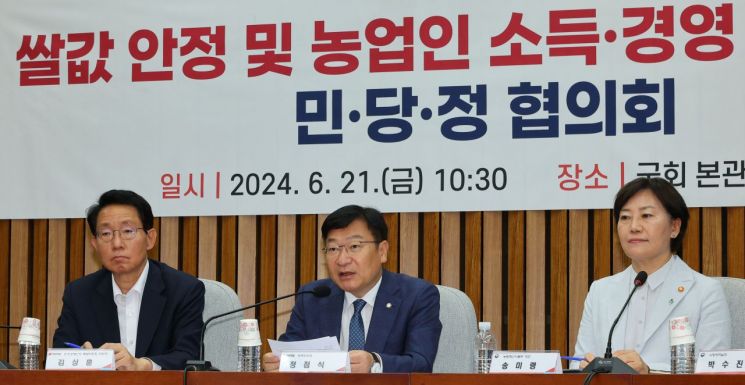
On the same day, the coalition held a meeting at the National Assembly titled 'Measures to Stabilize Rice Prices and Farmers' Income and Management,' discussing ways to stabilize farm income while minimizing market distortion. During the meeting, opinions from agricultural organizations and local distribution companies were reviewed, along with causes of stockpiles and rice price declines, to discuss solutions for resolving 150,000 tons of private stockpiles.
The government plans to further reduce the rice cultivation area this year to cut rice production by more than 50,000 tons and purchase 50,000 tons of last year's rice stockpiles for food aid purposes. Additionally, it was concluded to consume 100,000 tons of stockpiles through sales promotion linked to consumer markets centered on NongHyup and by discovering new demand. The repayment period for 500 billion won worth of rice purchase funds will also be extended by three months to prevent rice processing complexes (RPCs) that borrowed funds from selling at low prices.
To ensure stable income for farmers, income stabilization insurance guaranteeing up to 85% of average income based on appropriate production by item will be fully introduced. Furthermore, the budget related to the agricultural direct payment system will be expanded to 50 trillion won. The government had planned to increase the agricultural direct payment budget to 3.1 trillion won this year and expand it to 5 trillion won by 2027, but decided to accelerate the plan due to growing concerns over farmers' income instability.
Moreover, the coalition agreed on promoting consumption projects such as expanding discount events for Hanwoo farmers and supporting delivery of Hanwoo beef to school meals and processing companies. They also recognized the need to extend the repayment period for feed purchase funds and support interest differences to alleviate management difficulties for livestock farmers. To expand the foundation for Hanwoo industry development and protect small and medium-sized farms, they plan to promptly revise the Livestock Act reflecting the purpose of the Hanwoo Act and prepare mid- to long-term industry development measures.
This is interpreted as a countermeasure against the opposition party’s attempt to pass the Grain Management Act, the Act on Distribution and Price Stabilization of Agricultural and Fishery Products (Nongan Act), and the Hanwoo Act in the 22nd National Assembly, which were discarded during the 21st National Assembly, while preventing income decline for farmers and livestock producers caused by price drops in grains and livestock products. At the meeting, Jeong Jeom-sik, chairman of the People Power Party Policy Committee, pointed out, "Rice is already oversupplied, and creating additional surplus through mandatory purchases only encourages overproduction with taxpayers' money," adding, "Items excluded from price support are induced to be underproduced, which only worsens supply and demand instability."
© The Asia Business Daily(www.asiae.co.kr). All rights reserved.

















