Record High Surface Temperatures on the Korean Peninsula from January to May This Year
1.39°C Above the 1991-2020 Average
Scorching Land... Worst Heatwave Warning
 Strong sunlight is shining down over the fountain tunnel at Gwanghwamun Square in Seoul. Photo by Jo Yongjun jun21@
Korea is heating up. Due to global warming, the average surface temperature of the Korean Peninsula from January to May this year was found to be the highest since the pre-industrial era. While other countries are already experiencing disaster-level heatwaves causing numerous deaths, warnings have emerged that Korea could face its worst heatwave this year.
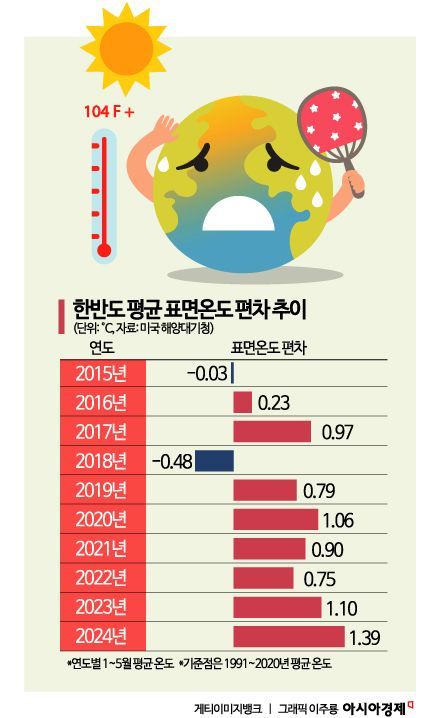
According to the National Centers for Environmental Information (NCEI), operated by the U.S. National Oceanic and Atmospheric Administration (NOAA), the average surface temperature across the Korean Peninsula from January to May this year was 1.39 degrees Celsius higher than the global average surface temperature from 1991 to 2020. This is the hottest temperature recorded since 1850, when scientists first began measuring widespread and consistent global surface temperatures.
Before 1988, the surface temperature of the Korean Peninsula did not exceed the average. However, since 2018, when the surface temperature was 0.48 degrees lower, abnormal high-temperature phenomena have appeared every year. The temperature variance is also increasing. The gap between the Korean Peninsula and the global average surface temperature from January to May has grown from 0.79 degrees in 2019 to 1.06 degrees in 2020, 0.90 degrees in 2021, 0.75 degrees in 2022, and 1.10 degrees last year.
Abnormally high surface temperatures are a global phenomenon. Using the same criteria, the difference between the land and ocean surface temperatures of the Earth is 1.32 degrees. This marks 48 consecutive years of record-high temperatures since 1976. The Earth's surface temperature has increased by an average of 0.06 degrees every decade since 1850, but since 1982, the rate has accelerated to 0.20 degrees per decade, more than three times faster. The hottest years in history have all occurred in the past decade (2014?2023).
The U.S. National Oceanic and Atmospheric Administration explained, “Considering the enormous size and heat capacity of the world's oceans, even a slight increase in the Earth's annual average surface temperature requires an enormous amount of additional heat energy,” adding, “An average surface temperature rise of about one degree Celsius may seem minor, but it means a significant increase in accumulated heat.”
The Main Culprit of the Burning Earth is 'Fossil Fuels'... Disaster-Level Heatwaves Worldwide
Fossil fuels are identified as the main culprit behind the rising surface temperatures of the Earth. Fifty-seven scientists worldwide analyzed the ‘2023 Earth Climate Change Indicators Report’ published on the 4th in the journal Earth System Science Data, concluding that 92% of the global temperature increase since industrialization is due to human activities. The researchers pointed out, “Human-induced warming is increasing at an unprecedented rate in observational records,” and “Record-high greenhouse gas emissions are the primary cause of global warming.”
As the surface heats rapidly, this summer is expected to be the hottest in history. In Korea, an unusually early heatwave advisory was issued on the 10th for the Yeongnam region, including Daegu. On the 19th, heatwave advisories were issued in many inland areas including Seoul, and the day before, heatwave warnings were issued in some areas such as Gapyeong. In Hayang-eup, Gyeongsan-si, Gyeongbuk Province, automatic weather observation equipment recorded a temperature of 39 degrees Celsius, the highest this summer.
 On the 16th (local time), a crowd of Islamic pilgrims gathered in Mecca, Saudi Arabia, the holiest site in Islam. [Image source=Yonhap News]
Other countries are already experiencing disaster-level heatwaves. According to AFP, in Saudi Arabia, temperatures in Mecca exceeded 50 degrees Celsius, resulting in the deaths of 550 pilgrims. In the United States, more than half the population is under the influence of heatwaves around 40 degrees Celsius, and in Europe, tourists have died due to temperatures approaching 50 degrees Celsius. In Mexico, India, Egypt, China, and other regions, people and animals have been injured or died due to the heat.
Experts explain that the abnormal temperatures are intensified this year due to the combined effect of last year's El Ni?o. Professor Kim Baek-min of the Department of Environmental Atmospheric Science at Pukyong National University said, “There is a tendency for abnormal weather to occur frequently in the year following an El Ni?o event, and last year, El Ni?o maintained strong influence until December,” adding, “The massive cloud mass called El Ni?o moved from the western Pacific to the eastern Pacific, distorting the global climate.”
© The Asia Business Daily(www.asiae.co.kr). All rights reserved.
![User Who Sold Erroneously Deposited Bitcoins to Repay Debt and Fund Entertainment... What Did the Supreme Court Decide in 2021? [Legal Issue Check]](https://cwcontent.asiae.co.kr/asiaresize/183/2026020910431234020_1770601391.png)


















