Bloomberg Dollar Spot Index
Highest Since November Last Year
Impact of Prolonged High US Interest Rates
Widening Interest Rate Gap with ECB and Canada
Indian Rupee Hits Record Low
Yen-Dollar Exchange Rate Rises for 6 Consecutive Days
Possibility of Re-entering 160 Yen per Dollar Level, Lowest in 34 Years
The value of the dollar has risen to its highest level this year compared to major currencies. This is the result of growing expectations that the U.S. will maintain high benchmark interest rates for a longer period as the American economy overheats and inflation remains stubbornly high. The interest rate gap with other major countries such as the European Union (EU) and Canada, which have succeeded in curbing inflation to some extent and have already lowered their rates, is fueling the strong dollar phenomenon. Even emerging countries whose local currencies are hitting new lows are appearing.
Continuing Strong Dollar
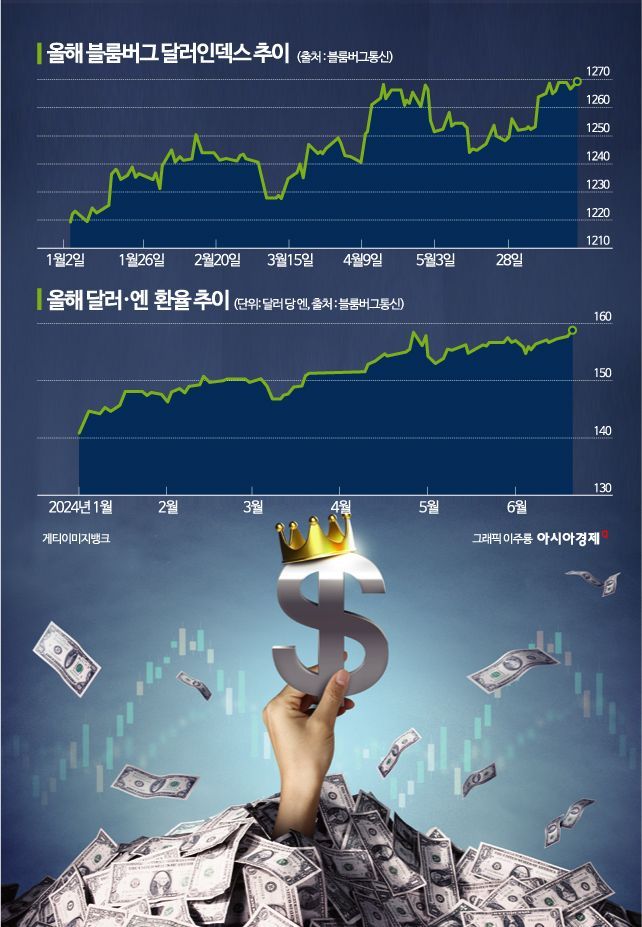
On the 20th (local time), the Bloomberg Dollar Spot Index closed at 1267.71, up 0.2% for the day. This surpassed the previous high on April 19 and is the highest level since November last year. The index has been rising for five consecutive weeks.
The main cause of the strong dollar is the widespread expectation that the U.S. will maintain its high interest rate stance for a prolonged period. The Consumer Price Index (CPI) remains in the 3% range, well above the Federal Reserve's (Fed) inflation target of 2%, and the economy is experiencing robust growth. Policymakers continue to signal that they are in no hurry to pivot (policy shift). At this month's Federal Open Market Committee (FOMC) meeting, the Fed raised its year-end interest rate forecast from 4.6% to 5.1%, revising its earlier projection of three rate cuts this year down to just one.
This contrasts with the moves by other major central banks such as the European Central Bank (ECB), the Bank of Canada, and the Swiss National Bank, which have cut rates this month. The prolonged U.S. tightening and the widening interest rate gap between the U.S. and other major countries are sustaining the trend of a 'strong dollar and weak foreign currencies.'
Emerging Market Currencies Hit Record Lows
The Indian rupee hit an all-time low. On that day, the rupee-dollar exchange rate rose 0.25% from the previous day (indicating a depreciation of the rupee), reaching 83.67 rupees per dollar, breaking the low set in April. David Forrester, Chief Strategist at Credit Agricole, explained, "The current dominance of the U.S. dollar is driving the rupee to record lows." The Indonesian rupiah also recently approached 16,500 rupiah per dollar, marking its lowest level since April 2020 during the COVID-19 pandemic, and its weakness continues.
The Chinese yuan is also at historically low levels. On that day, the offshore yuan exchange rate stood at 7.2604 yuan per dollar, the lowest since November last year.
The Japanese yen is nearing 160 yen per dollar, a level first breached in 34 years last April. The yen-dollar exchange rate has risen (yen depreciation) for six consecutive trading days from the 13th to the 20th. With the '1 dollar = 160 yen' level, which marked the yen's lowest value in 34 years last April, becoming visible again, concerns are growing that Japanese financial authorities may intervene in the market once more. Junya Tanase, a strategist at JP Morgan, said, "The Ministry of Finance is prepared to intervene again if it judges the movements to be 'excessive,' 'speculative,' or 'detached from economic fundamentals.' The speed of exchange rate movements and speculative yen selling will be key factors in deciding intervention."
"Strong Dollar Negatively Impacts Global Economy"
Major foreign media outlets analyze that the global strong dollar phenomenon poses risks to the world economy and could hinder disinflation (the slowing of price increases). The expectation that U.S. interest rates will remain higher than those of other countries leads markets to continue investing in the dollar, which in turn adds upward pressure on the dollar's value and could pose risks to the global economy. There is also speculation that the strong dollar, by increasing U.S. purchasing power, could spread inflation to countries that have lowered their interest rates.
The continuation of the strong dollar is expected to reach a turning point with the U.S. presidential election in November. Both Democratic candidate President Joe Biden and Republican candidate former President Donald Trump have expressed negative views on the strong dollar.
© The Asia Business Daily(www.asiae.co.kr). All rights reserved.

















